
At first glance, the Montessori Bell on a Ribbon can feel almost underwhelming. A single bell hanging from a ribbon does not resemble what we have come to expect from baby toys. Surrounded by bright colours, flashing lights, and constant stimulation, it is easy to question whether something this simple can truly support development.
And yet, this simplicity is exactly the point.
By around two to three months, babies are beginning to move beyond passive observation. Their movements are still uncoordinated, but they are no longer entirely accidental. They are starting to reach, to make contact, and to notice that their actions can influence the world around them. The Bell on a Ribbon meets the baby precisely at this stage. As the first one in the series of the Montessori Tactile Materials, it offers just enough to invite movement, without overwhelming the senses.
The bell is typically metallic and reflective. Its surface catches the light, and even the slightest movement changes what the baby sees. When touched, it produces a gentle sound, adding another layer to the experience.
Why This Simple Material Is So Engaging
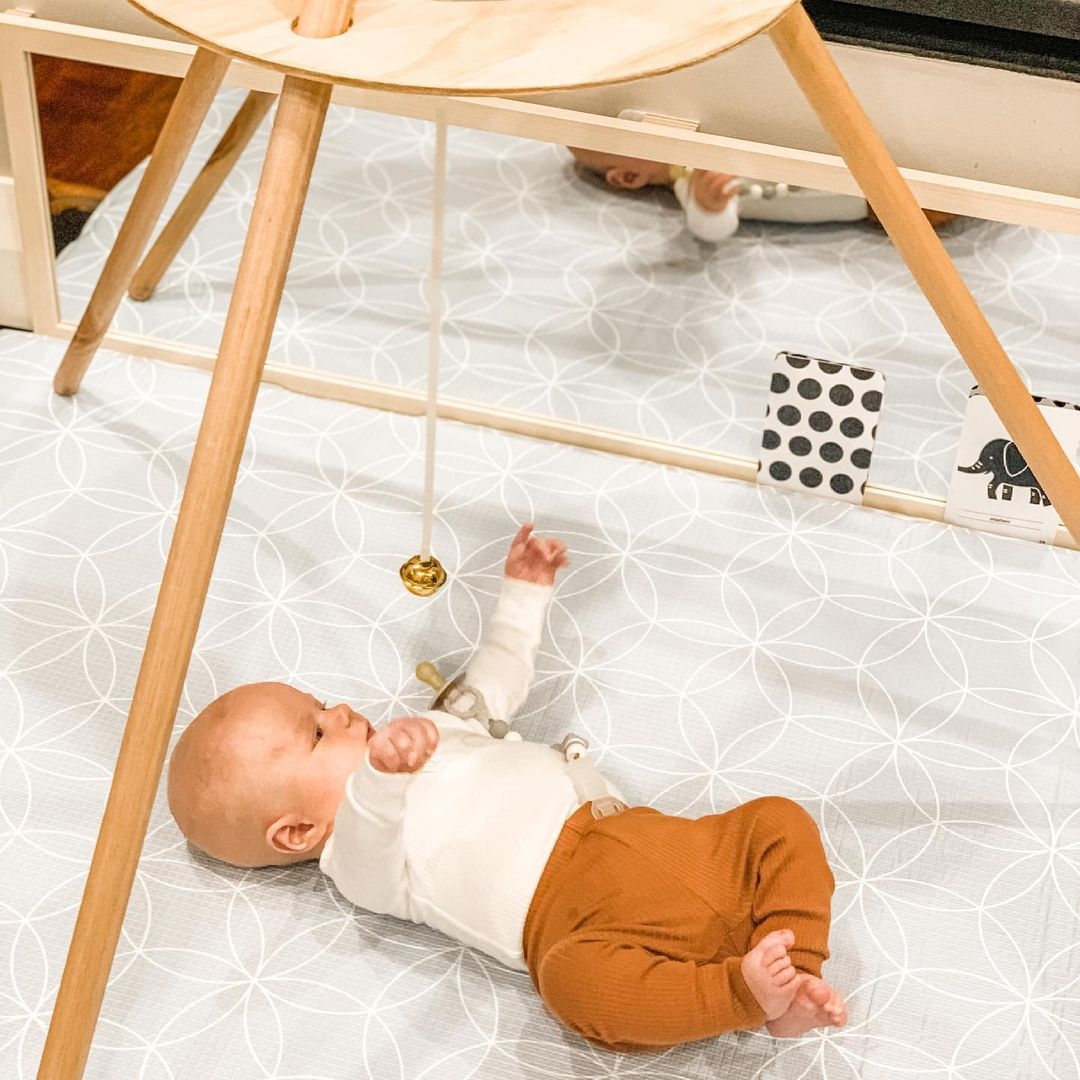
What appears minimal to an adult can be deeply engaging to a baby. The reflective surface of the bell draws the eye, while its gentle movement creates subtle changes in light and shape. At first, the baby may simply watch. Then, almost by accident, their hand makes contact.
The moment the bell makes a sound, something shifts.
The baby begins to notice that their movement has produced a result. This is one of the earliest experiences of cause and effect. It may take time, but gradually the baby starts to repeat the action, not by chance but with growing intention. What begins as an accidental movement becomes a deliberate one.
This process does not require instruction. It unfolds naturally through repetition, curiosity, and concentration.
Supporting Early Movement and Coordination
The Bell on a Ribbon supports a quiet but important transition in development. In the beginning, movements are broad and uncontrolled. Over time, they become more precise.
Through repeated interaction with the bell, the baby begins to refine their movements. Reaching becomes more accurate, contact becomes more intentional, and the connection between action and result becomes clearer. This strengthens hand–eye coordination and encourages longer periods of focus. As your baby’s movements become more controlled, you can introduce the Ring on a Ribbon as the next step.
Because the material responds immediately and consistently, it provides clear feedback without overwhelming the baby. There is no need for additional stimulation. The simplicity allows the baby to concentrate fully on what they are doing.
The Bell on a Ribbon is more than a tactile toy; it is a lesson in cause and effect. Each accidental bat produces a sound, which encourages the infant to repeat the movement intentionally. This process of learning how sounds relate to physical actions is a cornerstone of early cognitive exploration, helping the baby ‘map’ their reach through auditory feedback.
Extending the Experience
As your baby becomes more familiar with the Bell on a Ribbon, the way it is offered can change slightly to keep the experience meaningful. It can be positioned closer to the feet, encouraging kicking and introducing a different type of movement. It can also be used during tummy time, either held low enough for the baby to reach or offered directly in the hands.
These small variations allow the same material to remain interesting over time. Rather than constantly introducing new objects, the experience deepens through continued exploration.
Safety Considerations
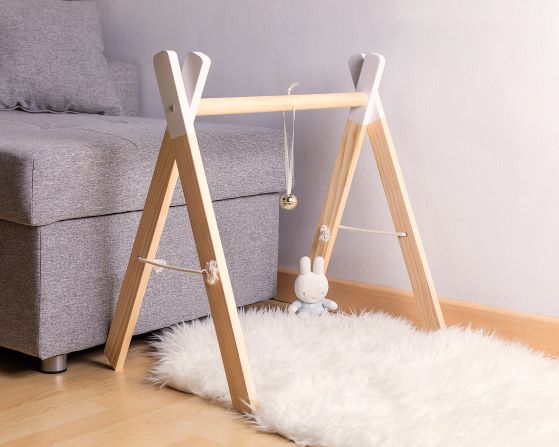
As with all Montessori materials, the Bell on a Ribbon should always be used under supervision. The bell must be securely attached, and the ribbon should be strong enough to withstand repeated movement.
Unlike the previous visual mobiles, this material is designed for touching, batting, and exploring movement. It is not intended for mouthing, and if the bell is offered separately from the ribbon, close supervision becomes even more important.
Preparing the Material
One of the strengths of the Bell on a Ribbon is how simple it is to prepare. A single bell and a piece of ribbon are all that is needed.
For those who prefer a ready-to-use option, it is also available as part of a Montessori tactile set, where each material is prepared to follow the natural progression of development.

Final Thoughts
The Montessori Bell on a Ribbon is a reminder that development does not require complexity. A single, well-chosen object can invite movement, concentration, and discovery in a way that more elaborate toys often cannot. Through this simple material, the baby begins to experience something fundamental: that their actions have an effect on the world. This sense of agency develops quietly, through repeated interaction and growing control.
In an environment where less is offered, more can be discovered.
Further Reading
If you’d like to explore how your baby’s movement and coordination develop step by step, these articles may also be helpful:
Montessori Grasping Beads – Developing Hand Control and Coordination
How babies move from batting to intentional grasping and manipulation.
Montessori Baby Play – What It Really Means
A closer look at how babies learn through movement, observation, and simple materials.