
Among Montessori materials for babies, the Montessori Puzzle Ball is one of the most widely recognised. Sometimes referred to as a clutch ball, gripping ball, or Takane ball, it appears during a stage when babies begin reaching, grasping, and coordinating movement with greater intention.
Its popularity does not come from novelty or trend, but from how closely its structure aligns with early tactile development and the natural progression of hand use in infancy.
Rather than functioning as a toy designed to entertain, the Montessori Puzzle Ball supports the emergence of grasp refinement, bilateral coordination, and tactile exploration at the moment these abilities are beginning to organise through movement and repetition.
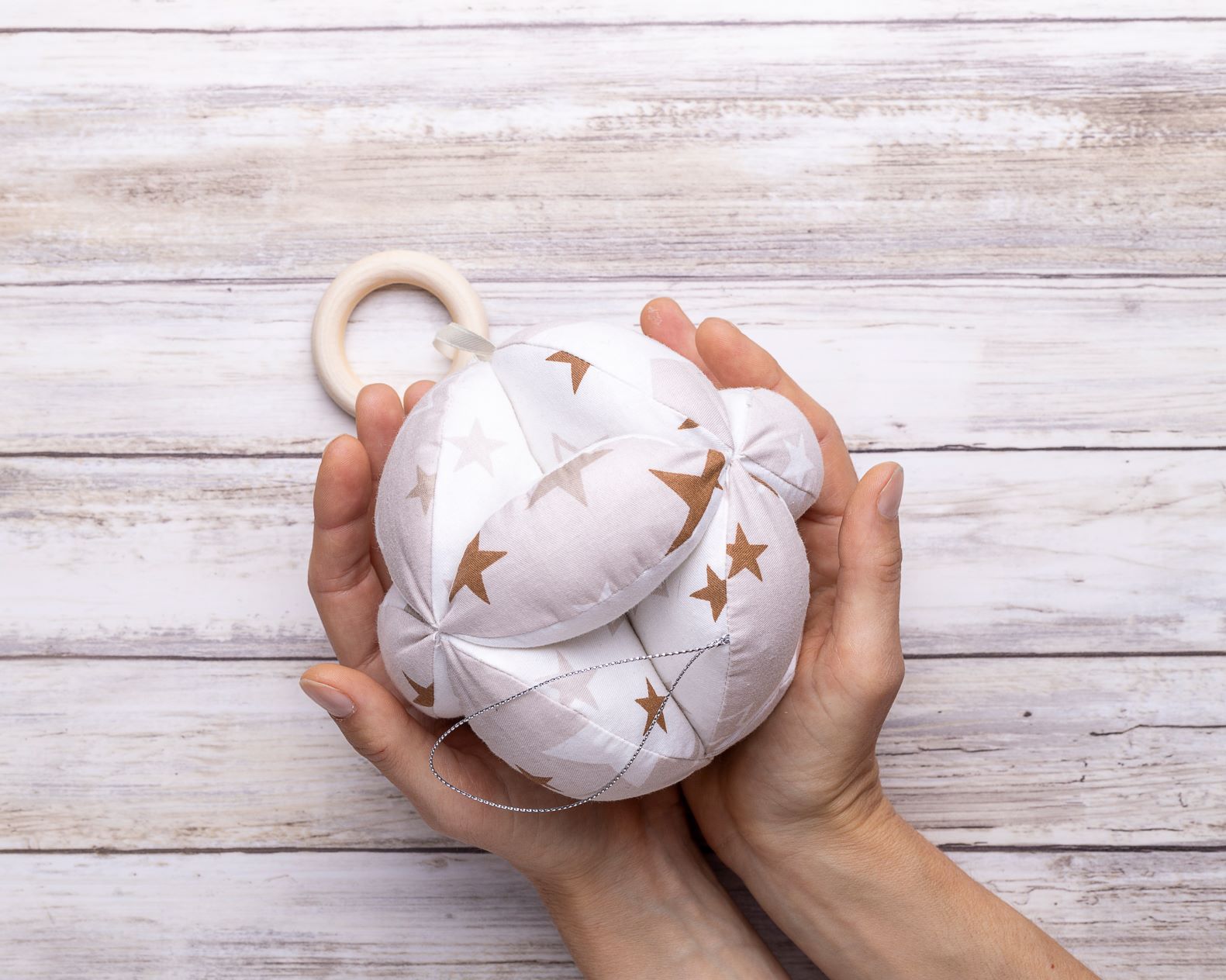
What It Is
The Montessori Puzzle Ball is constructed from twelve wedge-shaped sections joined at the centre, forming a soft sphere with visible segments. Its shape is intentional. The separated sections create natural openings where small fingers can press, hook, and hold. Unlike a smooth ball, it does not slip easily from the hand. The design supports early grasping without requiring strength beyond the baby’s ability.
The choice of fabric matters. Subtle contrast between inner and outer sections can make the form visually clear. Texture adds another layer of sensory information once the baby begins exploring with their hands and mouth.
Because babies explore orally in the early months, natural and breathable fillings are generally preferred. The material should feel safe, washable, and durable enough for repeated handling.
For families who prefer to sew their own, a DIY Montessori Puzzle Ball can be found here.
Why It Draws the Baby’s Attention
In the first months, babies observe more than they act. Gradually, the hands begin to open and close with more control. The Puzzle Ball meets this developmental shift.
Its segmented design makes grasping easier than with many other objects. It offers resistance without being heavy. When squeezed, it responds. When dropped, it moves. These simple reactions are enough.
The interest lies not in stimulation, but in feedback.
The ball does not perform. It allows the baby to act — and to notice the result.
A Material That Changes With the Child
The Puzzle Ball may appear simple, but its role changes over time.
In the earliest weeks
It may be offered as a suspended tactile material, low enough for the baby to brush accidentally with hands or feet. At this stage, interaction is unintentional. The movement and occasional sound (if a soft bell is inside) simply extend the baby’s sensory experience.
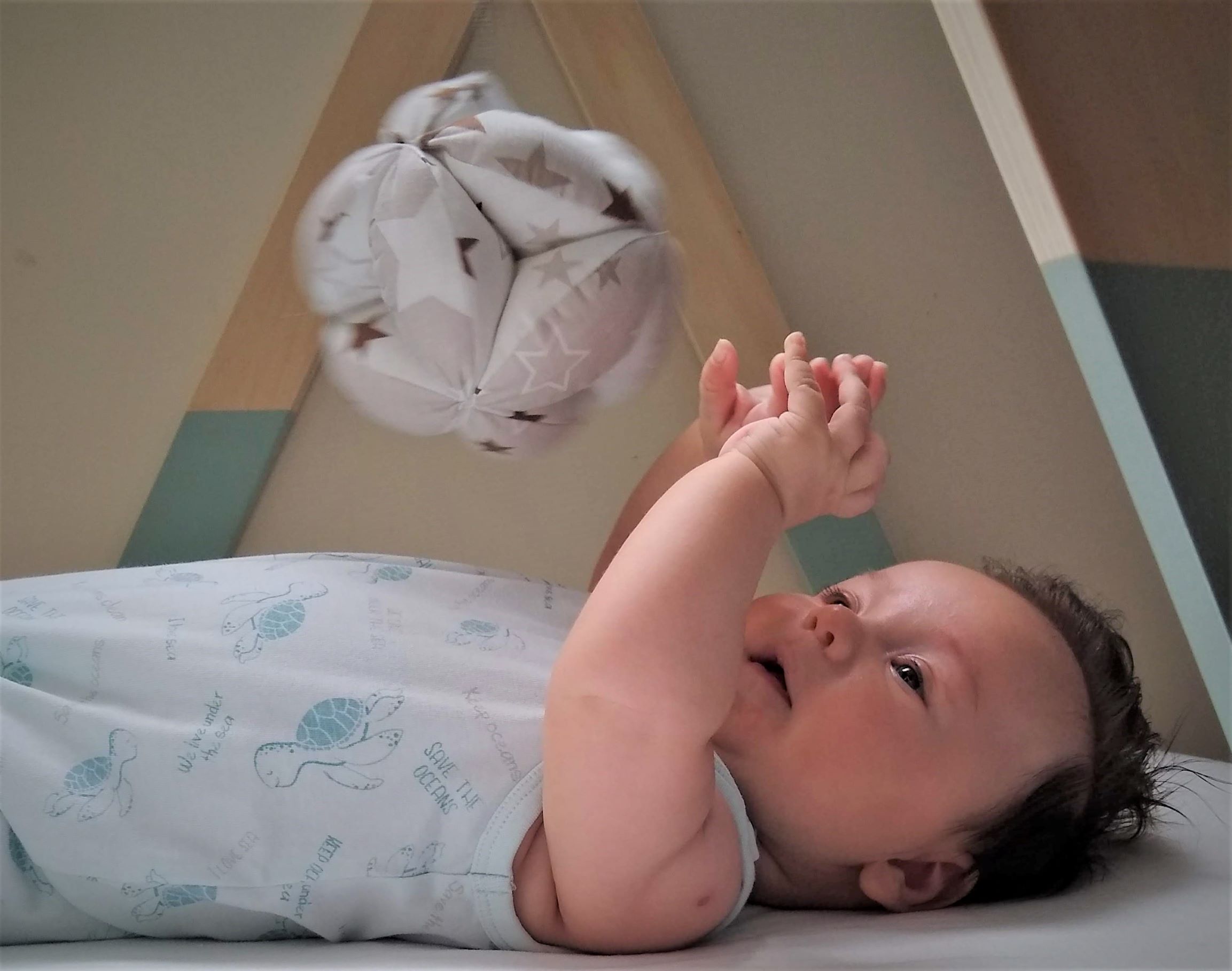
As grasping emerges
When the baby begins reaching deliberately, the ball can be placed within reach during floor time. The segmented structure supports early holding and transferring from one hand to the other.
The baby may squeeze, mouth, release, and re-grasp. These repetitions are not practice sessions — they are how coordination organises itself.
As mobility increases
Later, when rolling or crawling begins, the Puzzle Ball offers gentle motivation. It rolls, but not too far. It invites pursuit without frustration.
From different positions — lying down, sitting, or moving — the same object offers new perspectives.
There is no fixed schedule for these transitions. Observation remains the guide.
Movement, Coordination, and Integration
As babies handle the Puzzle Ball, several processes unfold simultaneously:
- fingers begin to separate and refine movement
- both hands may start to work together
- the object may cross the midline of the body
- squeezing and releasing become more controlled
These are not skills the ball “teaches.” They are capacities the baby is already developing. The material simply makes space for them to emerge.
When the ball contains a soft bell, the gentle sound can add another layer of feedback. The baby moves — a sound follows. This connection forms gradually, without explanation.
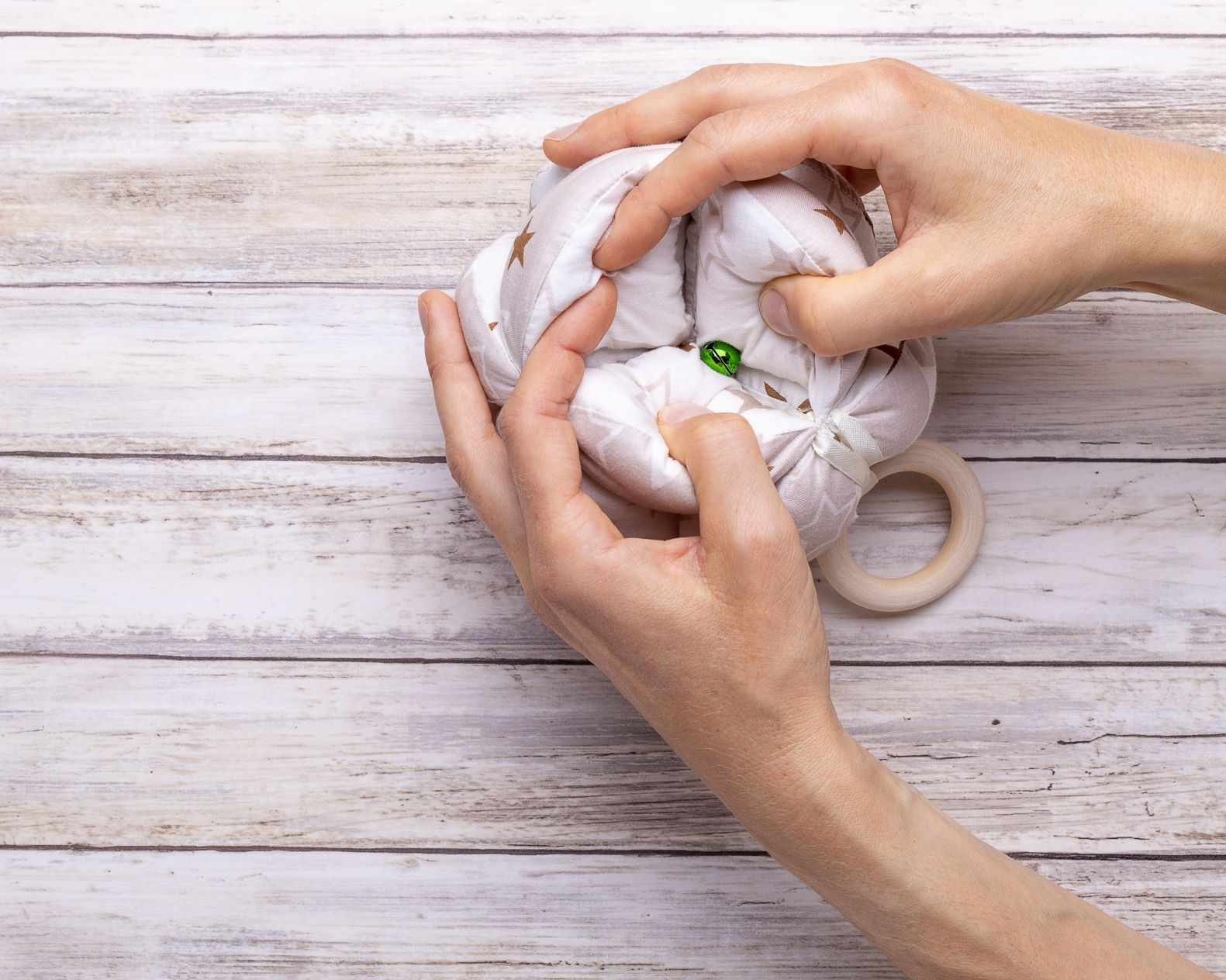
As voluntary grasping replaces early reflexes, babies begin refining hand control and bilateral coordination. Developmental milestones described by the American Academy of Pediatrics offer a broader, non-Montessori overview of how these early hand movements gradually become intentional.
Using the Puzzle Ball Thoughtfully
The Puzzle Ball does not need additions to be meaningful. Simplicity supports clarity.
If small elements such as ribbons or rings are attached, they should be secure and removable. Added parts may change how the ball rolls or feels. Any variation should be intentional, not decorative.
As with all tactile materials, supervision is essential. Regular checking of seams, attachments, and structure protects both safety and continuity of experience.
In the Wider Montessori Context
The Puzzle Ball typically appears after visual mobiles and tactile materials have already supported early coordination. It belongs to the moment when observation shifts toward interaction.
It does not replace earlier materials. It extends them.
The prepared environment continues to matter. A calm movement space, a firm floor surface, and limited visual distraction allow the baby to focus fully on the experience of handling the object.
Final Thoughts
The Montessori Puzzle Ball is often described as versatile. What makes it so is not that it does many things, but that it remains relevant as the child changes. It does not rush development. It does not demand performance. It offers form, texture, and weight — and leaves the rest to the baby.
As always, observation is more useful than expectation. When you watch how your baby approaches the ball — whether briefly or with deep concentration — you begin to understand how movement, curiosity, and coordination quietly take shape.
Further Reading
If you’d like to understand how tactile materials fit within the wider Montessori progression, these articles offer additional context:
- Montessori Baby Materials vs. High-Tech Sensory Toys
A closer look at how simple, responsive objects differ from electronic or overstimulating alternatives — and why clarity and restraint matter in the early months. - Montessori materials – should you buy or DIY?
Learn how to decide based on time, cost, and your baby’s development needs.