
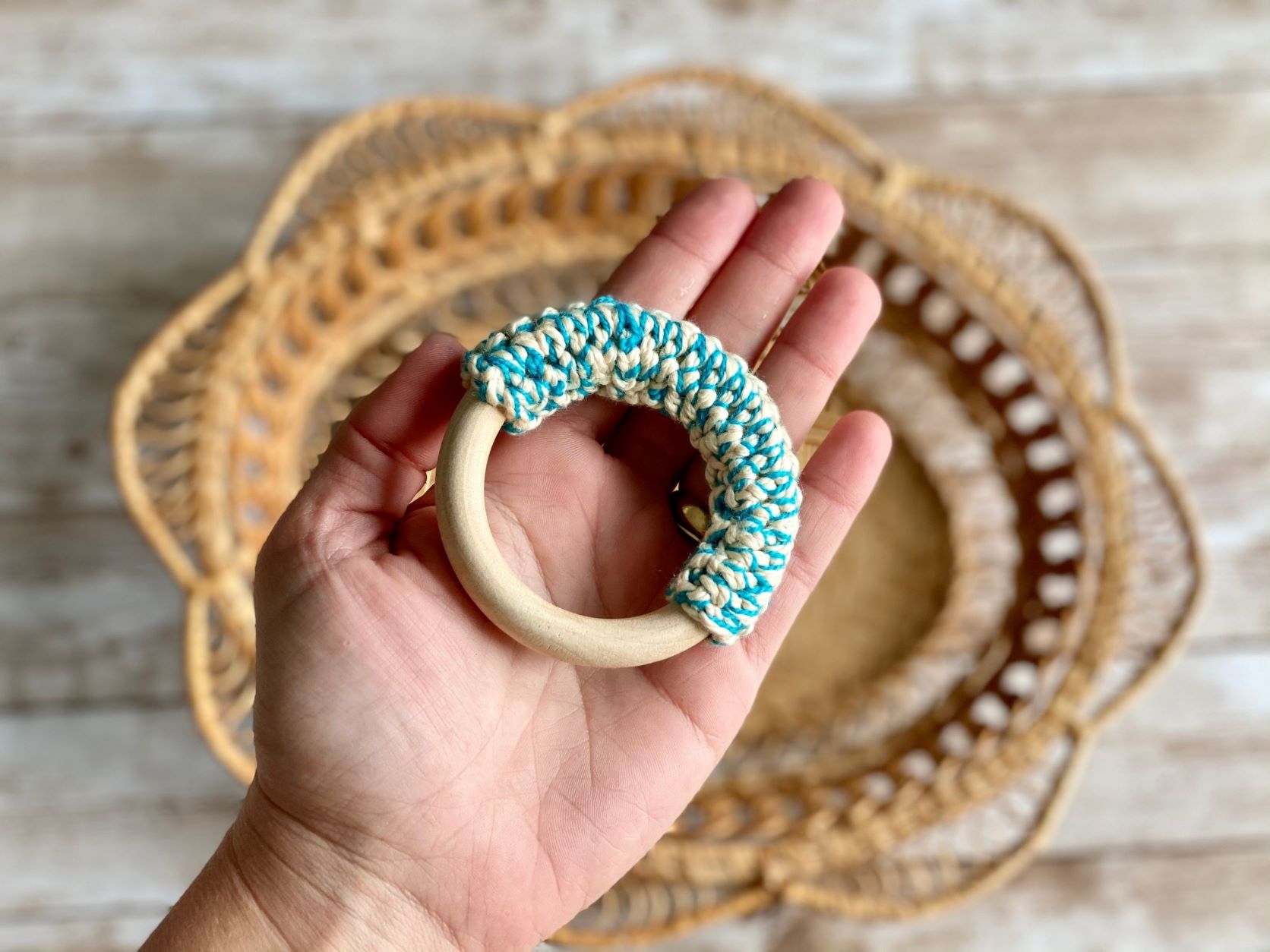
A crochet teething ring may look like a very simple object. A wooden ring, partially wrapped in yarn, does not seem particularly remarkable at first glance. And yet, it is one of the most consistently used materials in early development.
The benefits of a crochet teething ring go far beyond teething relief. Its value lies in how it adapts over time — first supporting early movement and reaching, then sensory exploration through touch, and later becoming part of oral development. As your baby grows, the same object takes on new roles, without needing to change form. This is what makes it such a lasting and effective material in the first months.
Why this material appears so early
In the first months, babies begin to move from observation to interaction. What was previously watched now becomes something they try to reach, touch, and eventually grasp.
One of the great benefits of a crochet teething ring is that it fits naturally into this shift. It can first be introduced as a Ring on a Ribbon, where the baby begins by batting at it, slowly coordinating movement between the eyes and the hands. Over time, this develops into grasping, holding, and bringing the object closer.
Because the material remains the same while the way it is used changes, it creates continuity in the baby’s experience. This is one of the key benefits of a crochet teething ring — it supports development without needing to be replaced.
What attracts the baby’s attention
The appeal of the crochet teething ring is not visual complexity, but tactile contrast. The combination of smooth wood and soft yarn creates a clear difference that the baby can explore. As the ring is held and turned, the hands encounter changing textures, resistance, and temperature. This simple variation provides enough information to hold attention without overwhelming it.
At this stage, babies are not seeking stimulation. They are noticing differences.
From grasping to mouthing
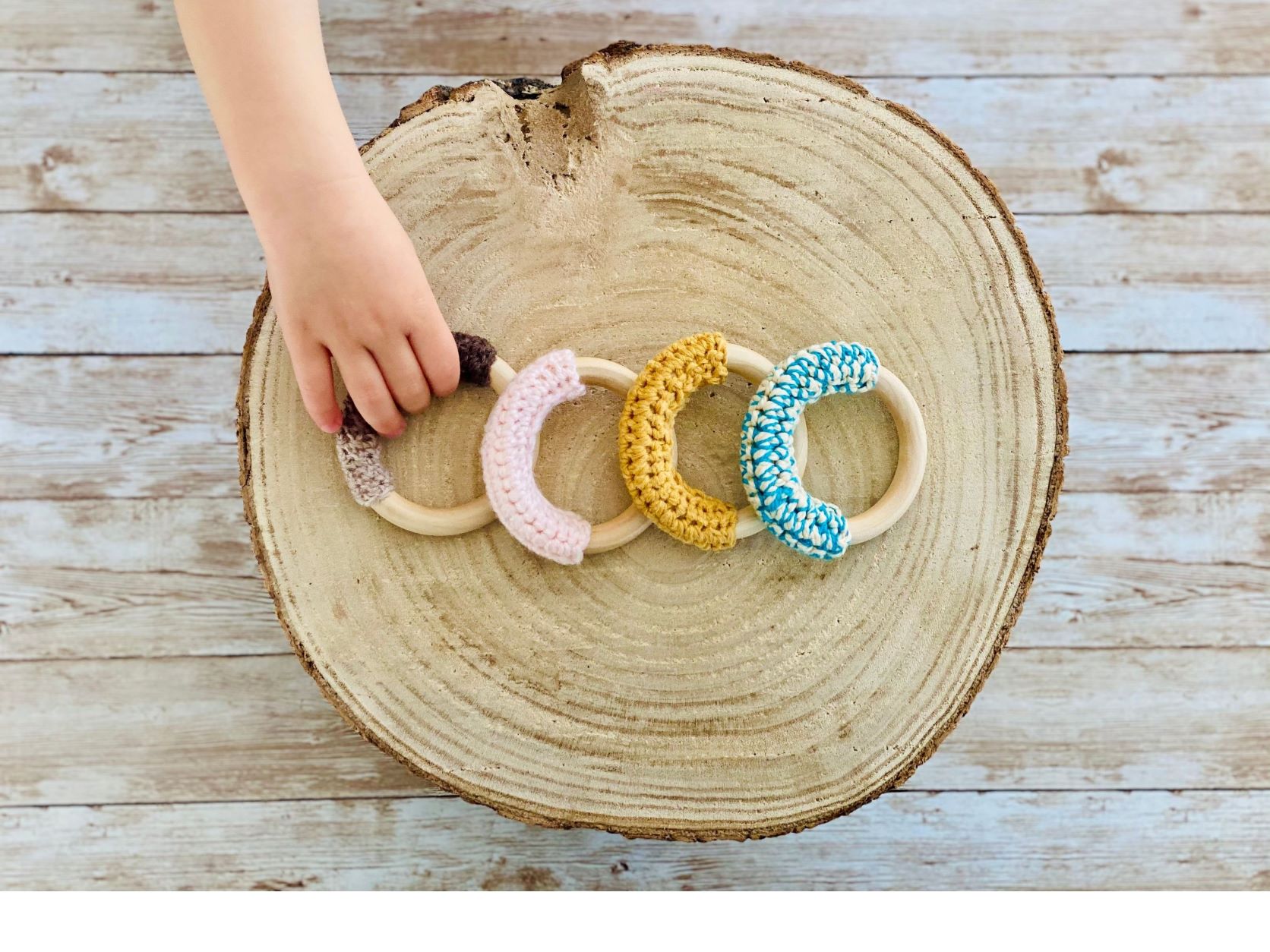
As your baby grows, the same object begins to take on new roles. What starts as a material for reaching and holding gradually becomes something to explore more actively, first with the hands and then with the mouth. One of the key benefits of a crochet teething ring is that it can support this progression naturally.
When teething begins, this progression continues. The firm wooden surface provides pressure for sensitive gums, while chewing supports the development of oral movement.
If you’d like a broader, practical overview of how to support your baby during this stage, you can read this NHS guide on teething in babies.
The benefits of a crochet teething ring at different stages
One of the reasons this object appears so often is that it does not belong to a single stage. It can be revisited in different contexts — during independent play, as part of a small selection of objects, or within a simple treasure basket.
The way the baby interacts with it continues to evolve, even though the object itself remains unchanged. This makes it a stable element within an otherwise changing environment and a valuable baby sensory development toy.
Safety and material considerations
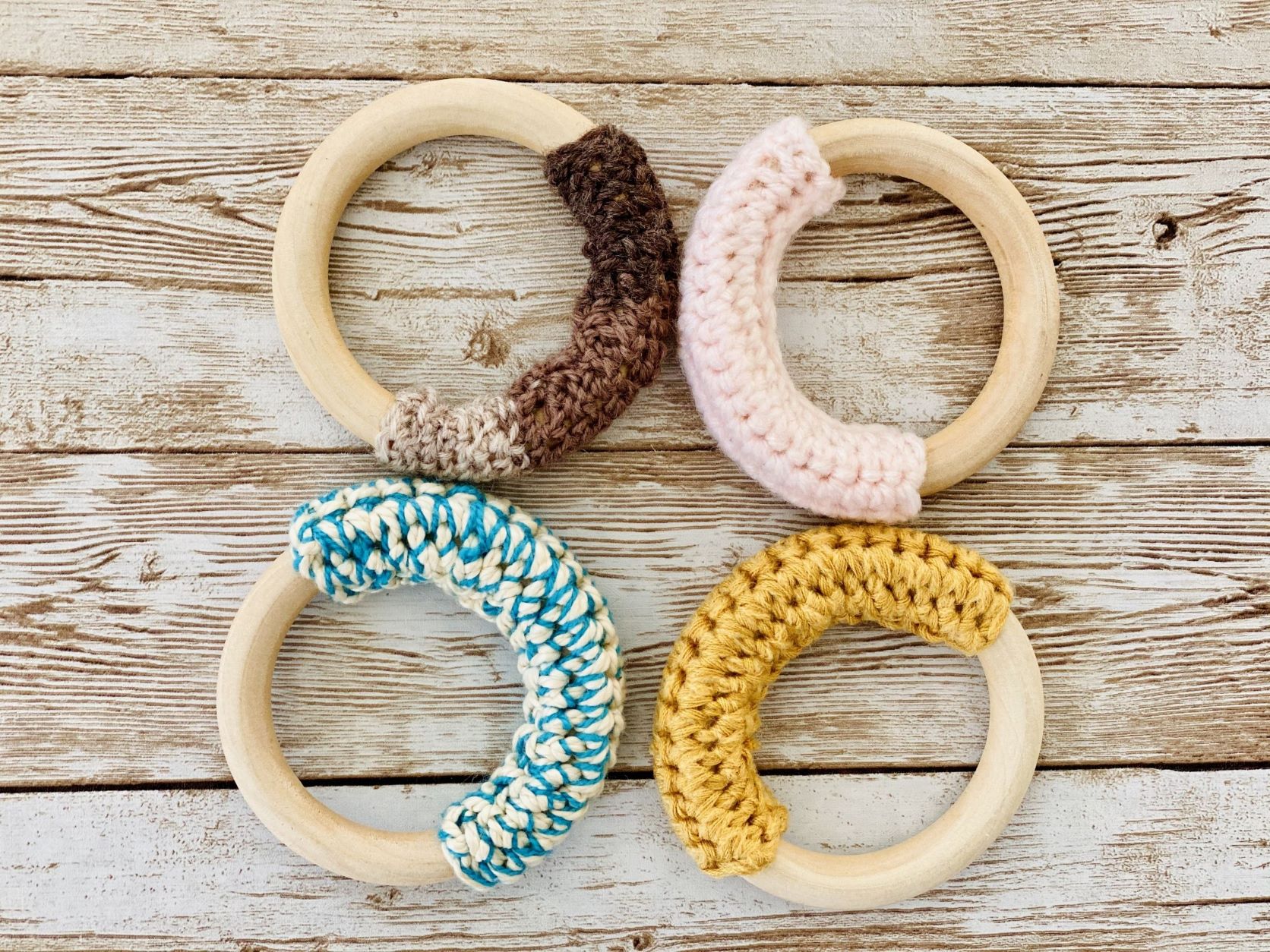
Because this object is frequently brought to the mouth, material quality matters. Many parents wonder whether crochet teething rings are safe. The wood should be untreated or finished with baby-safe products, and the yarn should be securely attached without loose elements.
Supervision remains important, particularly during the earlier stages of use.
How to choose a crochet teething ring
Not every teething ring supports the same kind of experience. Simpler designs tend to work better — not because they offer less, but because they are easier for the baby to understand and use.
A clear shape, natural materials, and a size that fits comfortably in the hand are usually enough. When an object is easy to grasp and explore, the baby can focus on what matters — their own movement and interaction.
If you’re looking for a simple version that follows these principles, you can explore this crochet teething ring here.
Where it fits in the wider Montessori environment
One of the main benefits of the crochet teething ring is that it appears at a point where development is no longer limited to looking. Movement, touch, and interaction begin to take a more central role.
It often sits alongside tactile mobiles and other simple grasping materials, reflecting a gradual expansion of attention. This is not a replacement of earlier experiences, but a continuation of them in a different form.
Some families also include it as part of a DIY sensory toy set, where it becomes one of several objects supporting early exploration.
Final thoughts
The crochet teething ring is widely used not because it is complex, but because it adapts. It follows the baby’s development from early movement to grasping and later to oral exploration, without needing to change form. In this sense, it is less a toy and more a consistent point of reference within the baby’s environment.
The crochet teething ring is used so often not because it does more, but because it does exactly what is needed at each stage. It supports movement, touch, and later oral exploration in a way that remains clear and manageable for the baby.
If you prefer to offer fewer, more intentional materials, this is one of the simplest ways to support your baby’s development in the first months.
Further reading
If you’d like to explore related questions around materials and early development:
- Montessori toys vs. high-tech baby toys — why simplicity often supports focus and exploration more effectively
- Are crochet baby toys safe? — what to look for when choosing simple, tactile materials