
At some point, objects start to matter.
Things that were once barely noticed are now picked up, held, and turned over. A simple object is no longer dropped immediately, but kept in hand a little longer. The same item is returned to more than once, as if something about it is still being explored. Attention begins to settle. Movements become more deliberate, even if still uncertain.
This is often when treasure basket play begins to make sense.
What is treasure basket play?
Treasure basket play is built around a simple idea: offering a small collection of everyday objects for a baby to explore freely. The basket itself is not important. What matters is what it contains, and how those objects are experienced.
Instead of toys designed with a specific purpose, the objects vary in texture, weight, shape, and material. Wood, metal, fabric, and natural elements each offer something distinct. This variation is what holds attention—not because it entertains, but because it can be explored.
The concept comes from Elinor Goldschmied and her work on heuristic play. While not originally Montessori, treasure basket play aligns closely with Montessori principles. It respects the child’s natural drive to explore and allows learning to happen through direct sensory experience, without interference.
What treasure basket play looks like
The interaction is often quiet, but sustained.
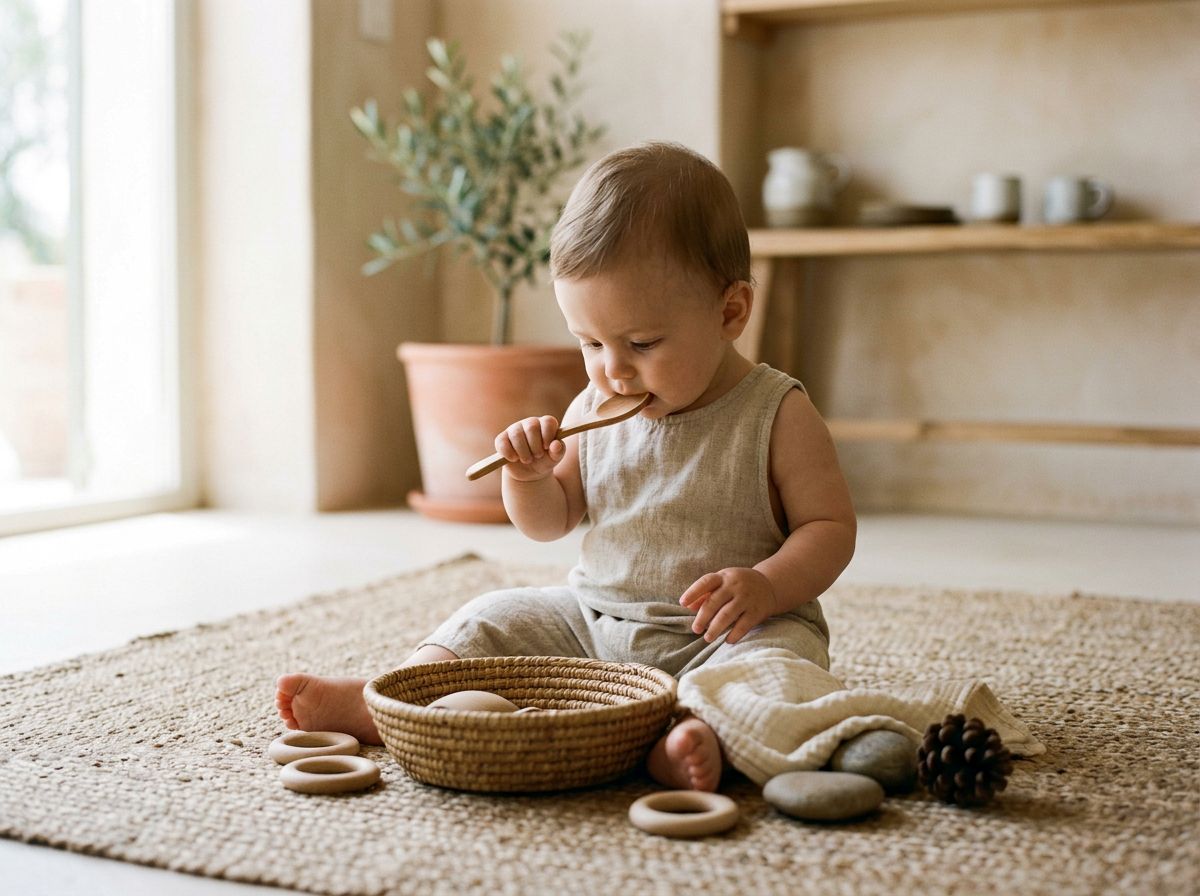
A baby sits with the basket and begins to explore one object at a time. An item is picked up, turned, brought to the mouth, dropped, and picked up again. Another object replaces it. The process continues without urgency and without direction. There is no goal, no sequence, and no expected outcome. This is what makes treasure basket play so effective. It remains open-ended, allowing the baby to repeat, compare, and gradually build understanding through their own actions.
At this stage, attention often holds for longer. What once lasted a few seconds begins to stretch into something more continuous.
Why this stage matters
By the time treasure basket play becomes relevant, several earlier shifts have already taken place. Visual observation has stabilised. Reaching is no longer accidental. Grasping, while still developing, begins to hold.
The focus moves from learning how to act to learning through action.
Touch, weight, temperature, texture, and sound begin to form a kind of internal reference. Objects are not simply handled—they are compared, tested, and revisited. What appears repetitive is, in fact, refinement. This is why treasure basket play often holds attention in a way that many toys do not.
What makes treasure basket play different
Many toys are designed to stimulate. Fewer are designed to clarify.
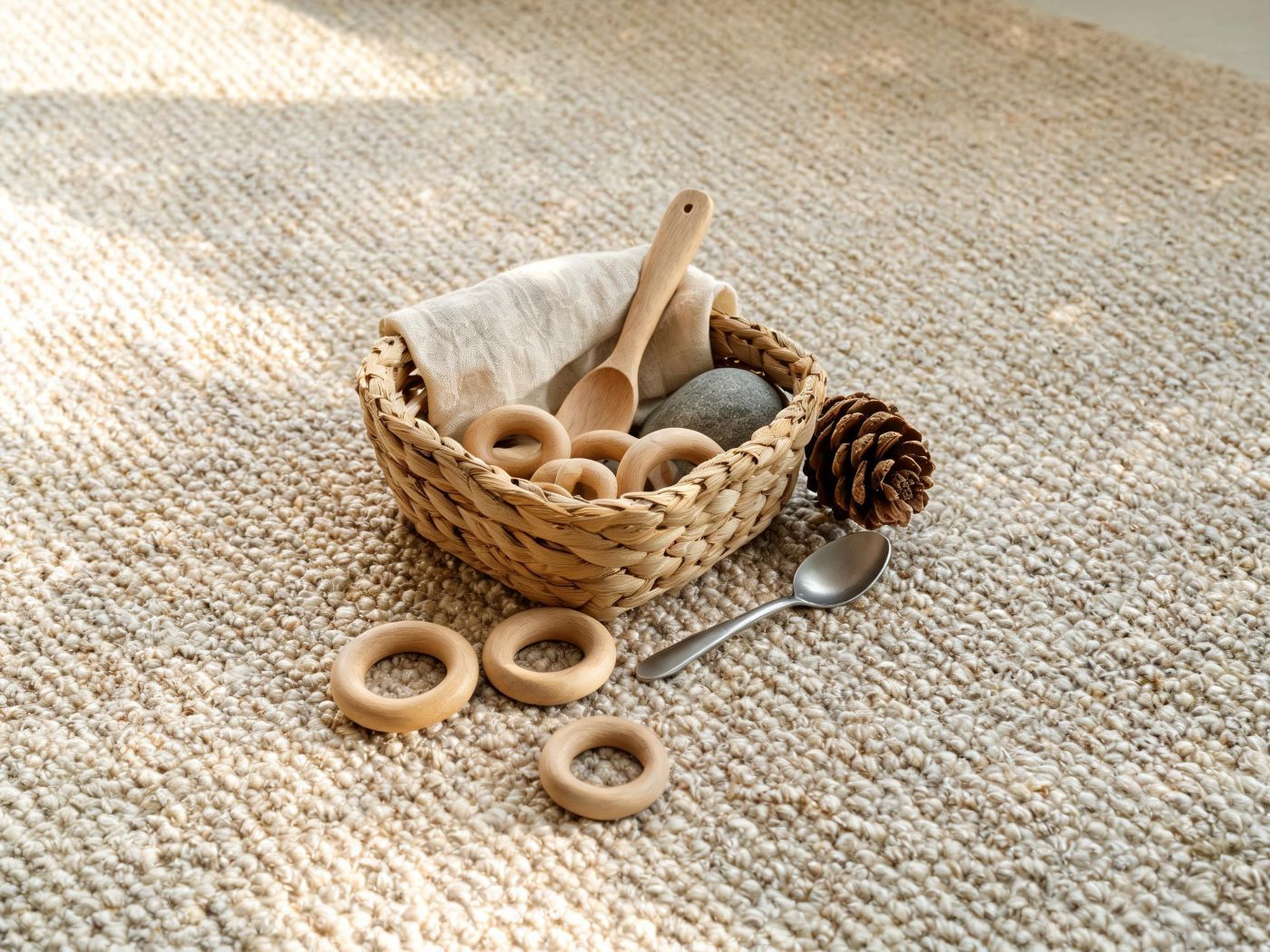
Treasure basket play works because it removes unnecessary layers. Each object offers one clear experience. A metal spoon feels cold and hard. Fabric feels soft and flexible. Wood has weight and warmth. These differences are not competing—they are distinct.
This clarity allows the baby to notice, return, and compare without being overwhelmed. Instead of adding stimulation, the basket gives structure to sensory experience.
What to include in a treasure basket
The choice of objects is less about quantity and more about variation. A small number of carefully chosen items is often enough, as long as each offers something different. Wooden objects, metal utensils, natural materials such as pinecones or shells, and simple fabric pieces all provide distinct sensory input. Plastic is usually avoided—not as a strict rule, but because it tends to offer less variation in temperature, weight, and texture.
The aim is not to fill the basket, but to create contrast that can be explored.
When to introduce treasure basket play
Treasure basket play becomes meaningful when a baby can sit with stability and use their hands more freely. Before this stage, interaction tends to be brief and less controlled. After it, exploration becomes more deliberate and sustained. This is when treasure basket play fits naturally into the environment.
There is no need to introduce it earlier or extend it beyond what holds attention. The timing usually becomes clear through observation.
The role of the adult
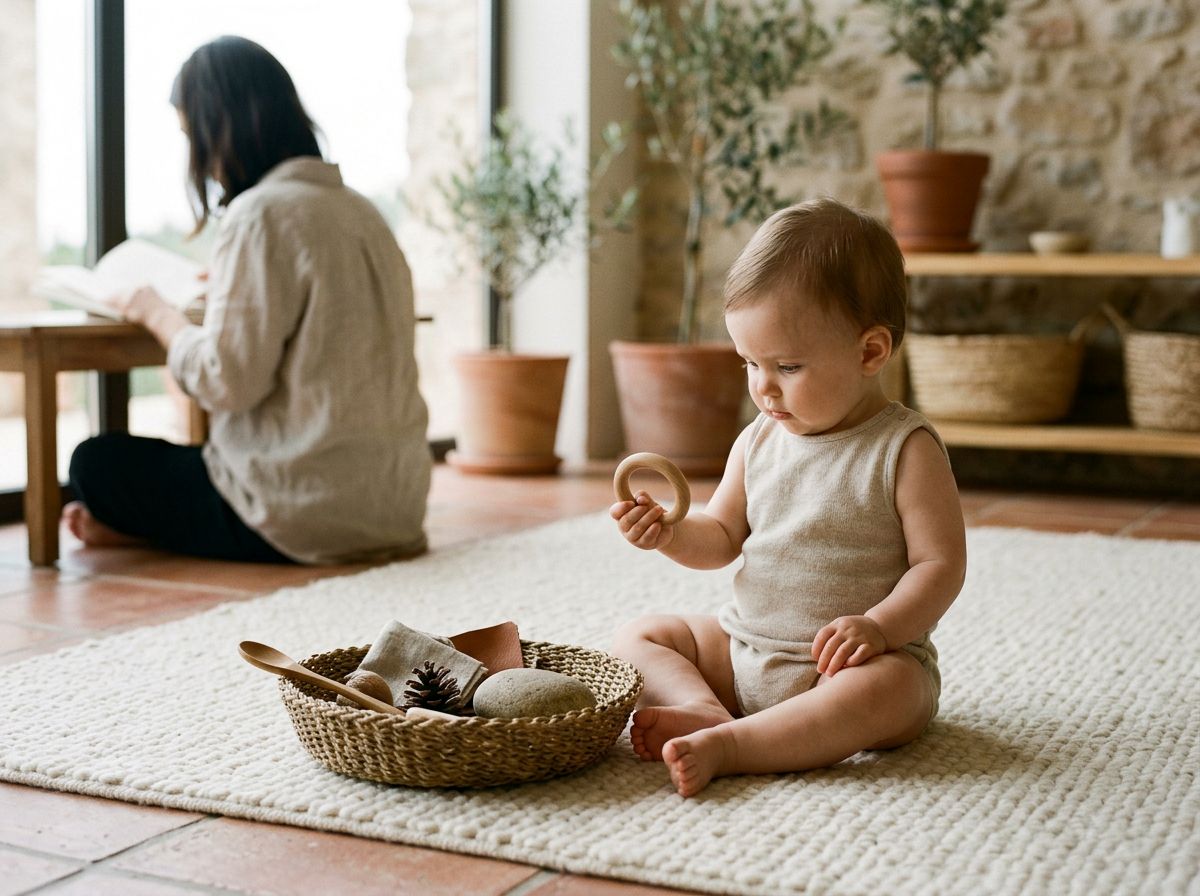
The role of the adult remains minimal. Once the basket is offered, the interaction belongs to the baby. Observation replaces intervention. The process does not need to be guided or extended.
This is often the point where development becomes most visible—not because something is being taught, but because nothing interrupts the experience.
Final thoughts
Treasure basket play is simple by design. Its value lies in how closely it matches the stage of development. A small number of objects, offered at the right moment, can support long periods of focused exploration.
What looks like quiet play is, again, development in progress. Through repetition, comparison, and sensory experience, the baby begins to understand the physical world—one object at a time.
Further Reading
If you’d like to understand how this fits into the wider environment: