
When Montessori mobiles are first introduced, one of the most common questions is how to use Montessori mobiles correctly. The materials themselves are simple, yet their effect depends almost entirely on how they are presented. It is easy to approach mobiles as something that should keep a baby occupied. In a Montessori context, their role is different. Visual mobiles are not designed for entertainment or interaction, but for observation. They offer the baby something to look at, follow, and gradually make sense of.
Understanding how to use Montessori mobiles begins with this shift. The focus moves away from doing more, towards allowing the baby to see clearly and concentrate.
For some parents, preparing these mobiles becomes part of the experience itself. The process of making or choosing each one introduces a different kind of attention, one that mirrors the simplicity of the materials and the pace of the baby’s development.
The place of visual mobiles and how to use Montessori mobiles at this stage
Unlike tactile materials that invite the baby to reach and grasp, visual mobiles belong to an earlier stage of development. They are placed just out of reach, creating a space where the baby can observe without the need to act. This distinction is important, as it allows the baby to focus entirely on visual exploration without the pressure of movement or interaction.
In these first weeks, development is closely linked to what the baby can take in through sight. Contrast, shape, and gentle movement all contribute to this process, but only when they are presented in a way that remains clear and manageable. When the visual field is simple, the baby can remain with the experience longer, gradually refining their ability to focus and track.
Understanding how to use Montessori mobiles at this stage helps keep the focus on observation rather than interaction.
Setting up the mobile
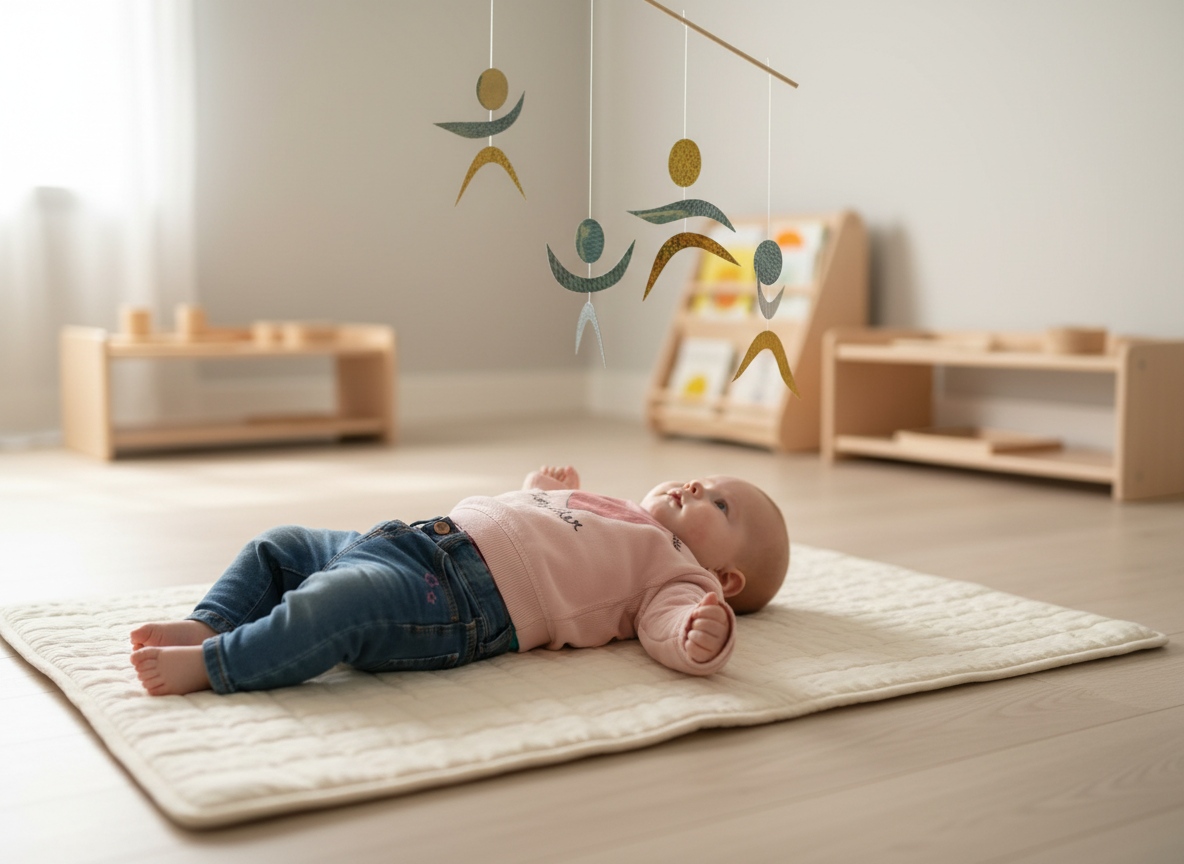
The way a mobile is positioned determines how the baby is able to engage with it. It is typically placed above the baby’s chest, at a distance where it can be seen comfortably without strain. At this range, the elements of the mobile remain distinct, and the baby can take in the whole without becoming overwhelmed.
At first, the mobile is usually still. This allows the baby to observe its form and structure without distraction. Movement can be introduced later, but it remains subtle. A slight shift in air or a gentle breath is often enough to bring the mobile to life. When movement becomes constant or too strong, it begins to compete with the baby’s ability to focus, rather than support it.
It is also important that the baby can see the mobile clearly but not touch it. This reinforces the purpose of the material, which is observation rather than interaction. The transition to touching and grasping comes later, with tactile materials.
Having the next mobile prepared in advance can make these transitions easier. When the baby shows readiness, the change can happen smoothly, without the need to interrupt the rhythm of their exploration. Preparing the mobiles yourself can also become part of the experience, allowing you to create something simple and purposeful for your baby at each stage.

What the baby is doing
From the outside, it may look as though the baby is simply watching. In reality, something more precise is taking place. The eyes begin to follow the elements of the mobile, at first in short, uneven movements, then with increasing control. Over time, this tracking becomes smoother. Attention, which was initially brief, begins to extend.
There is no need to encourage this process. When the conditions are right, it unfolds on its own. This is why simplicity is so central. When there is less to process, the baby can stay with the experience longer.
When to change a Montessori mobile
There is often a suggestion that each mobile is used for around two weeks, but this should be understood as a flexible guideline rather than a fixed rule. The most reliable indicator is the baby’s response. A mobile that once held attention may gradually lose its effect, and the baby may begin to look away more quickly or turn their head.
This change is not a loss of interest in the usual sense, but a sign that the current visual challenge has been absorbed. The baby is ready for something slightly more complex. Knowing how to use Montessori mobiles and when to change Montessori mobiles comes from observing these small shifts rather than following a strict timeline.
Having the next mobile prepared in advance can make these transitions easier. When the baby shows readiness, the change can happen smoothly, without the need to interrupt the rhythm of their exploration.
Small changes within the same material
Even within one mobile, there is room for variation. Changing the orientation can alter how the baby observes it. A mobile presented across the chest encourages horizontal tracking, while a head-to-toe position invites a different movement of the eyes.
If a mirror is present near the movement area, placing the mobile so that it is reflected can introduce another layer of observation. The baby may begin to notice the relationship between the object and its reflection, even if only gradually.

Taking a mobile outside can also shift the experience. Natural air movement creates a slower, less predictable motion, which some babies follow with renewed interest.
These changes remain subtle. They do not replace the material, but allow the baby to return to it in a slightly different way.

Common misunderstandings
Many difficulties with Montessori mobiles come from how they are used rather than from the materials themselves. One common tendency is to introduce too much movement. Constant rotation or strong motion can make it harder for the baby to follow what they see.
Another issue is positioning. If the mobile is too far away, it becomes difficult to see clearly, while placing it too close can overwhelm the visual field. There is also a tendency to expect interaction too early, treating the mobile as something the baby should reach for. In reality, this stage is about observation, and the transition to action comes later.
Understanding the milestones of infant vision helps ensure the material remains a tool for observation rather than a source of strain.
The role of the adult
Once the mobile is in place, there is little for the adult to do. Observation becomes the main role. There is no need to point things out or guide attention. The baby is already engaged in their own way.
This can feel unfamiliar, especially when we are used to interacting more actively. But in this context, stepping back allows concentration to develop without interruption. When the baby has had enough, the signs are usually clear. Attention fades, the head turns away, or the body becomes unsettled. This is the moment to remove the mobile or prepare for a change. Recognizing these infant engagement and disengagement cues is essential for supporting a child’s concentration without unnecessary interruption.
In this way, learning how to use Montessori mobiles becomes less about following rules and more about observing development as it unfolds.
Final Thoughts
Learning how to use Montessori mobiles is less about applying a set of rules and more about understanding their place in development. When they are presented with care, they create the conditions for observation, focus, and gradual refinement of visual ability.
Each mobile has its moment. By following the baby’s response, rather than a fixed timeline, this progression becomes both natural and meaningful.
Further Reading
If you’d like to explore how Montessori materials support your baby’s development beyond the visual stage, these articles may also be helpful:
- Montessori Myth Busting
A closer look at common misunderstandings around Montessori materials and what actually supports development. - Crochet Baby Toys
How simple, natural materials can support early sensory exploration and why texture matters in the first months.