
By around three to four months, something begins to shift in a baby’s development. Movements that were previously uncoordinated start to become more directed. The hands, which until now moved mostly by chance, begin to act with intention. Reaching becomes more precise, and the first attempts at grasping appear.
After the Bell on a Ribbon, where the baby discovers that movement can create a result, the next step is to hold on to that experience. The Montessori Ring on a Ribbon builds directly on this transition. It is the second in line in the series of tactile materials and offers a simple but meaningful challenge: not just to touch, but to grasp, hold, and eventually pull.
At first glance, the material is almost nothing. A wooden ring suspended from a ribbon. But this simplicity is exactly what allows the baby to focus, repeat, and gradually refine their movements.
What is the Montessori Ring on a Ribbon?
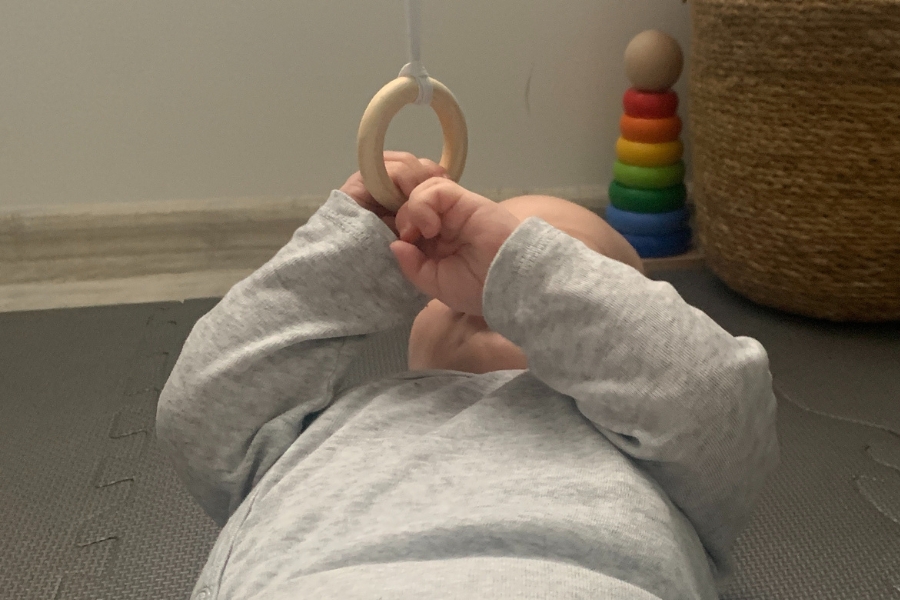
The Ring on a Ribbon is made of a smooth wooden ring suspended at a height where the baby can reach it while lying on their back or side. Unlike the previous visual mobiles, which are designed to be observed from a distance, this tactile material is intended to be touched. The focus shifts from looking to acting. The baby is no longer only following movement with their eyes, but beginning to reach, grasp, and influence what happens.
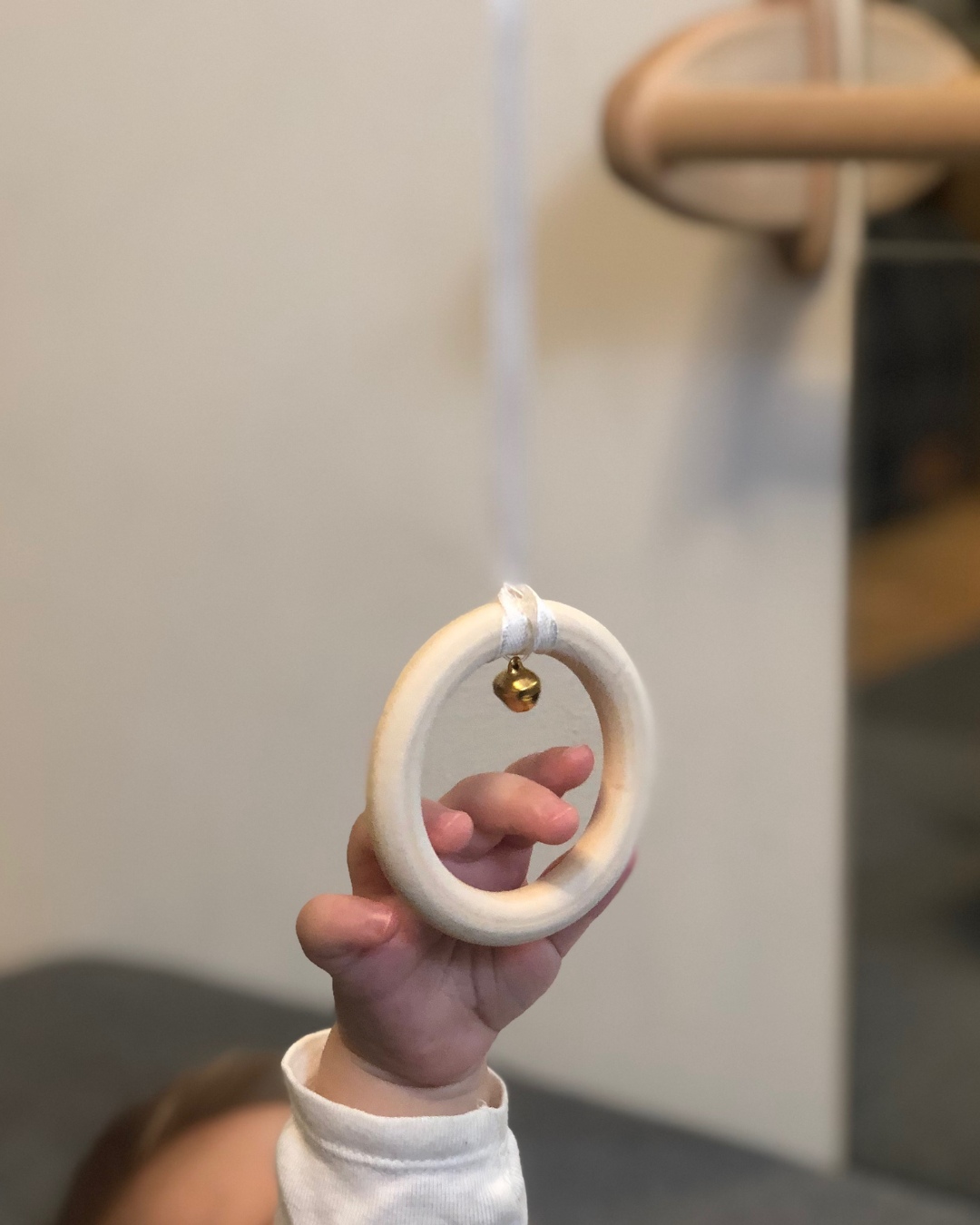
The ring fits naturally into the baby’s hand. Its size and shape make it possible to grasp without unnecessary effort, while still offering enough challenge to encourage repeated attempts. The ribbon allows the ring to move freely, creating a direct and visible connection between the baby’s action and what happens next.
A simple ribbon works well, but using an elastic ribbon can slightly change the experience. When pulled, the ring gently returns, offering a different kind of feedback that some babies find especially engaging.
From Batting to Grasping
At this stage, the baby is beginning to act with intention. What may look like a simple movement is, in reality, a coordinated effort. The baby focuses on the object, plans the movement, extends the arm, and attempts to close the hand around it.
When the Montessori Ring on a Ribbon is grasped and pulled, something happens. The object moves. This moment is often repeated again and again, not because it is entertaining in the usual sense, but because it is meaningful.
The baby begins to explore what they can do. They are not just reacting anymore, but actively trying, adjusting, and trying again. This is where movement, concentration, and early problem-solving begin to come together.
How the Ring Supports Development
Although the activity appears simple, several processes are working together at once. The baby is coordinating vision and movement, learning to guide the hand toward a specific object. The fingers begin to close more deliberately, and the first controlled grasp appears.
At the same time, the baby starts to understand cause and effect in a more concrete way. Pulling leads to movement. Movement leads to a visible change. This connection strengthens with repetition.
There is also a noticeable increase in concentration. Rather than shifting quickly from one stimulus to another, the baby may remain with this single activity, repeating it many times. Through this repetition, movement becomes more refined and controlled.
As coordination continues to develop, the next step is to introduce materials that support more controlled and sustained grasping, such as grasping beads.
Why Simplicity Matters
It is tempting to think that adding more features would make the material more interesting. In reality, the opposite is often true. At this stage, reaching and grasping already require significant effort. If the object introduced multiple textures, sounds, or visual elements, attention would be divided. The baby would need to process several things at once.
The Montessori Ring on a Ribbon offers one clear invitation. Because of this, the baby can remain with the activity, repeat it, and gradually improve. This clarity is what allows development to unfold naturally. This focus is essential, as managing sensory input is a primary task of the developing nervous system.
Materials and Variations
The most common version uses a simple wooden ring. Wood offers a clear tactile experience. Its surface, weight, and temperature are easy to distinguish, which supports the development of the tactile sense.
Some variations introduce small changes without losing simplicity. An elastic ribbon can add a different type of movement, as the ring gently returns after being pulled. There are also crochet variations, where part of the ring is covered in soft cotton. This creates a subtle contrast between smooth and soft surfaces, offering additional tactile information without overwhelming the experience.
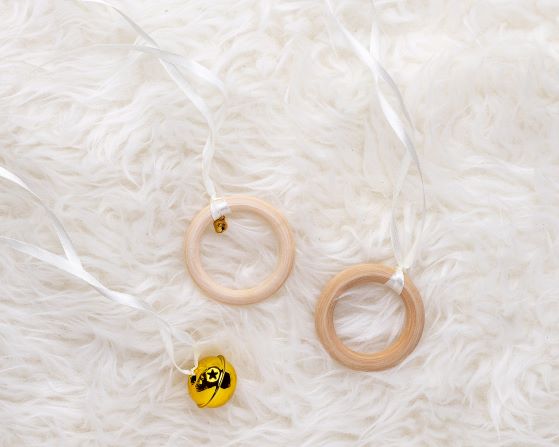
If you prefer a ready-to-use option, a tactile set that includes both the Bell and the Ring can make it easier to follow this developmental progression at home.
How to Use the Ring on a Ribbon
The ring should be positioned so that the baby can reach it with effort, but without frustration. If it is too high, the baby may lose interest. If it is too low, it removes the challenge.
It can be offered while the baby is lying on their back, during side-lying play, or during tummy time when held at an appropriate height. At first, the baby may only touch the ring. Over time, movements become more precise, and grasping begins to emerge.
There is no need to demonstrate or guide the action. Observation is usually enough. The baby will repeat the movement as long as it remains meaningful.
Safety Considerations
As with all tactile materials, the Montessori Ring on a Ribbon requires careful supervision. The ribbon must be securely attached, and its length should be appropriate and safe. The baby should never be left unattended while interacting with it.
This is not a passive toy, but an activity that takes place within a prepared and observed environment. It also offers an opportunity for quiet, shared time, where the adult observes rather than intervenes.
FAQ
When should the Montessori Ring on a Ribbon be introduced?
Around 3 to 4 months, when reaching becomes more intentional.
What comes next after the Ring on a Ribbon?
The next step is usually grasping materials, such as grasping beads, which support more refined coordination.
Can the ring be used as a teether?
Once appropriately prepared, the wooden ring can later be used for mouthing, or part of the treasure basket play, but its primary purpose here is grasping and pulling.
Final Thoughts
The Montessori Ring on a Ribbon represents a quiet but important shift in development. It marks the transition from observing movement to creating it.
Through repeated attempts to reach, grasp, and pull, the baby begins to coordinate their actions more precisely. What appears simple becomes a meaningful experience of movement and discovery.
Further Reading
If you’d like to explore how babies continue to develop through touch and movement, these articles may also be helpful:
- Montessori Sensory Learning – How babies explore materials through touch, movement, and repetition.
- Flying with a Baby – Practical tips to stay calm, reduce stress, and make air travel easier for both you and your baby.