
As a baby’s vision begins to organise, movement becomes increasingly interesting to observe. Objects that glide slowly through space allow the eyes to practise following motion and maintaining focus.
Among the animal mobiles, the Montessori Whale mobile stands out for its calm movement and simple, recognisable shapes. Its slow, natural motion invites the baby’s eyes to follow gently across space, supporting early visual tracking without overstimulation. Although animal mobiles are typically introduced after the first sequence of Montessori visual mobiles, the Whale mobile can sometimes be offered earlier. Its strong contrast and clear forms make it accessible even when vision is still developing, while also preparing the baby for more complex movement.
Unlike earlier Montessori visual mobiles that introduce contrast, colour, and depth step by step, the Montessori Whale mobile brings these elements together in a single, coherent scene.

What the Montessori Whale Mobile Looks Like
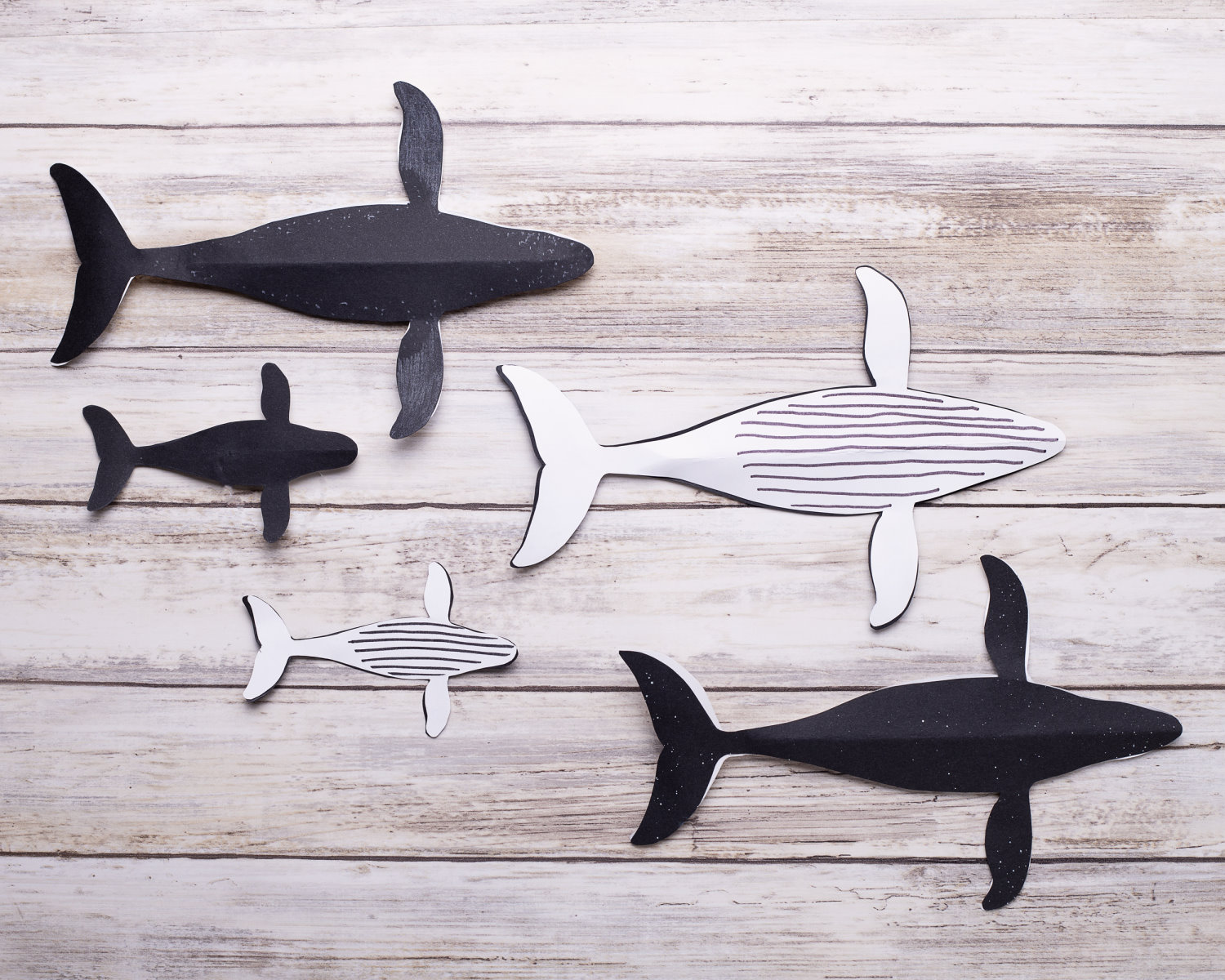
The Montessori Whale mobile depicts a small pod of humpback whales — typically three adult whales and two calves. The shapes are simple but realistic. The proportions reflect the natural form of the animals, which aligns with Montessori’s preference for presenting real images rather than fantasy during the early years.
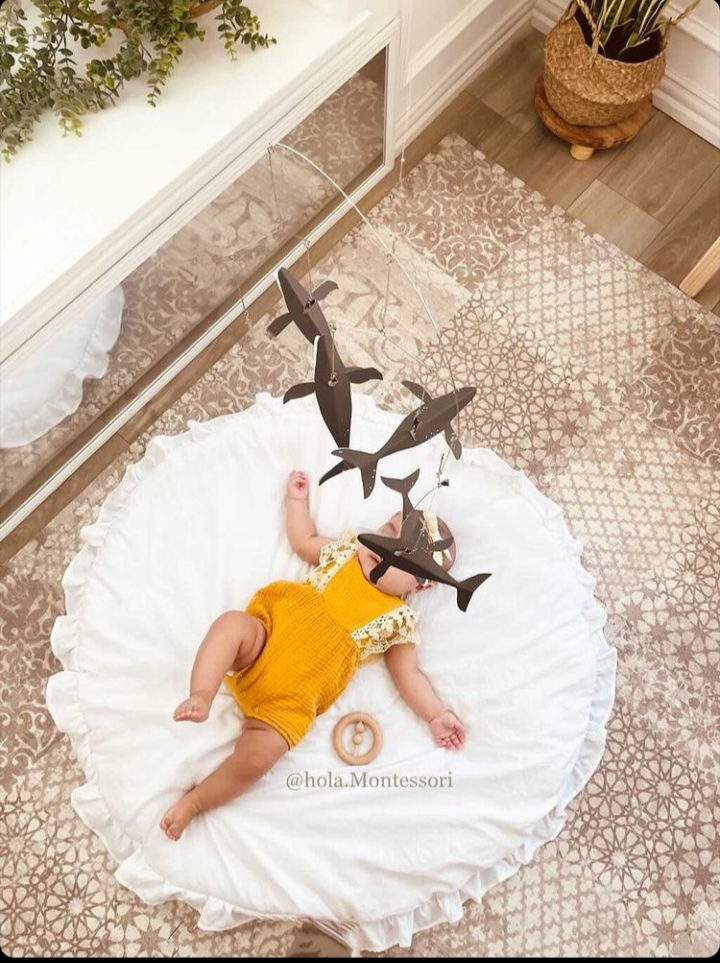
The whales are suspended at slightly different heights, allowing them to move independently in the slightest air current. As they drift slowly from side to side, their movement resembles the calm rhythm of whales swimming through water.
Small visual details also attract the eye. The black lines on the whales’ white bellies represent the throat pleats of humpback whales, adding subtle visual interest without creating clutter.
Why the Whale Mobile Captures Babies’ Attention
The Whale mobile works well because it combines clarity, contrast, and gentle motion. The colours are simple — black, white, and grey — making the shapes easy to distinguish even when vision is still developing. At the same time, the calm movement invites the baby to follow the whales as they drift slowly across the visual field.
As the whales move at different heights, the baby may begin to notice how objects relate to each other in space. As their visual skills improve, they gradually discover new details within the mobile. The result is a material that remains interesting for longer than many simpler visual objects.
Nothing flashes. Nothing spins mechanically. The movement responds only to the air in the room, allowing the baby’s attention to develop naturally.
When parents typically introduce the Whale mobile
Many parents begin looking for the Montessori Whale mobile when they notice that simpler visual materials are no longer holding their baby’s attention for as long.
At this stage, the baby is ready for:
- more dynamic movement
- multiple elements to follow
- subtle variation in size and position
The Whale mobile meets this moment precisely. It offers more to observe without overwhelming the visual field, making it a natural next step for families following the Montessori sequence.
Visual Development Supported by the Whale Mobile
The Montessori Whale mobile supports several aspects of early visual development through quiet observation.
As babies watch the moving whales, they may begin to:
- follow a moving object with their eyes
- maintain visual attention for longer periods
- shift their gaze between different moving elements
- notice differences in size between the adult whales and the calves
- perceive depth as the elements move at different heights
These abilities do not develop through instruction. They emerge naturally through repeated observation of slow, predictable movement.
Like all Montessori mobiles, it avoids mechanical movement and sound, preserving a calm and coherent visual experience.
How the Whale Mobile Fits Into the Animal Mobile Sequence
One interesting feature of the Montessori Whale mobile is that it can adapt slightly to the baby’s stage. Some families begin by offering only the three adult whales. With fewer elements, the shapes are easier to perceive when vision is still developing. Later, the two calves can be added, introducing additional visual relationships between the elements. Because the movement remains ungurried and predictable, many babies continue observing the Whale mobile for an extended period as their visual tracking becomes more stable.
As visual attention grows stronger, many families naturally move on to the Montessori Swallows mobile, which adds longer horizontal movement and a small point of visual interest that encourages even more focused observation.
Placement and Use
As with all Montessori visual mobiles:
- offer the mobile during calm awake time
- position it above the baby’s chest, never within reach
- maintain a distance of about 30 cm / 12 inches
- remove the mobile when the baby loses interest
The Whale mobile is designed for observation, not interaction. When reaching becomes consistent, tactile materials gradually begin to accompany visual exploration.
Final Thoughts
The Montessori Whale mobile combines contrast, movement, and simple realism in a way that supports the next stage of visual development. For babies who are beginning to follow motion more deliberately, it offers a clear and engaging point of focus without overstimulation.
For many families, this is the stage where visual observation becomes more sustained and intentional. Choosing a mobile that matches this shift can make a noticeable difference in how long and how calmly a baby observes.
While many visual tools are outgrown quickly, the slight complexity of the whales often captures the attention of babies who are beginning to seek more dynamic movement and realistic forms. Observing this shift helps you determine when they are ready to transition from pure observation to physical reaching.
For families who enjoy preparing Montessori materials at home, the Whale mobile is available as both a Montessori Whale mobile DIY kit and a Montessori Whale mobile digital pattern, allowing you to create the mobile step by step while maintaining the correct proportions and balance.
Further Reading
If you’d like to explore how Montessori mobiles support visual development in the early months, these articles offer additional perspective:
- Timeline of the Montessori Mobiles – Mobile Progression by Age Explained
A guide to how Montessori visual mobiles follow the natural development of infant vision. - Montessori Seagull Mobile – Visual Stability and Calm Movement
A later bird mobile that invites even longer periods of visual observation.