
As your baby’s vision becomes more organised, something shifts. Tracking is no longer brief or uncertain. The eyes begin to follow movement more steadily, across a wider space, and for longer periods of time. This is often the point where parents begin to ask what comes next — and which materials are actually worth introducing at this stage.
The Montessori Swallows mobile is often introduced here, as part of the Montessori animal mobiles. It builds on earlier tracking by inviting the eyes to follow longer, more fluid horizontal motion. Rather than adding complexity, it refines what is already developing — helping attention become more stable, sustained, and organised.
What the Swallows Mobile Looks Like
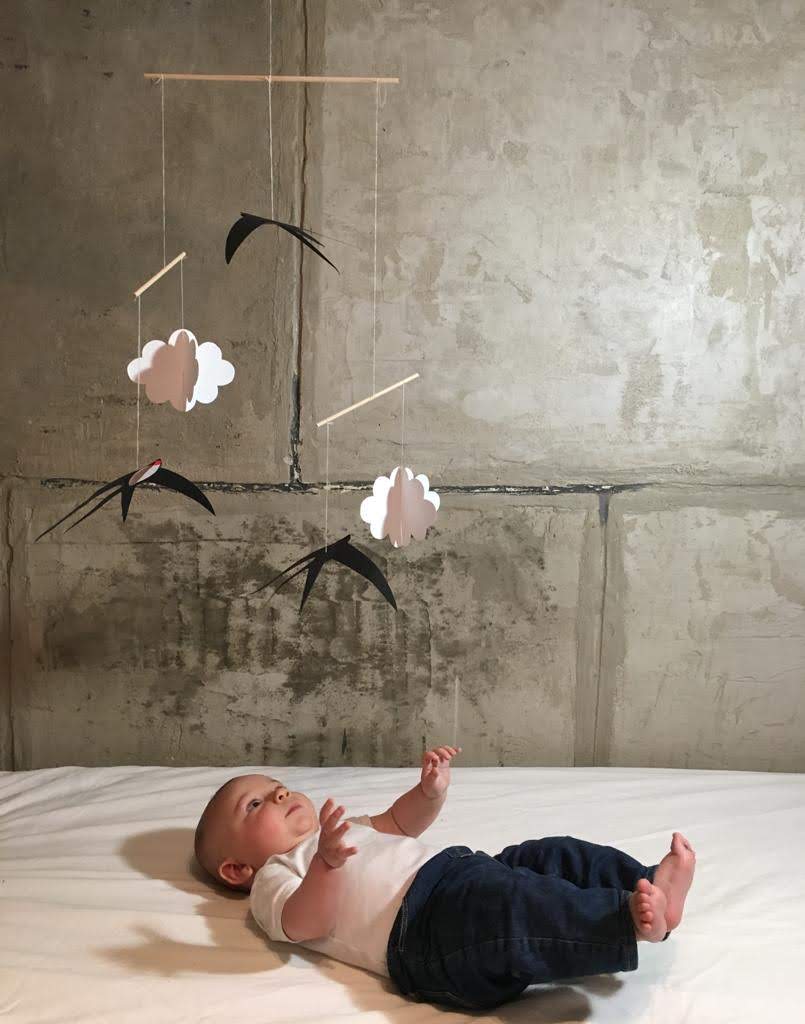
The Montessori Swallows mobile consists of three stylised birds suspended at different heights. The forms are simple and recognisable. Each swallow has extended wings and a clear outline that remains easy to perceive even while the mobile moves.
Small folded elements create a subtle three-dimensional effect, while the tiny red detail at the beak creates a clear point of contrast. This small detail often becomes a natural point of interest, where the baby’s gaze briefly settles as the bird moves through space. Two soft cloud shapes complete the composition, creating the impression of birds gliding across an open sky.
Viewed from below — the baby’s perspective — the mobile appears spacious and balanced. The eye can move calmly from one element to another without becoming overwhelmed.

Extending Visual Tracking
By the time the Swallows mobile is introduced, babies have already begun practising visual tracking with the earlier Montessori mobiles. It builds on this foundation by inviting the eyes to follow longer and more fluid horizontal movement.
Because the birds hang at slightly different heights and move independently in the slightest air current, the baby may begin to:
- follow movement across a wider visual field
- maintain focus for longer periods
- shift their gaze between moving elements
- notice small visual details within the moving forms
The small red detail at the bird’s beak often becomes a natural point of interest. As the mobile moves, the baby’s gaze may briefly settle on this contrasting point before returning to the movement of the bird itself.
These abilities do not develop through instruction. They emerge naturally through repeated observation of calm, predictable motion. This is what makes the Swallows mobile a distinctive baby visual tracking mobile within the Montessori sequence.
Nothing flashes. Nothing spins mechanically. The movement responds only to the air in the room.

Why Birds?
Montessori environments generally favour realistic forms rather than fantasy in the early months. Clear, recognisable shapes help the child gradually organise their understanding of the world.
Birds also offer a particular kind of motion that is visually interesting without being overwhelming. Swallows glide smoothly through the air, often travelling horizontally across space. This kind of movement allows the eyes to follow a form comfortably from one side of the visual field to the other.
Later bird mobiles continue exploring this idea of horizontal movement. In the Seagull mobile, broader wings and slightly longer gliding motion invite the eyes to follow movement across an even wider visual field.
The mobile does not demand attention. It quietly invites it.
Where the Swallows mobile fits in the sequence
The Montessori Swallows mobile is part of the transition from the early visual mobiles into the animal mobiles. It is typically introduced after the first visual sequence, when tracking has already begun to feel more steady. Within the animal mobiles, the Swallows mobile often follows the Whale mobile, extending the experience into more sustained horizontal movement.
From there, later mobiles such as the Seagull mobile and Butterfly mobile continue refining this same idea, inviting the eyes to follow movement across an even wider visual field with greater stability.
Rather than introducing something completely new, each mobile builds on what has already been established. The sequence moves gradually — from simple observation to more sustained tracking, and from shorter movements to longer, more continuous visual flow.
If you’d like to see how all the mobiles connect step by step, you can explore the full progression in the Montessori visual mobiles guide.
Observing the Baby’s Attention
What matters most is not the exact order of the mobiles, but the baby’s response.
When the mobile is appropriate for the moment, the baby may watch it quietly, following the movement of the birds and occasionally returning their gaze after looking away. These short cycles of looking, pausing, and returning are part of how attention develops in the early months.
If the baby’s gaze settles on the mobile repeatedly, the material is likely serving its purpose. If attention fades quickly, it may simply not be the right moment yet.
For many parents, this is the stage where the purpose of each mobile becomes easier to recognise, making the sequence feel more intuitive. Observation remains the most reliable guide.
You can read more about how to keep your baby interested in Montessori mobiles here.
Placement and Use
Like all Montessori visual mobiles, the Swallows mobile is offered during calm awake time.
It is typically positioned:
- above the baby’s chest
- out of reach
- at least 30 cm / 12 inches away
- in a quiet environment
The mobile remains a visual material rather than a toy for interaction.
For families who enjoy preparing Montessori materials at home, the Swallows mobile is available as a Montessori Swallows mobile DIY kit with prepared elements, or as a Montessori Swallows mobile digital pattern, allowing you to prepare it without sourcing each element separately.
Final Thoughts
The Montessori Swallows mobile introduces recognisable forms and calm horizontal motion into the baby’s perceptual environment. By this stage, the baby has already begun practising visual tracking. The swallows extend this experience by allowing the eyes to follow motion across a wider visual field.
Like all Montessori visual mobiles, the material is simple, quiet, and intentional. Its purpose is not stimulation, but observation. Through repeated moments of looking, the baby gradually strengthens the ability to track movement, notice detail, and sustain attention.
Further reading
If you’d like to explore more aspects of early development and everyday life with a baby, these articles offer additional perspective:
- Flying With a Baby — Practical Tips for a Calmer Journey
A realistic look at travelling with a baby, including simple strategies that help maintain rhythm and comfort during flights. - Montessori Myth Busting
Addressing common misunderstandings about Montessori materials, stimulation, independence, and what the approach really means in everyday family life.