
When people imagine a Montessori baby room, they often picture a beautifully prepared nursery filled with special furniture and carefully chosen materials. In reality, Montessori looks much simpler. The baby’s environment is less about buying specific things and more about creating calm spaces that support movement, observation, and gradual independence.
Rather than creating the perfect Montessori baby room, it helps to understand the key areas that tend to support early development. Many of these elements are simple, and some may already exist in your home. What matters most is choosing what fits your baby — and observing how they respond.
In Montessori, the baby’s work space refers to the areas that support movement, observation, and calm exploration during awake time.
What is a Montessori baby space?
Rather than separating play, learning, and care into different activities, the environment itself becomes the baby’s first place of discovery. A movement mat, a mirror, simple visual materials, and space to move freely often form the centre of this early environment.
Each home will look a little different. The goal is not a perfect setup, but a calm space where the baby can move, observe, and over time become aware of their surroundings.
1. A movement mat
Many products are sold as Montessori play mats, but in Montessori the movement mat has a different purpose. Rather than encouraging constant entertainment, it provides an uncluttered space for free movement and observation.
The movement mat becomes a Montessori baby’s work space on the floor. It offers a safe, comfortable area where the baby can lie freely, move their body, and gradually become aware of their own movements. This space is intended for awake time, not for sleep, and it helps both the baby and the adults around them recognise where this quiet, active observation takes place. It often turns into the centre of the baby’s daily rhythm.
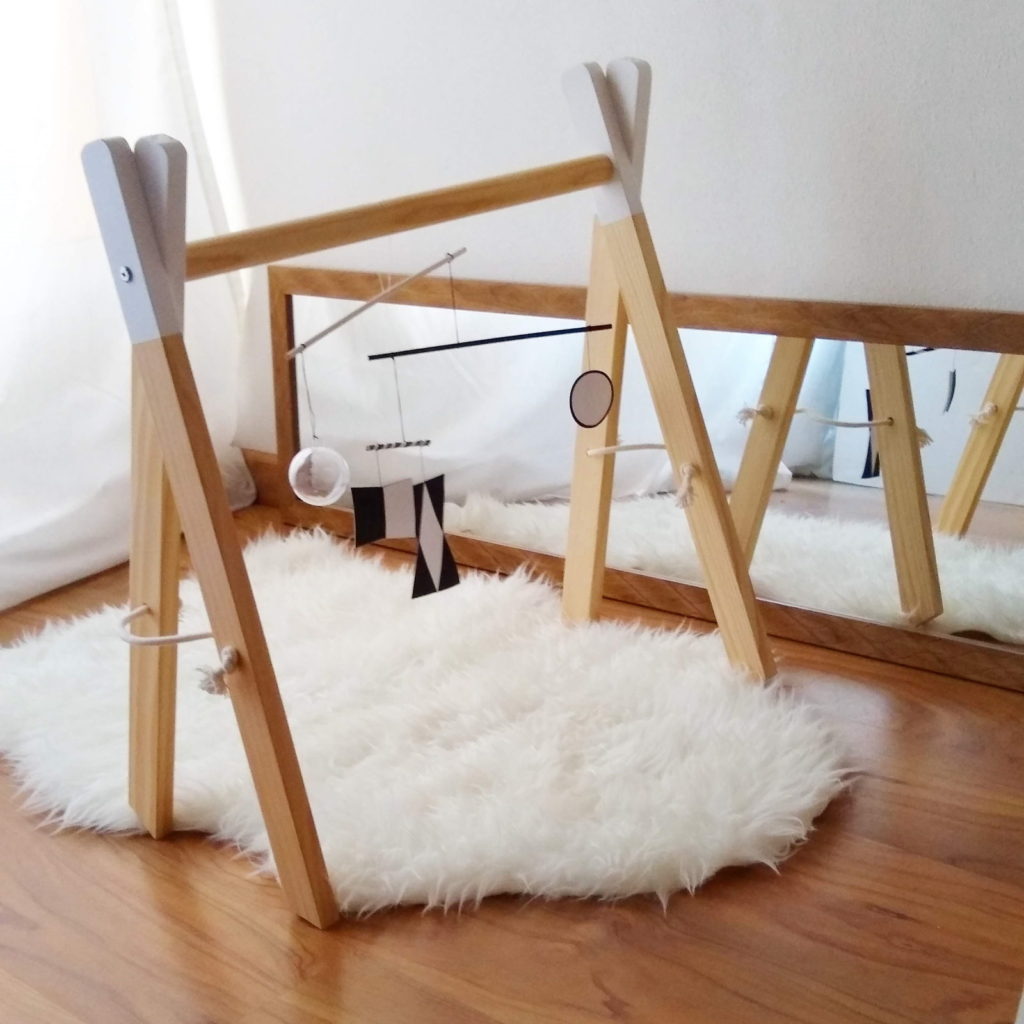
Complex baby gyms or elaborate equipment are rarely needed. In many homes, a folded blanket or a simple mat works well. In the earliest weeks, some families use a soft rug or faux sheepskin as a temporary surface. Rugs such as the IKEA TOFTLUND, when placed over a firmer base and used with supervision, can provide warmth and comfort for very young babies.
As the baby grows and movement becomes more active, the surface may need to change as well. A firmer mat that stays flat and does not bunch up supports freer movement and makes rolling and pushing easier. Like the rest of the environment, the movement area evolves alongside the baby.
2. A horizontal mirror
Babies are naturally drawn to faces. In the early weeks, they are not recognising themselves, but they are observing features, expressions, and movement.
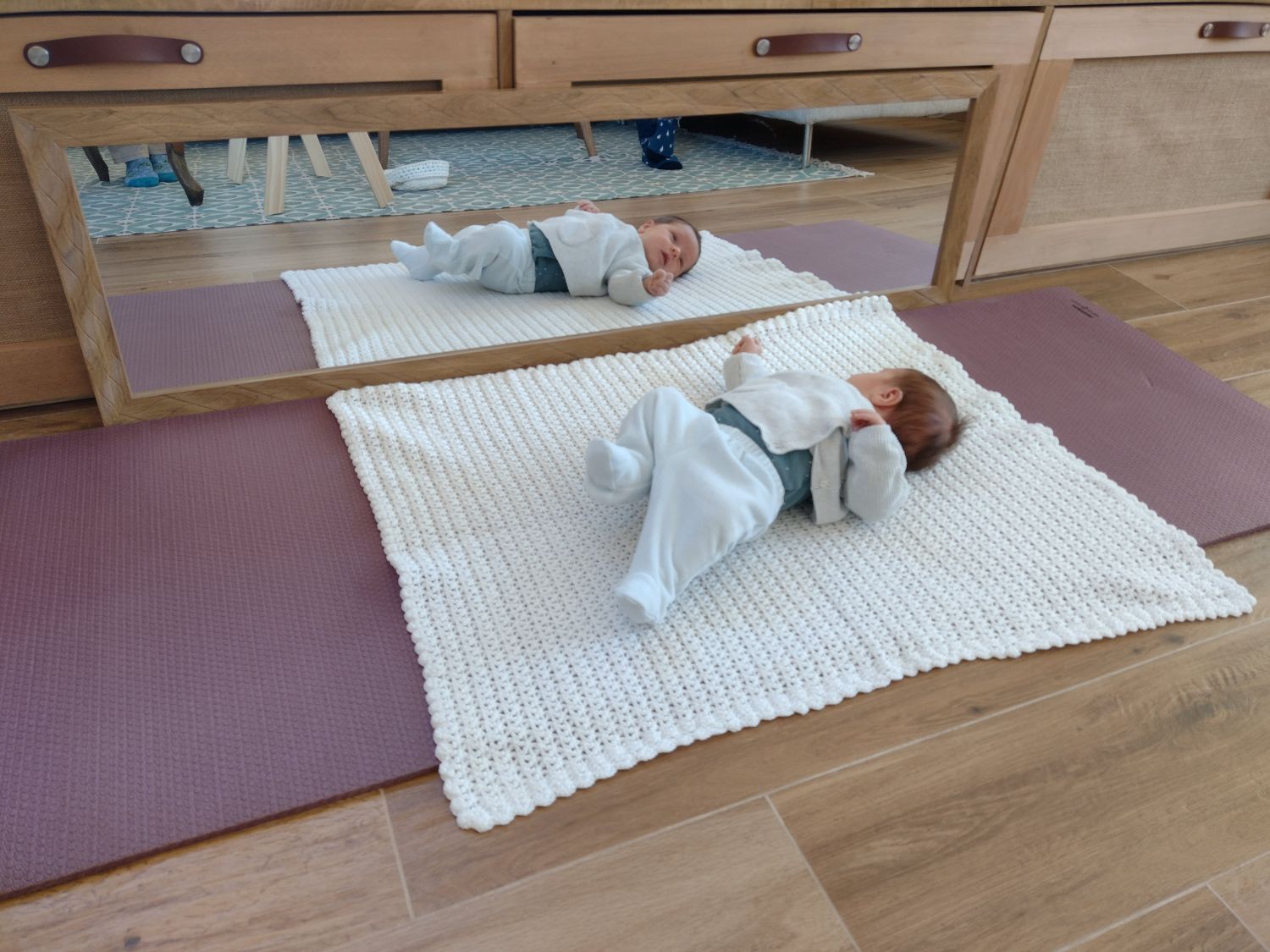
A horizontal mirror placed at floor level allows the baby to see their own body, notice movement, and over time become aware of how their actions relate to what they see. It also reflects the surrounding space, giving the baby a wider visual field.
The mirror is usually placed away from the sleeping area, as it tends to stimulate rather than calm. A long mirror positioned horizontally allows the baby to see their whole body as they move.
Many families choose acrylic or plexiglass rather than glass for durability. As with all elements in the Montessori baby’s work space, secure placement and supervision are essential.
Some parents also bring the mirror into tummy time occasionally, placing it flat on the floor with a few simple objects nearby for the baby to observe.
3. Topponcino
The topponcino is a thin, oval mattress designed to support the newborn’s need for containment. It offers a consistent surface under the baby when being held, fed, or moved, helping the baby feel secure during transitions.
Although not originally designed by Maria Montessori herself, the concept aligns well with Montessori principles. The topponcino is typically used only for a short period, until the baby outgrows it.
Not every family chooses to use one. It is most often used in the early weeks, while the baby adjusts to life outside the womb.
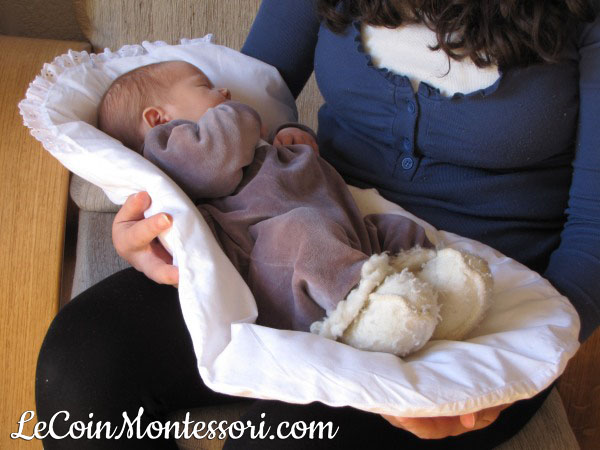
If you are comfortable using a sewing machine, it is also possible to make a topponcino at home. This great tutorial from Voilá Montessori offers a clear overview of the basic structure and proportions.
4. Black and white contrast cards
Newborn vision is limited. In the early weeks, babies see best at close range and are most responsive to strong contrast rather than colour. Black and white contrast cards offer simple visual input that matches what the baby can perceive at this stage. They can be placed within the baby’s visual field during awake time, near the movement mat or mirror.
Rotating images occasionally helps maintain interest, but there is no need for constant change. Brief moments of looking are enough.
If you’d like to explore this topic further, you can read more about black-and-white resources here.
5. Montessori mobiles in the baby’s work space
In Montessori-informed environments, visual mobiles are often one of the first materials introduced to the baby’s work space.
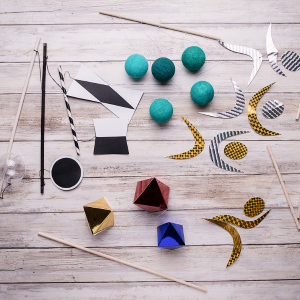
These mobiles are not toys meant for interaction. They are designed for observation. Suspended above the movement mat, they offer gentle visual experiences that correspond to different stages of early visual development.
Each mobile introduces a slightly different visual element — contrast, colour, depth, or movement. As the baby’s vision becomes more organised, the mobiles gradually change as well.
During awake time, the baby may spend quiet moments observing the mobile, following its movement or focusing on its shapes. This kind of quiet visual attention supports the development of tracking, concentration, and visual stability in the early months.
6. Montessori mobile stand (mobile holder)
A mobile holder provides a stable way to position mobiles above the movement area in a Montessori baby’s work space. It does not need to be elaborate.
Simple wooden holders are often sufficient, and many families choose foldable or second-hand options, knowing they will be used only for a limited time.
Many wooden baby gyms are marketed as Montessori, but they usually become suitable only after the hanging toys are removed and replaced with simple visual mobiles.
7. Baby books
Introducing books early is less about reading and more about shared attention. In the first months, this may mean looking at black and white images, naming shapes, or simply talking while the baby observes.
Babies are especially drawn to the adult’s face and voice. The shared moment is more significant than the content itself. When the baby turns their head away, it is a sign that they have had enough.
8. Low-hanging baby art pictures
Simple images placed at the baby’s eye level in a Montessori baby’s work space can become part of the visual environment. These do not need to be expensive or decorative. Realistic images, such as animals or natural forms, work well.
These pictures often become points of shared attention during tummy time or quiet observation, and can be changed occasionally as the baby’s interests evolve.
+1. The Montessori floor bed
Although sleep may take place in a different room, the baby’s sleeping space is still part of their overall environment. Floor beds are often used in Montessori settings to support independence and freedom of movement when the baby is ready.
You read more about the Montessori floor bed in this post.
Final thoughts
A Montessori baby’s environment is never truly finished. As your baby grows, their interests, abilities, and ways of exploring the world gradually change—and the environment changes with them.
You don’t need every element described in this guide. A simple movement area, thoughtful visual experiences, and enough freedom to move are often more valuable than a perfectly designed nursery. The most important guide will always be your baby. A few well-chosen areas, offered thoughtfully and adjusted through observation, are enough. The most important guide is always the baby themselves.
By observing how they move, what captures their attention, and how they respond to their surroundings, you can create an environment that grows naturally alongside them.
Further reading
If you’d like to explore how the baby’s environment supports movement, observation, and early development, these articles offer additional perspective:
- Timeline of the Montessori Mobiles — Visual Development Step by Step
An overview of how Montessori visual mobiles follow the natural development of infant vision during the first months. - Baby gear and free movement — Movement, Containers, and Everyday Reality
Why limiting restrictive baby equipment can support natural movement and motor development in the early months.