
The first days with a newborn can feel uncertain. It’s not always clear what they actually see, or what is truly worth offering in those early weeks. Then something subtle happens — the eyes pause, fix, and begin to follow. Many parents come across the Munari mobile while searching for a black and white mobile for newborns, or trying to understand when to introduce it within the Montessori visual mobile sequence.
The Montessori Munari mobile is typically the first visual mobile introduced at this stage, from birth to around four to six weeks, when high-contrast shapes are easiest to perceive. During this time, it can be tempting to offer more stimulation. In practice, newborns benefit far more from a small number of carefully prepared visual experiences that align with how their vision is developing.
The Munari mobile is one such material. Designed specifically for early visual perception, it offers contrast, balance, and gentle movement without overwhelming the baby.
Why the Munari mobile belongs in the newborn period
The Munari mobile is typically introduced from birth and used until around six weeks of age, during the earliest stage of visual development.
It’s easy to choose baby materials from an adult point of view: colourful, detailed, and visually busy. But newborn vision works very differently. Because of this, many babies are offered objects that are simply too complex to process in the early weeks. In the first weeks of life, babies:
- perceive strong contrast more easily than colour
- focus on simple shapes rather than detail
- respond to light and subtle movement
- tire quickly when visual input is too complex
When visual input is too complex or poorly matched to this stage, babies often turn away quickly or fail to engage at all — not because they are uninterested, but because the experience is not yet accessible to them.
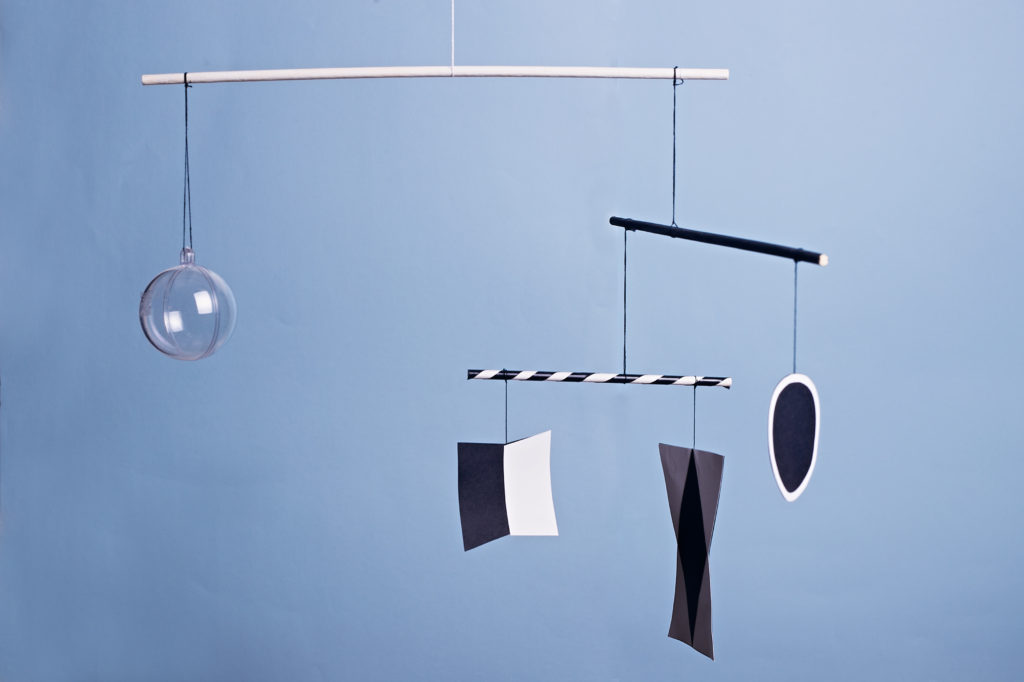
The Munari mobile is designed around these realities. Its black-and-white geometric forms, balanced structure, and slow movement reflect what a newborn can comfortably take in. Rather than trying to “entertain” the baby, the Munari mobile offers something to observe quietly. This is why adding more toys at this stage often does less, not more — what the newborn needs is clarity, not variety. That’s the reason why the Montessori Munari mobile fits: it meets the newborn exactly where they are developmentally.
As the baby’s vision begins to develop further — particularly with the emergence of colour perception — the Munari mobile is gradually replaced by the next mobile in the sequence.
What newborns actually see
Newborn vision is still organising. Images beyond a short distance appear soft, and the visual system is learning how to process light, shadow, and form. The Munari mobile is not just one of many mobiles, but the starting point of the entire visual progression.
It supports this stage through:
- high-contrast black-and-white elements
- simple, clearly defined shapes
- symmetrical balance that keeps the visual field stable
- a transparent sphere that reflects ambient light gently
Together, these elements create a visual experience that is clear rather than stimulating, and calming rather than distracting.

The Role of Gentle Movement
The Munari mobile does not rotate mechanically or move at a constant speed. Instead, it responds subtly to the natural air movement in the room. This slow, irregular motion allows the baby to notice movement without being overstimulated — something that is difficult to achieve with faster or mechanically moving objects.
There is no expectation of reaching or touching. At this stage, visual observation alone is sufficient.
Making a Munari mobile yourself
Some families choose to make a Munari mobile themselves, finding value in the quiet, hands-on process of assembling a material intended for their baby’s earliest weeks.
For families who prefer to prepare materials at home, the Montessori Munari mobile is available in two formats through Montessori Edited. A DIY Munari Mobile Kit includes all necessary materials, making the process more straightforward without sourcing individual components. The printable Munari template, on the other hand, allows for a more hands-on approach, where each element can be created from the beginning. The choice often depends on how much time and preparation you want to invest.

Beyond the Munari
The Munari mobile is typically the first visual mobile introduced in Montessori-informed environments. This usually happens from birth or within the first weeks of life. There is no exact moment for when to introduce the Munari mobile, but many families begin once the baby starts spending short periods calmly observing their surroundings. As the baby’s vision develops, other materials gradually follow, each responding to a different stage of visual perception.
This sequence reflects a progression from contrast, to colour, to tonal variation, and finally to more complex movement.
Observing the Munari mobile in use
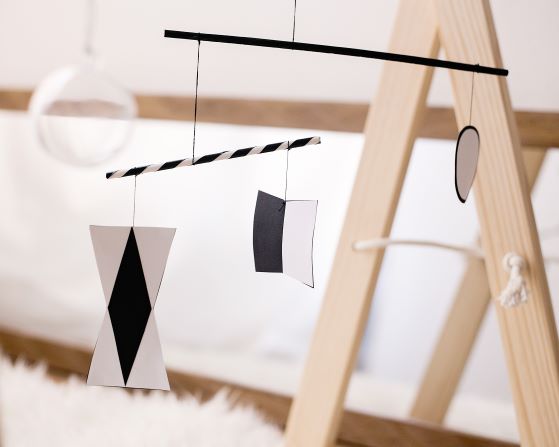
The Munari mobile is not an activity to be completed or a tool to be used for a set outcome. It becomes part of the baby’s environment, offering a visual point of reference when the baby is calm and alert.
Some newborns may watch the mobile for a few minutes, following the shapes and movement with their eyes. Others may glance briefly and then turn away. Both responses are appropriate. Looking away is not a sign of disinterest, but of regulation.
Parents sometimes worry that short observation means the baby is not interested, or try to extend the moment. In reality, looking away is part of how newborns regulate themselves. The experience is complete when the baby disengages. There is no need to encourage longer looking or repeated sessions. The role of the adult is simply to notice when the baby is receptive, and to allow the experience to unfold without interference.
Over time, parents often notice that these short moments of quiet observation fit naturally into the rhythm of the day and need no planning or extension.

Placement — where the Munari mobile belongs
The Munari mobile is typically offered as part of the baby’s movement area, where the baby can lie comfortably and observe without distraction. This is often a soft mat or rug on the floor, where the adult can also sit nearby.
The adult positions the mobile within the baby’s natural visual field, at a distance where the shapes can be clearly perceived. If placed too far away or outside this field, the mobile often goes unnoticed — not because the baby is uninterested, but because it is simply not yet accessible.
As with any element in a newborn’s environment, an adult offers it with supervision and adjusts it as the baby grows and changes.
Final Thoughts
The Munari mobile is small and simple by design. Its value lies not in what it does, but in what it allows: a moment of quiet visual focus during a period when the world is still coming into view. For many families, it becomes a quiet point of focus in the early weeks — something to observe, rather than something to use.
As the baby’s vision begins to change, this calm observation gradually gives way to something new: the introduction of colour, depth, and longer attention. This is where the next stage in the sequence begins.
See the full Montessori visual sequence: Munari → Octahedron → Gobbi → Dancers