
The Montessori Dancers mobile is typically introduced around 8 to 12 weeks, when a noticeable shift has already taken place in how a baby observes the world. The eyes begin to follow movement through space, and attention can settle for longer, more connected moments. At this stage, many parents think about moving beyond the earlier mobiles. This change in how the baby looks is usually the sign that the next step has arrived.
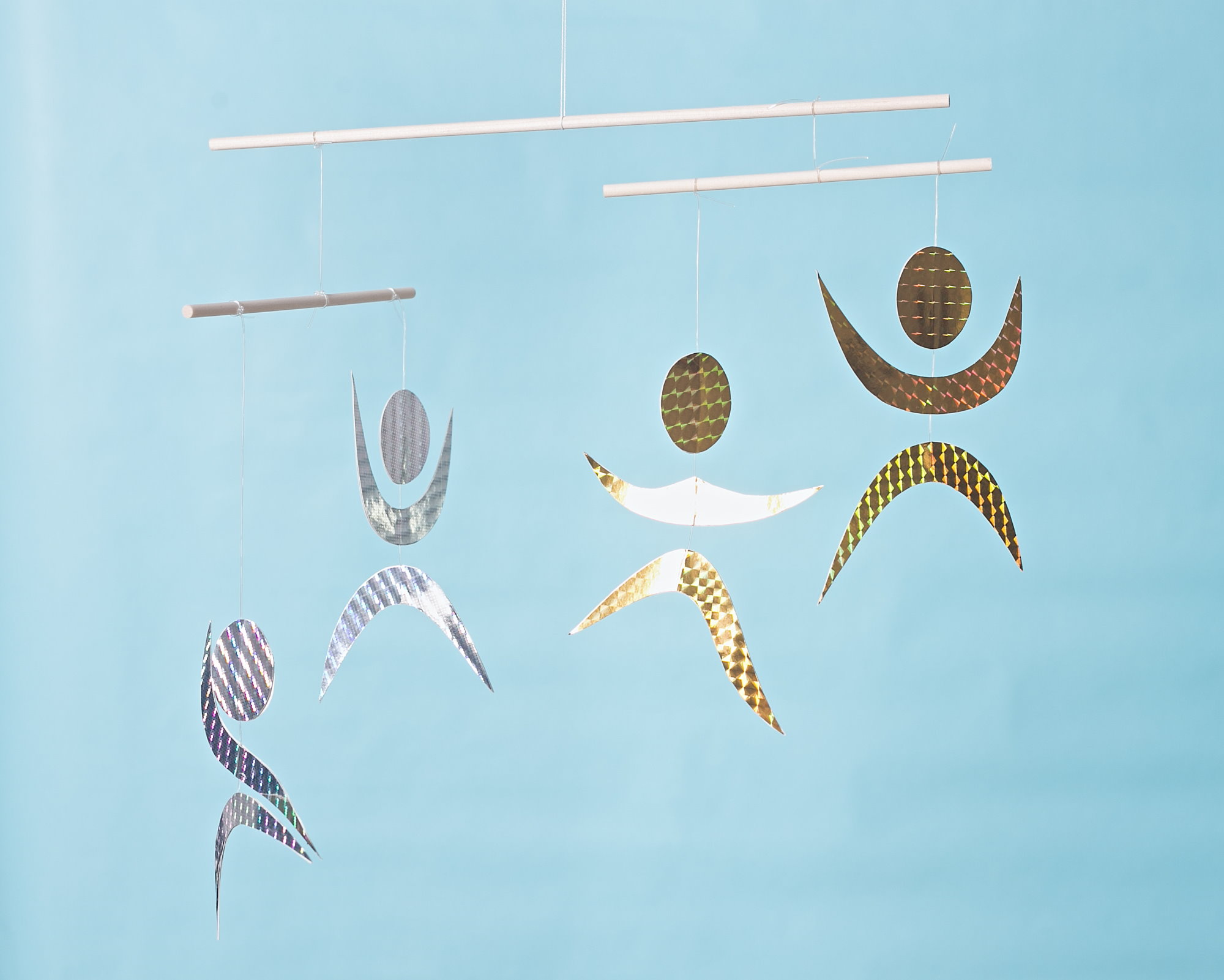
The Dancers appear at this stage not to add complexity for its own sake, but to reflect what perception is now ready to organise. It is the first mobile in the sequence to emphasise movement and depth perception. It follows the Gobbi mobile in the Montessori visual sequence, building on the baby’s growing ability to notice subtle differences by introducing movement through space.
Unlike the earlier mobiles, the Dancers introduce a new visual dimension. They move freely in three-dimensional space, responding to air, light, and gravity in a way that feels alive, yet unhurried.
Where the Dancers fit in visual development
This Montessori mobile is typically offered after the Gobbi mobile, when the baby’s visual system has already had time to explore contrast, colour, and tonal variation. It’s easy to assume that adding more visual elements or faster movement will support development. In practice, too much stimulation often makes it harder for the baby to organise what they see. At this point, vision is increasingly able to track movement across different planes. The eyes may follow an object not just side to side, but forward and back, noticing how forms move closer, farther, overlap, and separate.
The Dancers respond to this readiness. They do not ask the baby to focus on a single element, but allow attention to move freely among several figures, each suspended at a slightly different distance.
This is not about faster looking or stronger focus. The purpose of the Dancers mobile is not to increase stimulation, but to support how the baby begins to perceive movement and depth as part of a single visual experience.
What draws the baby’s attention at this stage
The Dancers consist of several lightweight figures, usually made from paper, hanging at different lengths from a central point. Their balance is precise, but their movement is never fixed. As air moves through the room, the figures rotate, drift, and occasionally cross paths. Sometimes one comes briefly into focus; sometimes another moves away. There is no predictable pattern to follow. What draws attention here is not shape or colour, but relationship: how objects move in relation to one another and to the surrounding space.
The eyes may follow one figure, pause, then shift to another. At times, the gaze may rest on the space between them. All of this is part of how depth and spatial awareness begin to organise through observation..
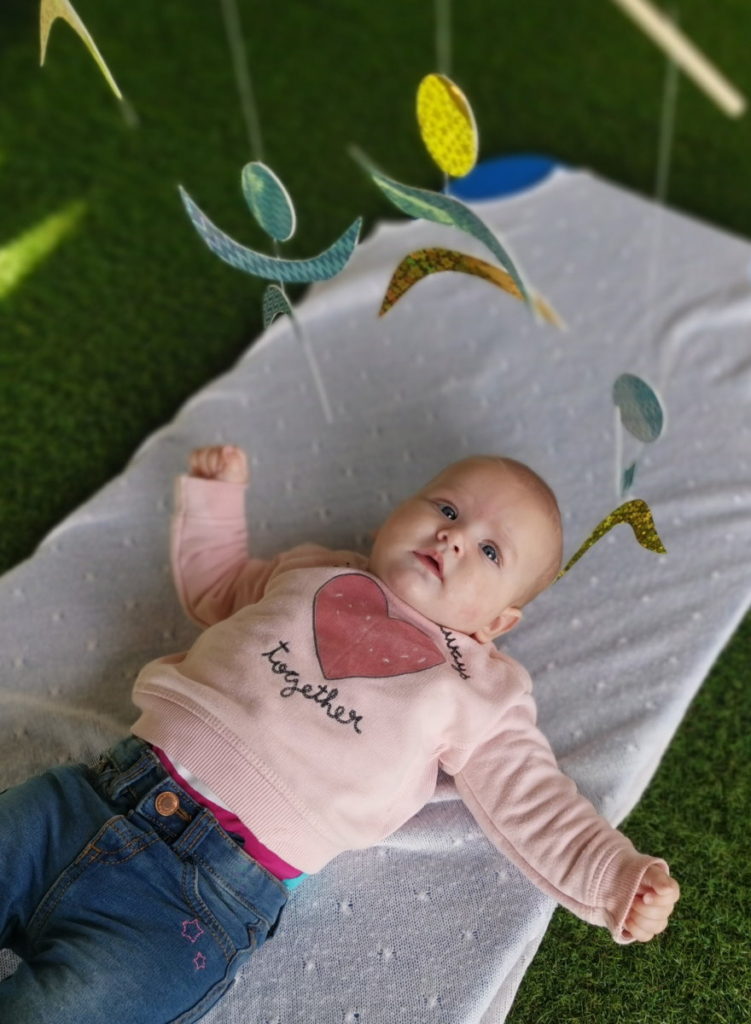
For a general overview of how depth perception and visual tracking emerge in infancy, see Infant Vision Development: What Can Babies See? on HealthyChildren.org.
Movement without demand
The movement of the Montessori Dancers mobile is slow, irregular, and responsive. There is no motor, no repetition, and no single focal point.
This lack of predictability is intentional. It allows the baby to look, look away, and return without missing anything. The experience remains open-ended, with no expectation of completion or response.
The Dancers are not meant to be touched or reached for. Their role is visual. Observation remains the primary work at this stage.
Space, placement, and the adult role
Knowing how to use the Dancers mobile matters more than it may seem. The amount of space around it, the distance from the baby, and the calmness of the environment all influence how clearly movement and depth can be perceived. If the mobile is placed too close, too far, or in a visually busy environment, the movement can become confusing rather than meaningful — not because the baby is uninterested, but because the experience is no longer clear.
Some families choose to place a floor mirror nearby. As with earlier mobiles, the reflection does not add stimulation, but another layer of spatial information. Movement can be seen from more than one angle, reinforcing the sense of depth in a quiet, intuitive way.
The adult’s role remains primarily observational. Noticing when the baby looks, when attention drifts, and when rest is needed matters more than adjusting the mobile or extending the experience.
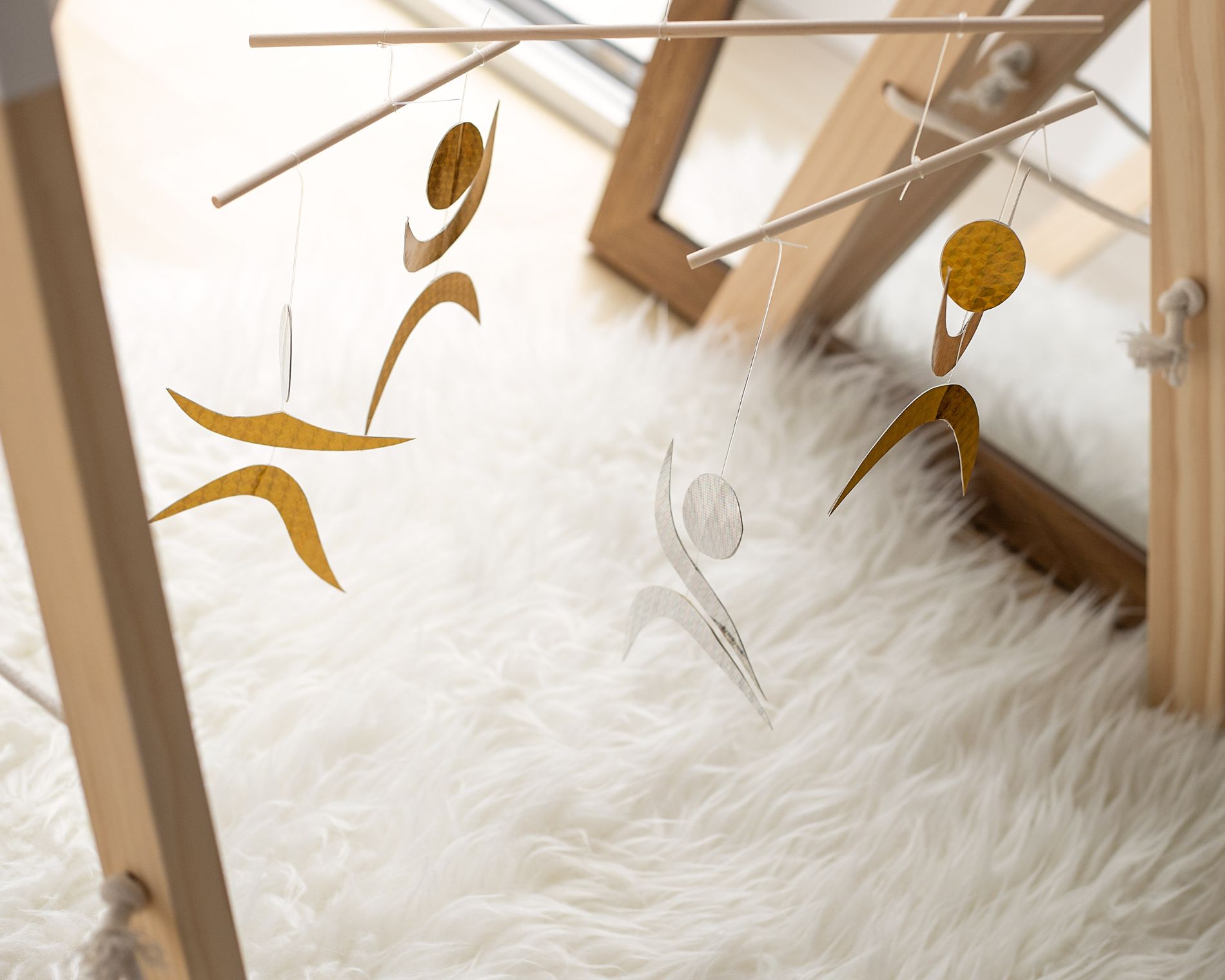
You can read more about how a calm, uncluttered movement area supports observation in the baby’s workspace.
Making and materials
The Dancers mobile is often made from very lightweight materials so that even small air currents create movement. Balance and proportion are more important than decoration.
For parents who want to offer this stage without overthinking materials or balance, a digital download version or a prepared DIY kit provides a simple and clear way to prepare it — while still keeping the experience of making the mobile yourself. The making process does not change the developmental role of the mobile. What matters is that the finished form remains light, balanced, and free to move.
When observation begins to shift
This is often the stage where the difference between a carefully prepared visual experience and a random object becomes most noticeable. S
Around this stage, many babies also begin reaching more deliberately. This does not replace visual observation, but adds to it. Looking remains important, while the first signs of interaction begin to appear. Attention is starting to expand beyond looking alone, sometimes alongside the gradual introduction of tactile Montessori mobiles.
When attention begins to turn outward in new ways, it is simply a sign that the environment will soon change again, responding to what development is asking for next.
For some parents, having a simple structure for noticing can feel grounding. If that feels helpful, a quiet observation sheet is available here, designed to support looking rather than measuring.
Final thoughts
The Montessori Dancers mobile marks the final stage in the early visual mobile sequence. It reflects a moment when perception has expanded beyond surface qualities into space itself. Its value lies not in what it produces, but in what it allows: time, movement, and the quiet organisation of depth and distance through observation.
From here, attention begins to shift again — from looking alone toward interaction. This is where the next stage of development begins.
Further reading
For readers interested in related aspects of visual movement, form, and changing attention:
- Montessori Animal Mobiles — a look at how gentle movement and recognisable forms can remain visually meaningful as babies’ perception continues to expand.
- The Montessori Swallows Mobile — a closer look at how lightness, balance, and free movement support quiet visual observation during later stages of early development.