
The Montessori Gobbi mobile is the third mobile in the Montessori visual mobile sequence, typically introduced around 6–8 weeks, when babies begin noticing subtle differences in colour. For many parents, it is also the first time they notice a clear change in how their baby observes the world. The gaze lingers longer. The eyes move more deliberately. Attention, while still brief, begins to settle.
At this stage, babies begin perceiving gradual variation in colour. Its appeal is easy to understand. Its appeal is easy to understand. Five spheres, all the same colour, arranged in gentle gradation. Nothing loud. Nothing competing for attention. Just subtle shift, movement, and time.
It belongs to a very specific window in early development, when vision is no longer purely high-contrast, but not yet fully colour-rich. Understanding why it appears at this moment helps clarify what the baby is practising through simple looking.
The Gobbi mobile is named after Gianna Gobbi, an Italian Montessori educator who made significant contributions to Montessori teacher education. Rather than describing the coloured spheres themselves, the name honours the educator who developed this visual material.

Where the Montessori Gobbi mobile fits developmentally
This baby mobile is typically offered when a baby is around 8 to 10 weeks old, once the visual system begins to notice subtle differences within a single colour. By this stage, babies are beginning to notice differences within a single colour. Their eyes are learning to register nuance rather than contrast alone.
Earlier mobiles, such as black-and-white or strongly contrasted forms, meet the newborn’s need for clarity. The Gobbi follows naturally, not as a “next level,” but as a response to what vision is now capable of organising. At this stage, it’s easy to assume that adding more colour or more variety will support development. In practice, too much variation often makes it harder for the baby to focus.
This timing matters. Offered too early, the differences between the spheres may not register at all. Offered when the baby is ready, the mobile aligns quietly with what the eyes are already beginning to do.
What the baby is actually seeing
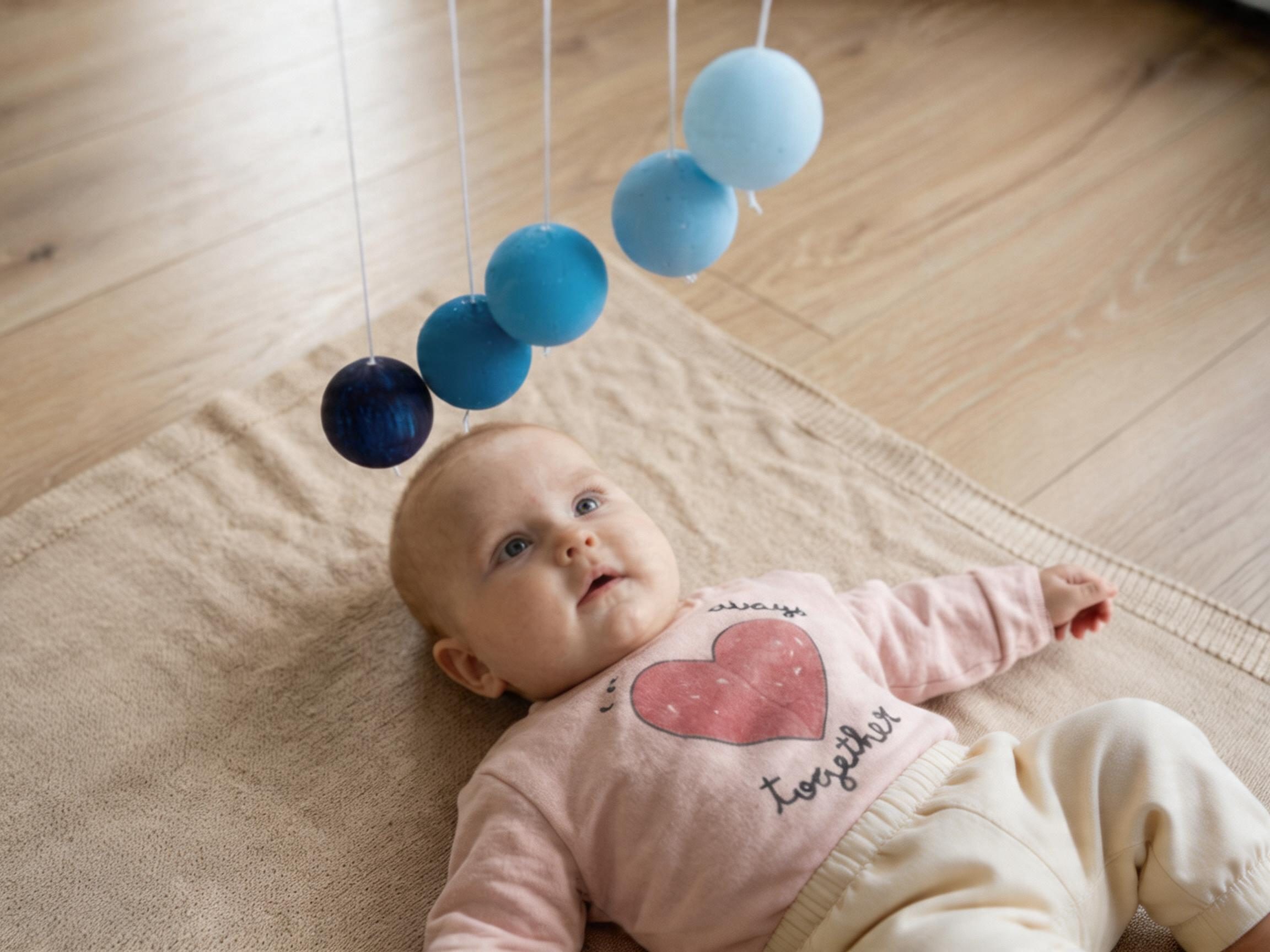
The Montessori Gobbi mobile consists of five spheres in the same colour, arranged from darkest to lightest and suspended on a diagonal line. The darkest sphere hangs lowest, as darker shades are generally easier to perceive at this stage.
What draws the baby’s attention is not the object itself, but the relationship between the spheres. The purpose of the Gobbi mobile is not to introduce colour, but to refine how colour is perceived — helping the baby distinguish subtle differences in shade within a single visual field.
At first, the gaze often settles on the darkest ball. Over time, as visual sensitivity refines, the lighter shades begin to emerge. This gradual discovery mirrors the way vision itself is developing: from broad perception toward finer differentiation.
The slow, almost imperceptible movement of the spheres adds another layer. It invites tracking without demanding it, allowing the eyes to follow, pause, and rest.
Parents often ask whether this visual mobile helps babies learn colours. Not yet. At this stage, babies are learning to distinguish subtle differences in shade rather than recognising colours in the way older children do. The Gobbi simply offers an opportunity to practise this emerging ability through repeated observation.
For a general overview of how a baby’s vision gradually develops in the first months, see Infant Vision Development: What Can Babies See? on HealthyChildren.org.
Subtlety instead of stimulation
The Montessori Gobbi mobile is sometimes described as “engaging,” but its strength lies in how little it asks of the baby.
There is no storyline, no sound, no variation in shape. The interest comes from sameness with difference — a quiet visual puzzle that unfolds slowly. This often allows longer periods of calm observation, not because the baby is entertained, but because the eyes are organising something meaningful.
This kind of attention is fragile. It grows best when the environment is calm, predictable, and free from competing input.
What the Gobbi corresponds to in visual development
By the time the Montessori Gobbi mobile is introduced, the baby’s visual system is no longer responding only to strong contrast or isolated shapes. Vision is beginning to organise itself around finer differences — variation within a single visual field rather than colour as we understand it.
At this stage, differences between light and dark become easier to register, and movement can be followed for slightly longer moments. The Gobbi appears at this period, offering a single, consistent form in which small variations can be noticed gradually, through repeated, unhurried looking.
The diagonal arrangement of the spheres allows the gaze to travel naturally, often settling first on the darkest shade before extending toward lighter ones. The gentle movement introduces change without disruption, allowing the eyes to follow, pause, and return.
What matters is not what the baby achieves, but the conditions being offered: clarity, consistency, and time. The Gobbi does not add stimulation. It corresponds to a moment when the visual system is ready to organise finer differences.
Movement, mirrors, and space
Knowing how to use the Gobbi mobile matters more than it may seem. Placement, distance, and simplicity all influence how clearly the baby can perceive these subtle differences.
Placed within the baby’s visual field, the Montessori Gobbi mobile works best when it has room to move gently. Small air currents or changes in light are enough to bring it to life. If the mobile is placed too far away or in a visually busy environment, the differences between the shades may not register at all — not because the baby is uninterested, but because the experience is not yet accessible.
Some families choose to place a floor mirror nearby. The reflection does not add complexity, but depth. It allows the baby to notice movement from another angle and begin to sense distance in a very early, intuitive way.
As with all visual materials at this stage, the role of the adult is primarily observational. Watching how long the baby looks, when attention fades, and when rest is needed matters more than adjusting or intervening.
A subtle shift in material
The visual principle of the Montessori Gobbi mobile remains the same: one colour, presented in gradual variation.
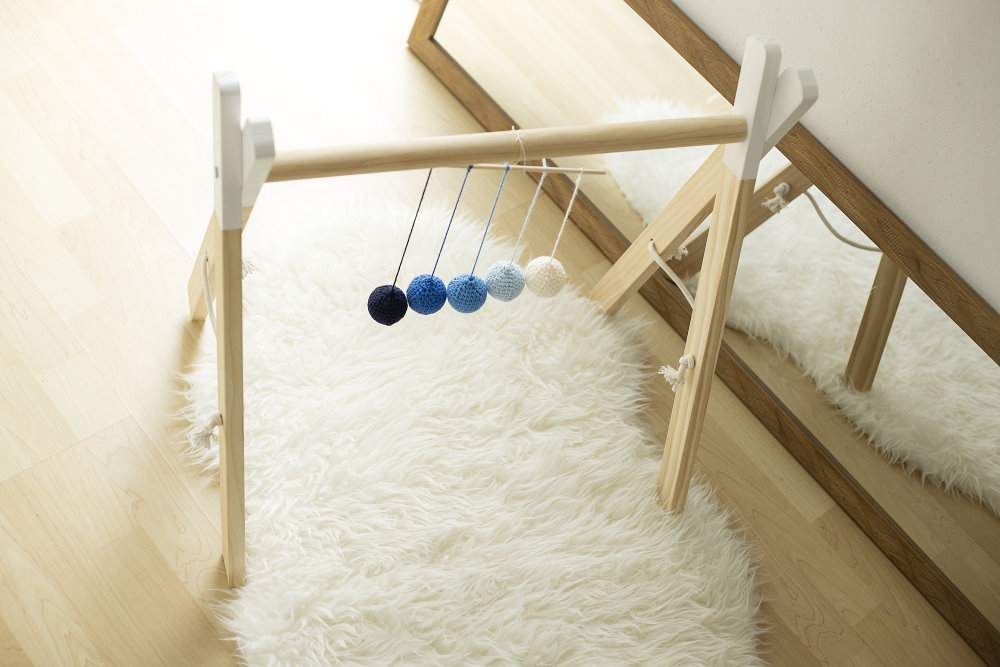
Traditionally, the Gobbi is made by wrapping coloured yarn around the spheres, creating soft transitions between shades. Variations such as pompom or painted versions follow the same principle, presenting a gradual progression of colour in different ways.
Families making DIY Montessori mobiles often find the Gobbi one of the most challenging mobiles, as creating a smooth colour progression requires careful preparation. For parents who prefer not to judge the shades themselves, both the painted DIY Gobbi mobile and the crocheted Gobbi mobile are designed around the same Montessori principle.
Regardless of the material, the purpose remains the same: supporting the baby’s ability to notice increasingly subtle differences in shade. As development continues, these small differences begin to matter more — especially as the baby begins preparing for reaching and interaction.
The crocheted Gobbi is explored in more depth in a separate article, where I look at how it supports this next stage of development.
When looking begins to change
Around this period, some babies also begin experimenting with reaching. This does not mean the mobile has lost its purpose. Looking often remains the primary work.
What matters is that the Montessori Gobbi mobile continues to be offered for observation, not interaction. If curiosity turns physical, it is simply a sign that development is moving forward, and the environment will soon need to change with it.
Final Thoughts
The Montessori Gobbi mobile is often remembered because it coincides with a noticeable deepening of attention. Not because it creates development, but because it meets the baby at a moment of quiet readiness. Its simplicity is deliberate. Its timing is precise. And its value is found in how quietly it respects the slow, layered way vision unfolds — one shade at a time.
The Gobbi doesn’t teach babies to see colour. It quietly accompanies the moment when colour begins to reveal itself.
See the full Montessori visual sequence: Munari → Octahedron → Gobbi → Dancers