
As a baby’s visual system becomes more organised, attention begins to hold for longer periods. Tracking is no longer brief and tentative. The eyes can now follow movement across a wider visual field with greater stability.
It is often at this stage that the Montessori Seagull mobile is introduced, as part of the wider Montessori visual mobile sequence. Like all Montessori visual mobiles, it is offered in alignment with how perception gradually organises itself in the early months.
The Seagull mobile does not increase complexity dramatically. Instead, it refines what has already been established: sustained tracking, horizontal movement, and visual balance.

What the Seagull Mobile Introduces
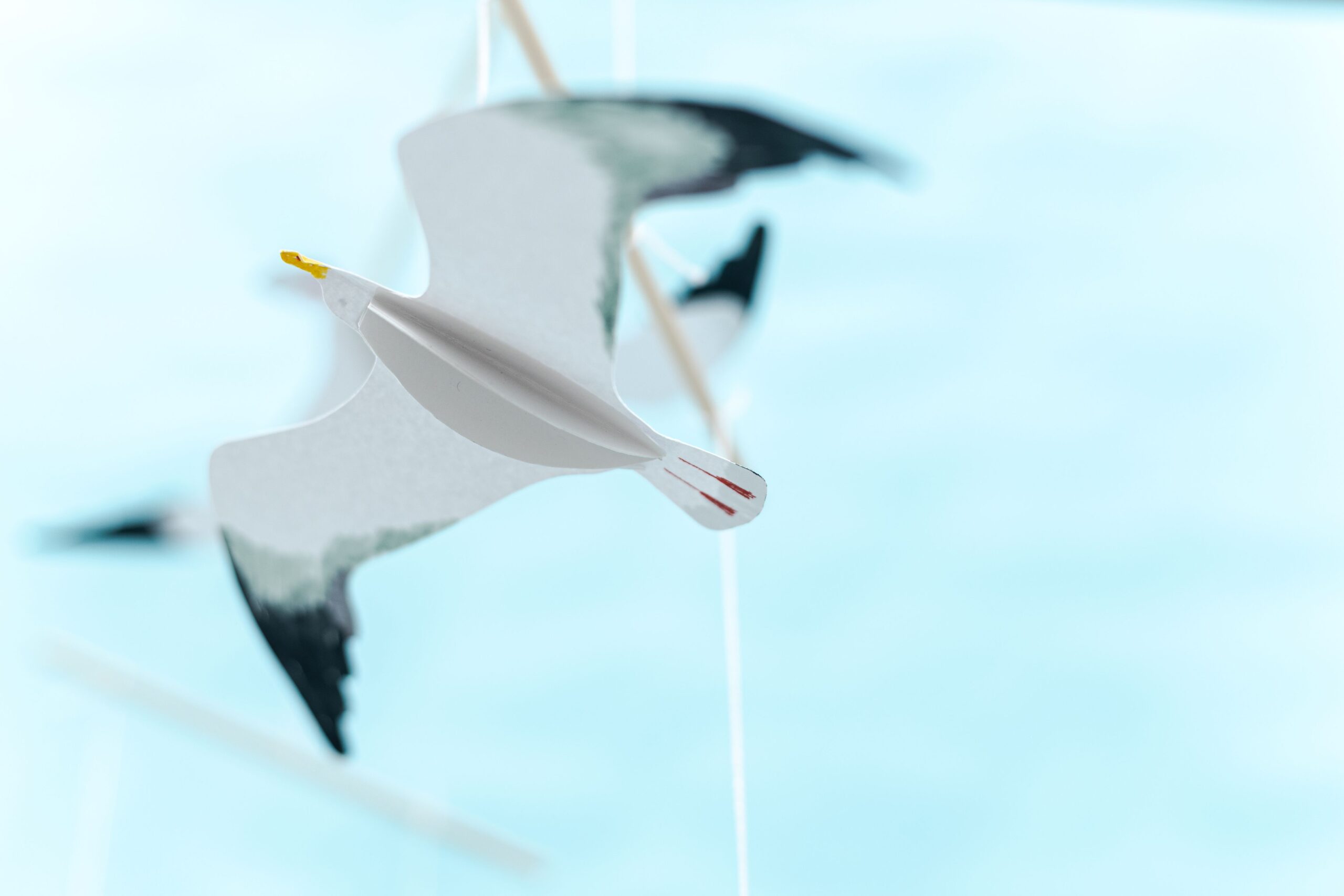
Unlike earlier mobiles that focus on contrast or colour gradation, the Seagull mobile emphasises glide.
The wings are extended.
The bodies are elongated.
The form travels horizontally through space.
This broader line of motion invites the eyes to follow steadily from one side to the other. The rhythm is calmer and more continuous than the directional lift introduced in the Montessori Swallows mobile.
Rather than presenting multiple focal points, the Seagull mobile creates visual flow. This is what makes the Seagull mobile a distinctive baby visual tracking mobile within the Montessori sequence.
Montessori materials traditionally favour realistic representations over fantasy in the early years. This preference supports clarity and helps the child build a coherent understanding of the world. You can read more about the Montessori approach to reality vs fantasy here.
Visual Stability Through Horizontal Movement
Horizontal tracking plays an important role in visual organisation. As babies observe the Seagull mobile, they may begin to:
- follow movement across a longer distance
- maintain focus for extended periods
- anticipate the return of a moving form
This does not happen through instruction. It emerges naturally through repeated exposure to slow, predictable motion.
The Seagull mobile offers just enough movement to invite attention — without pulling it in too many directions.
Contrast and Subtle Detail
Most Seagull mobiles retain clear contrast while introducing slightly softer visual transitions than earlier black-and-white designs.
Some versions include small colour accents, though these remain secondary to the overall form. The emphasis stays on clarity and proportion.
Nothing flashes.
Nothing spins mechanically.
Movement responds only to the air in the room.
This preserves the coherence of the visual field.
When It May Be Introduced
There is no fixed timeline. Many families notice that the Montessori Seagull mobile becomes appropriate after the Swallows or Whale mobile, once tracking feels steady and sustained.
Observation remains the guide.
If the baby’s gaze follows movement smoothly and returns repeatedly, the mobile is serving its purpose. If attention fades quickly, it may simply not be the right moment yet. For many parents, this is the point where the sequence feels more intuitive, as the role of each mobile becomes easier to recognise.
Placement and Use
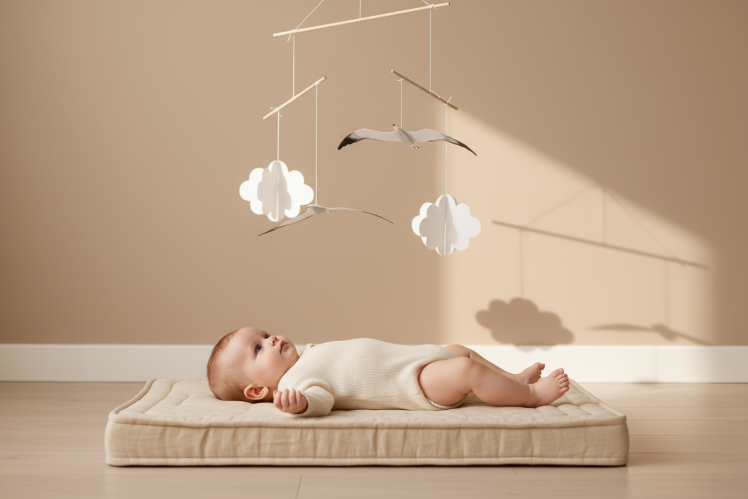
As with all Montessori visual mobiles:
- offer during calm, supervised awake time
- position above the chest, never within reach
- maintain at least 30 cm / 12 inches distance
- remove when attention fades
The Montessoir Seagull mobile remains a visual material. It is not meant for touching or interaction.
When reaching becomes consistent, tactile materials gradually take their place alongside visual observation.
How It Fits Within the Visual Sequence
The Seagull mobile continues the visual sequence introduced by earlier Montessori mobiles, extending tracking into sustained horizontal movement. You can see the full progression explained in the Timeline of the Montessori Mobiles.
Final Thoughts
The Montessori Seagull mobile offers stability through motion. It invites the eye to travel calmly across space, sustaining attention without overstimulation.
It does not demand performance.
It does not introduce noise.
It allows looking to continue evolving in its own rhythm.
For families who prefer to prepare materials at home, the Montessori Seagull mobile is available in DIY format through Montessori Edited, including digital instant-download patterns that allow you to prepare it without sourcing each element separately.
Further reading:
If you’d like to explore the wider context around visual attention and Montessori philosophy, these articles offer additional perspective:
- How Montessori Supports the Development of Concentration
A closer look at how calm, focused observation in the early months lays the groundwork for sustained attention. - Montessori Myth Busting
Addressing common misunderstandings about Montessori materials, stimulation, and early development.