
In the first months, play does not look like play in the usual sense. When looking at open-ended and closed-ended toys, the difference is not always obvious at first. A baby watches, pauses, moves their hands, misses, and tries again. Moments of focus appear briefly, then fade. From the outside, it can seem minimal. In reality, this is where coordination and perception begin.
Within Montessori, toys are not treated as entertainment. They are part of the environment that supports development. Some materials remain open, allowing the baby to explore freely. Others introduce a more defined experience, with a clear structure.
These are often described as open-ended and closed-ended toys.
Understanding the difference helps clarify why some materials hold a baby’s attention quietly, while others are used briefly or not at all.
What are open-ended toys?
Open-ended toys are materials without a fixed outcome. They do not suggest how they should be used, and they do not lead toward a specific result. Instead, they remain available for the baby to explore in their own way, according to their current abilities.
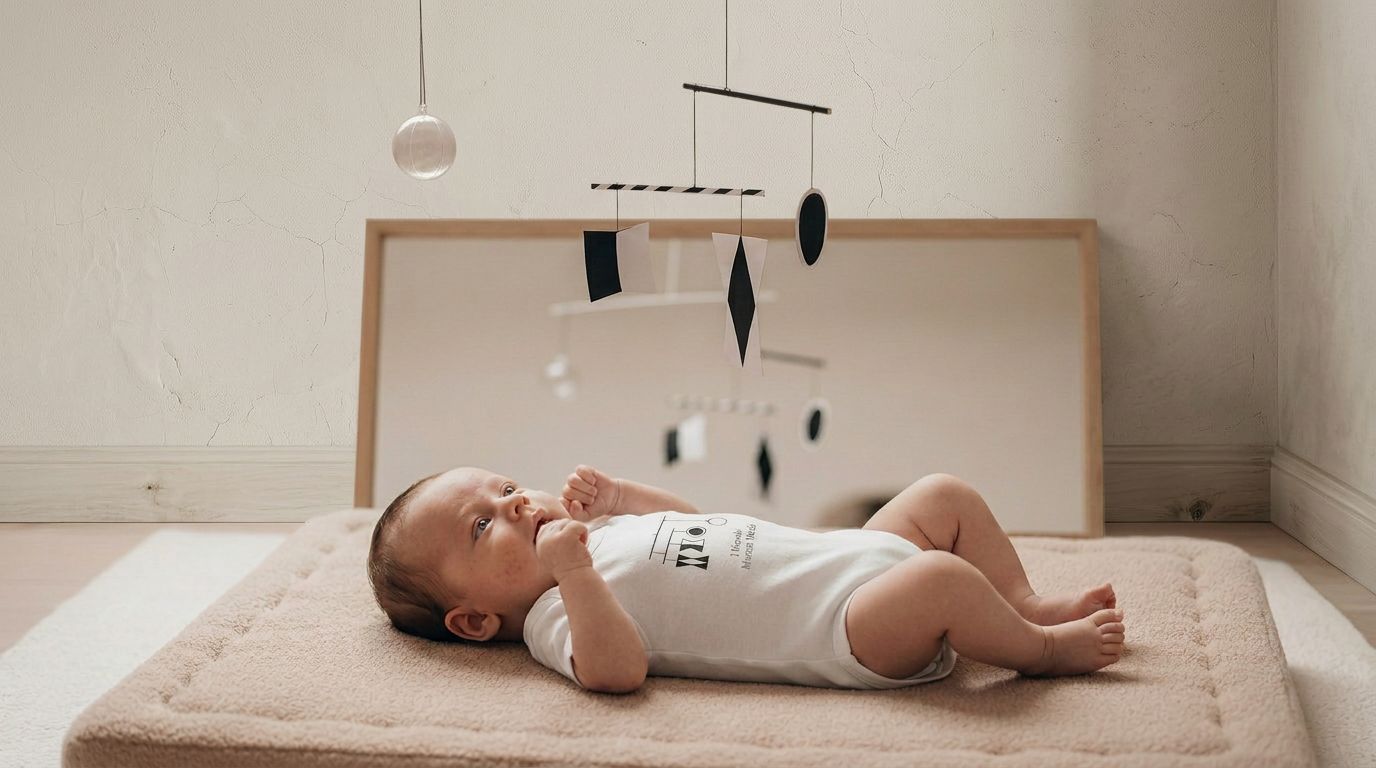
In the early months, this may look like a baby watching a mobile, slowly bringing their hands together, or grasping and releasing an object repeatedly. There is no clear beginning or end to the interaction. Materials such as the Montessori visual mobile sequence, the Montessori tactile materials, grasping beads, or simple sensory objects fall into this category. Their value lies in their openness. The same object can be returned to repeatedly, without needing to be used in a specific way.
Why open-ended materials matter in the beginning
Early development is built through repetition. A baby gradually learns how to focus their eyes, coordinate their hands, and respond to touch. These changes happen through small, repeated movements that often appear incomplete.
Open-ended materials support this process by remaining consistent. They do not interrupt or redirect the interaction. A visual mobile offers something clear to observe without requiring action. A tactile material introduces the possibility of contact. A simple object can be held, released, and rediscovered.
The material does not change. The interaction does. This is why these materials often remain engaging in the early months—they match what is accessible at this stage.
By providing materials that don’t have a single ‘right’ way to be used, we invite children to lead the experience. This approach is essential for unlocking children’s potential through open-ended play, as it encourages them to experiment, problem-solve, and develop executive function at their own pace.
What are closed-ended toys?
Closed-ended toys are designed with a specific purpose. They invite a defined action and usually lead to a predictable result. The structure is built into the material itself.
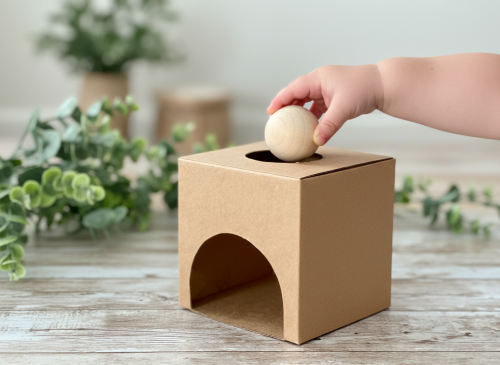
For babies, this may include materials such as an object permanence box, where an object is placed inside, disappears, and then returns. Within the broader idea of open-ended and closed-ended toys, these materials represent the more structured end of the spectrum. These materials narrow the range of possible interactions. Instead of open exploration, they introduce a simple sequence.
When closed-ended toys begin to make sense
Closed-ended materials tend to become meaningful later, when movements are more controlled. At this stage, actions begin to repeat intentionally rather than accidentally. Objects are held for longer, and simple sequences start to hold attention.
This is when a more structured material becomes accessible. Placing an object into a container, watching it disappear and reappear, or repeating a simple action begins to form a connection between movement and result.
Before this stage, the same material may not hold attention in a meaningful way.
Two different roles, at different moments
Open-ended and closed-ended toys are not alternatives. They reflect different stages within development. In the beginning, the baby needs openness. Observation, repetition, and gradual coordination form the foundation. There is no expectation of completing an action.
As control develops, more defined interactions begin to appear. Structured materials introduce clarity and sequence.
Open-ended exploration continues alongside this. It does not disappear, but remains part of the environment as development progresses.
Seeing the difference in everyday play
The distinction between open-ended and closed-ended toys becomes visible through observation. With open-ended materials, engagement is often continuous. A movement is repeated, paused, and repeated again, without a clear end point. With closed-ended materials, the interaction tends to have a beginning and an end. An action is completed, followed by a pause, and then either repeated or left.
These patterns emerge naturally, reflecting both the material and the stage of development.
How these materials appear over time
In the earliest weeks, visual materials support observation. High-contrast mobiles offer something the baby can focus on and follow. As coordination develops, tactile materials begin to invite reaching and grasping. Movements become more directed, though still inconsistent.
Both of these stages are open-ended. There is no result to achieve—only repetition and gradual refinement.
Closed-ended materials tend to appear later, once the baby can act with more control and intention. At this point, simple structured interactions begin to hold meaning.
The transition is gradual.
Final thoughts
In early development, the value of a material lies in how well it matches the child. Open-ended materials support the beginning—quiet observation, repeated movement, and gradual coordination. Closed-ended materials introduce structure once those movements become more intentional.
Together, they form part of an environment that responds to development as it unfolds—without needing to add more than what is already meaningful.
Further Reading
If you’d like to explore how these ideas show up in everyday life, these articles offer a more practical view:
- Flying with a baby – practical tips to make the journey easier
- Montessori baby play – is there such a thing?