
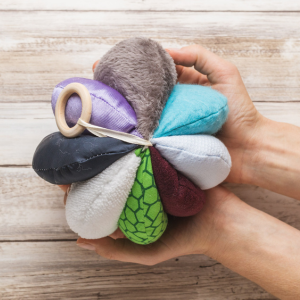
Some materials seem to invite interaction immediately, without explanation or demonstration. The fabric sensory ball is one of these. Its soft structure, varied textures, and easy-to-grasp shape naturally draw the baby’s attention, often prompting them to reach for it as soon as they notice it.
What makes it effective is not complexity, but clarity. It offers something to hold, something to feel, and something that responds to movement, allowing the baby to begin connecting action with experience in a direct and meaningful way.
When to introduce the fabric sensory ball
The fabric sensory ball can be introduced around 2.5–3 months, when the baby begins to develop more intentional movement. By now, the baby may already be familiar with materials such as the Montessori puzzle ball, which support early grasping and coordination.
At this stage, the hands are starting to open, reach, and explore, and earlier visual experiences have already supported attention and tracking. The sensory ball builds on this foundation by inviting the baby to act rather than simply observe.
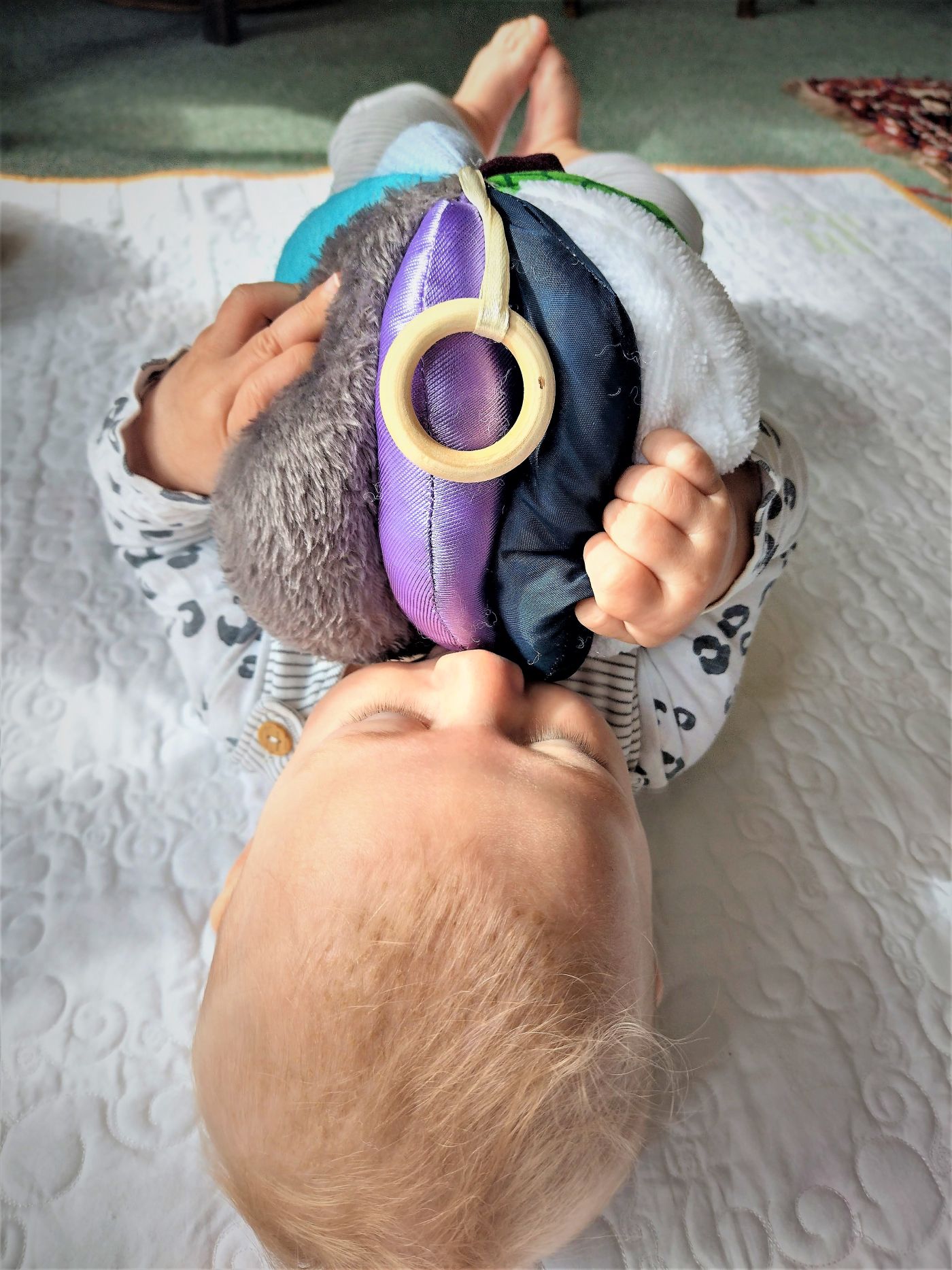
Because of its soft, segmented structure, it is easier to grasp than many other objects. This early success encourages repetition, and through repetition, coordination and confidence begin to develop naturally. The baby is not just holding an object, but refining movement through repeated attempts.
What makes the fabric sensory ball so engaging
The effectiveness of the fabric sensory ball lies in how it offers variation without becoming overwhelming. Each segment introduces a slightly different texture, while the overall shape allows the baby to hold and manipulate it with ease. As the baby turns the ball in their hands or watches it move, they begin to experience subtle differences in touch, weight, and movement.
These interactions form part of early sensory learning, where the baby gradually builds an understanding of the world through repeated, focused experiences. The material does not attempt to do too much at once, and this simplicity allows attention to settle and remain engaged for longer.
Supporting early movement
One of the key strengths of the fabric sensory ball is how naturally it supports movement. Because it is easy to grasp and does not roll too far away, it creates opportunities for repeated interaction. When placed just out of reach, it can encourage the baby to stretch, reach, and eventually begin to roll.
These small efforts are significant. They help the baby begin to understand how their body can be used intentionally, and how their actions influence what happens around them. As early motor development progresses, these interactions become the foundation for more controlled and purposeful movements.
How to use the fabric sensory ball at different stages
In the early months, the ball can be offered while the baby is lying on their back or during tummy time, allowing them to explore it at their own pace. At this stage, the focus is on grasping, holding, and bringing the object closer for observation.
As the baby begins to roll, placing the ball slightly out of reach can gently invite movement without forcing it. Later, when the baby is able to sit, the ball can be rolled in front of them, encouraging coordination and visual tracking from a new position. As development continues, the same material supports more complex actions, such as passing between hands, dropping intentionally, or following it while crawling.
Simplicity and clarity
Although the fabric sensory ball offers a range of sensory experiences, its effectiveness lies in how clearly these experiences are presented. The baby is not faced with multiple competing stimuli, but rather a material that allows them to focus on one aspect at a time, whether that is texture, movement, or coordination.
This clarity supports concentration and allows the baby to explore each experience more deeply. When the material is simple enough to follow, attention can settle and develop without unnecessary distraction. This works best when the ball is offered within a calm, prepared environment where the baby can focus without distraction.
Safety and supervision
As with all materials offered to babies, the fabric sensory ball should be used under supervision. If it includes additional elements such as bells, ribbons, or rings, it is important to ensure that these are securely attached and regularly checked.
The material should be durable enough to withstand repeated use, especially as it will be explored through both hands and mouth. The aim is to provide a safe object that allows exploration without introducing unnecessary risk.
A material that leads to further exploration
The fabric sensory ball often becomes a starting point for later sensory experiences. Once the baby becomes more comfortable handling objects and noticing differences in texture and movement, materials such as sensory bean bags or simple objects in a treasure basket can extend this exploration further.
In this sense, the ball is not an isolated object, but part of a natural progression, where each material builds on the experiences of the previous one. As the child grows, the same material continues to offer new possibilities, adapting naturally to each stage of development.
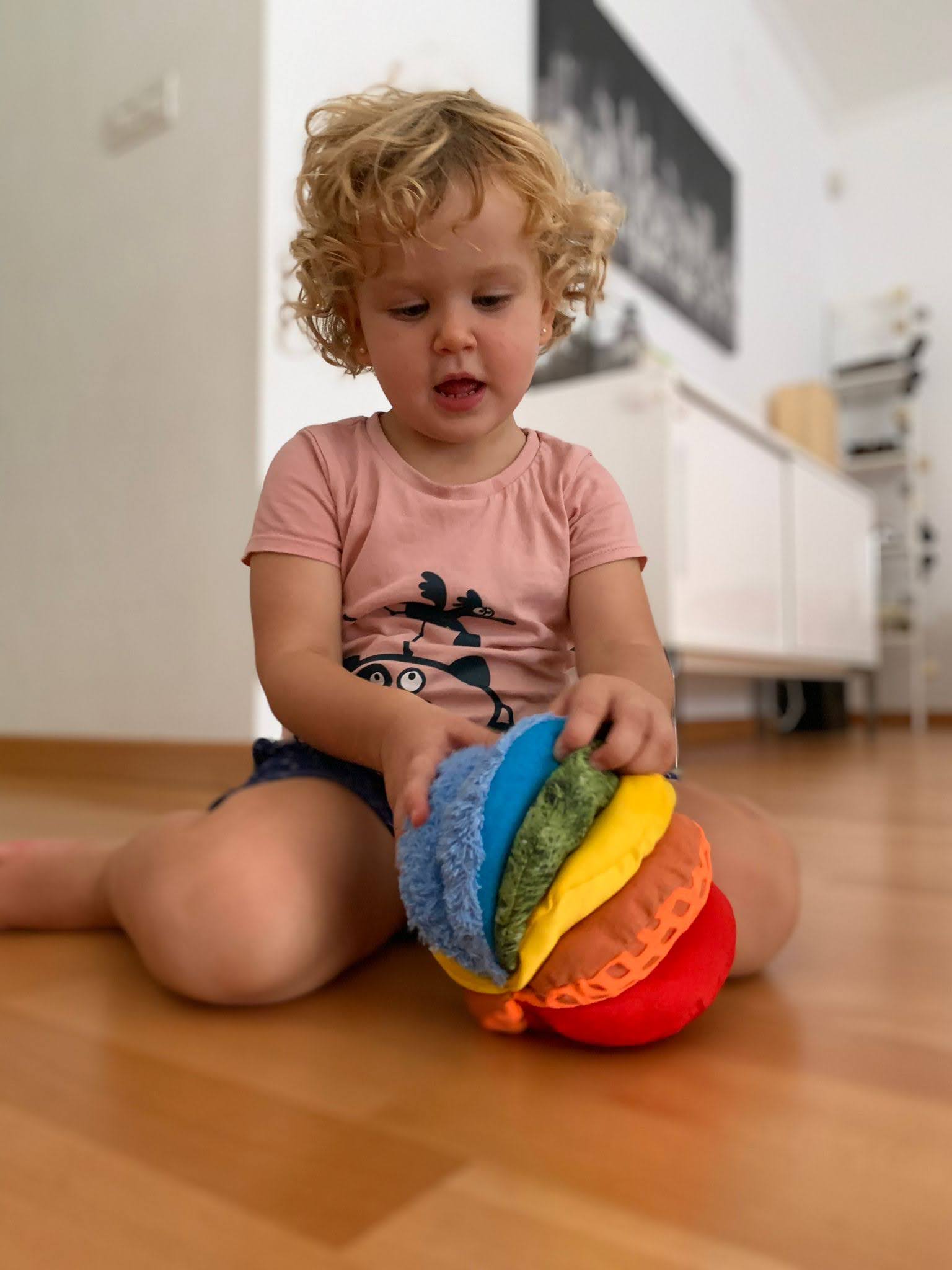
Once the baby becomes more comfortable handling different textures, materials such as sensory bean bags can extend this exploration further.
Final Thoughts
The fabric sensory ball is a simple material that offers a rich range of experiences. Through grasping, movement, and tactile exploration, it supports coordination, awareness, and concentration. Its strength lies not in how much it does, but in how clearly it allows the baby to connect action with experience.
When offered at the right moment, it becomes a natural and lasting part of early development.
If you decide to make one yourself, the process can be just as meaningful as the finished object. There is something different about offering a material you’ve prepared with your own hands, knowing exactly how it was made and how it will be used.
Further Reading
If you’d like to explore how sensory materials fit into your baby’s development and how to approach them more intentionally, these articles may also be helpful:
- Treasure Basket Play
How a variety of objects supports open-ended exploration and sensory discovery. - What to Do Before You Buy Montessori Baby Materials
Why observation matters more than buying more, and how to choose materials with intention.