
The Montessori Octahedron mobile is the second mobile in the Montessori visual mobile sequence, typically introduced around 4–6 weeks, when babies begin responding more clearly to colour. For many parents, it marks the first noticeable shift from high-contrast vision towards a richer visual world. The baby’s gaze lingers differently. The eyes begin to settle on colour as well as form, as if something new is starting to register.
As the first Montessori mobile to introduce clear, distinct primary colours, the Octahedron builds on the visual foundations laid by the first mobile in the sequence, the Munari. Rather than overwhelming the baby with more stimulation, it gently expands the visual experience, offering colour, light, and movement in a way that remains calm and accessible.
At this stage, it’s easy to assume that high-contrast materials are still enough. Yet this is often the moment when the visual environment begins to evolve. The Octahedron doesn’t ask the baby to do anything new. It simply reflects the quiet changes already taking place in their developing vision.
What the Octahedron mobile introduces
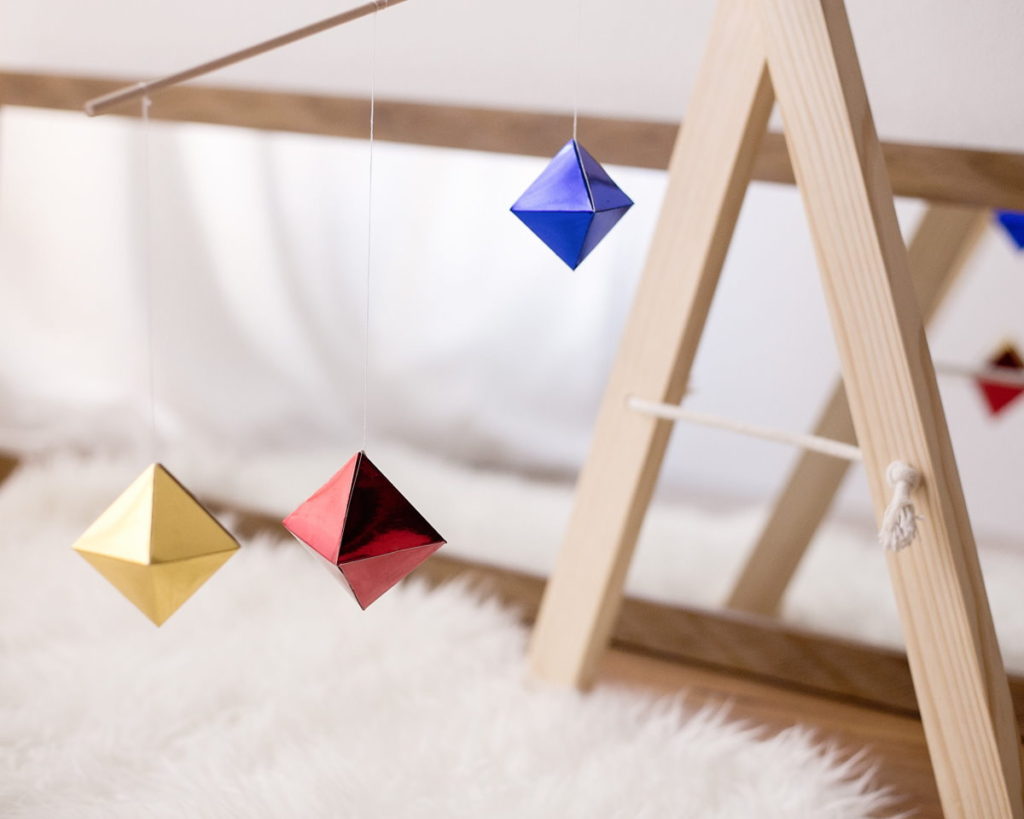
The Montessori Octahedron mobile consists of three geometric solids in the primary colours: red, yellow, and blue. Each is constructed from equilateral triangles, creating a clear, balanced form. As the infant’s visual system matures, their interest shifts from high-contrast patterns to primary colors and geometric depth. Understanding these infant vision milestones helps us realize why the Octahedron’s reflective surfaces and three-dimensional shapes are so engaging at this specific stage of development.
At this stage of visual development, babies begin to notice differences more reliably. If colour is introduced too abruptly or in a visually overwhelming way, babies may disengage just as quickly as they would with overly complex patterns earlier on.
Red is generally perceived most easily, followed by yellow and then blue. The Octahedron reflects this progression through both colour choice and visual weight, offering variation while remaining structured and predictable. Despite its simplicity, every element is intentional. The form, the spacing, and the gentle reflectivity are designed to remain visually accessible rather than stimulating.
Unlike the Munari or Gobbi mobiles, the Octahedron is named after its geometric shape rather than a person. The octahedron is a solid made from eight equilateral triangles, giving the mobile its distinctive balanced appearance.
You can read more about how the visual mobiles follow one another in sequence in this overview.
Colour, light, and movement
Unlike the Munari, which relies on contrast alone, the Montessori Octahedron mobile introduces coloured forms and reflection in a measured way. The surfaces catch ambient light softly, creating small changes as the mobile responds to the air in the room.
The movement is slow and irregular, never mechanical. This allows the baby to notice shifts in colour and position without becoming visually overloaded — something that faster or more constant movement tends to disrupt. Some babies will watch for several minutes; others may glance briefly and then look away. Both responses are typical.
At this point, observation remains the focus. The mobile is not intended to be touched or reached for.
Parents often ask whether the Octahedron mobile helps babies recognise visual differences. Not exactly. Rather than teaching colour, it offers babies repeated opportunities to observe colours that their developing vision is becoming ready to notice. Like the other Montessori visual mobiles, it responds to development that is already unfolding rather than creating it.

The reflective, lightweight elements move gently with minimal air currents, creating long moments of calm focus.
What the baby may notice at this stage
During this period, a baby’s attention may move between the different forms, colours, and positions of the mobile. The eyes may follow slow changes for brief moments, pause, and then return. These shifts happen naturally through observation, without encouragement or repetition.
There is no need to encourage longer looking or repeated sessions. The baby will disengage when they have had enough — and this is part of the process, not something that needs to be extended or corrected.
A note on variations
Some Montessori environments use a variation of the Octahedron mobile in which all three shapes are the same size but are hung at different heights, with red lowest, yellow in the middle, and blue highest.
Both versions follow the same developmental logic. The choice between them is largely aesthetic, and either can be appropriate when offered with the same calm intention.
Placement and use in the home
The Montessori Octahedron mobile is typically offered in the baby’s movement area, positioned so it can be observed comfortably within the baby’s natural visual field. If placed too far away or outside this range, the colours and depth may not register clearly yet.
It is best introduced when the baby is calm and alert, in a quiet, uncluttered space. At this stage, observation alone is sufficient. Touching or reaching is not expected, and the mobile remains a visual material rather than a tactile one.
See the full guide: How to Hang Montessori Visual Mobiles Safely
Making a Montessori Octahedron mobile
Many parents are surprised that the Octahedron is often the easiest Montessori mobile to make, making it a popular first DIY project.
For those who would rather focus on making the mobile than sourcing materials, both the DIY Octahedron mobile kit and the instant download mobile pattern bring everything together in a clear, simple format.
The making process itself does not affect the developmental role of the mobile; what matters is the clarity and balance of the finished form.

Final thoughts
The Montessori Octahedron mobile marks a quiet shift in visual experience. doesn’t encourage babies to seek more stimulation. It simply reflects the quiet changes already taking place in their developing vision. Like every Montessori mobile, its role is not to create development, but to accompany it.
As the baby’s perception continues to develop, colour gives way to something more subtle — tonal variation and depth. This is where the next mobile in the sequence begins.
See the full Montessori visual sequence: Munari → Octahedron → Gobbi → Dancers