
In the first months of life, a baby’s experience of the world is still taking shape. Vision is developing, movement is gradual, and attention tends to last only for short periods.
At the same time, many baby toys are designed to attract attention quickly, often combining colour, sound, and movement in a single object.
The Montessori approach takes a quieter direction. Instead of adding more stimulation, it focuses on offering materials that reflect what the baby is ready to perceive and explore at each stage. The aim is not to entertain, but to support the gradual organisation of movement, attention, and perception.
In this article, we’ll look at some common baby toys and how Montessori materials approach the same developmental needs in a simpler, more structured way. These Montessori alternatives offer a way to support development without adding unnecessary stimulation.
What makes a baby toy Montessori?
For babies, Montessori materials are not defined by how they look, but by how closely they follow development. In the early months, a suitable material responds to the baby’s current abilities and presents one main quality at a time. This makes it possible for the baby to remain with the experience long enough to begin understanding it.
Development moves gradually from seeing, to moving, and then to touching and grasping. Materials follow this progression, rather than trying to introduce multiple elements at once. When the environment reflects this sequence, the baby can engage more calmly and with greater focus.
Montessori Alternatives to Popular Baby Toys
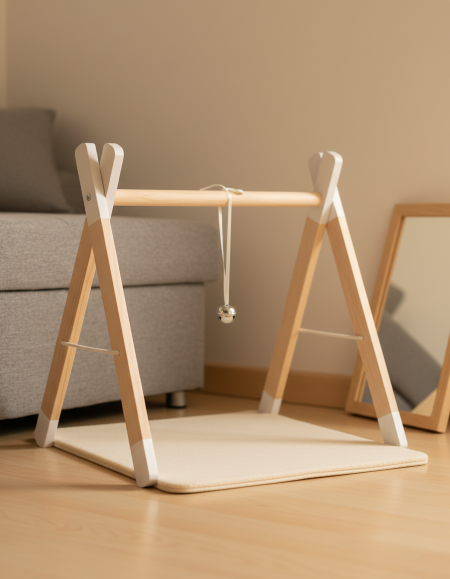
Baby gym vs a Montessori movement area
A typical baby gym often combines several elements at once—objects overhead, colours, textures, sometimes sound. While these can be visually engaging, they can also divide the baby’s attention.
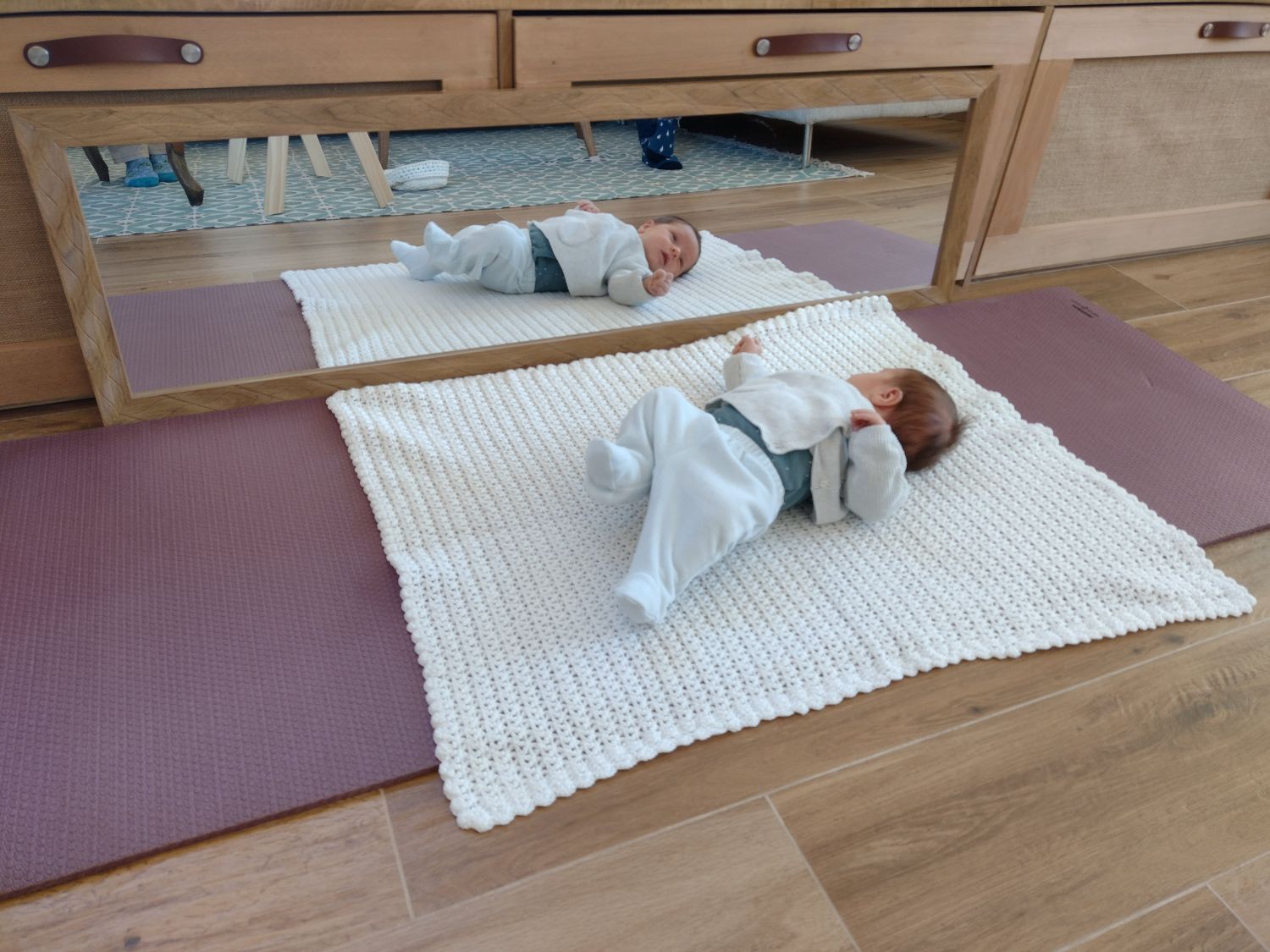
A Montessori movement area is more reduced. It usually includes a firm movement mat and a low wall mirror, with other elements introduced separately. This creates a space where the baby can move freely without interruption. Over time, the baby may begin to notice how movement is reflected in the mirror, gradually building coordination and awareness of the body.
Small toy mirrors vs a wall mirror
Small mirrors are often designed to attract attention, sometimes surrounded by colours or attached toys. In this case, the reflection becomes just one of many elements competing for the baby’s focus.
A wall mirror, placed at the baby’s level, offers a more stable experience. It remains in the same position and allows the baby to return to it over time. Without additional visual elements, the baby can focus on the relationship between movement and reflection, which supports early organisation of movement.
Decorative mobiles vs Montessori visual mobiles
Many baby mobiles are designed with visual variety in mind. Montessori mobiles are introduced differently, following a developmental sequence that begins with simplicity and gradually increases in complexity.
The first in this sequence is the Munari mobile, which offers strong contrast and simple forms suitable from birth. From there, colour, depth, and movement are introduced step by step.
Rather than being changed frequently, each mobile remains in place long enough for the baby to observe it with increasing attention. If you prefer a ready-to-use option, a complete set that follows this sequence can make it easier to maintain this progression at home.
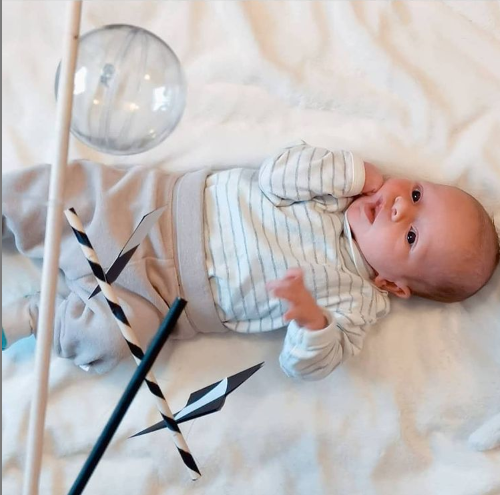
If you prefer not to source each mobile separately, a complete DIY set that follows this developmental sequence can make it easier to introduce them at the right time.
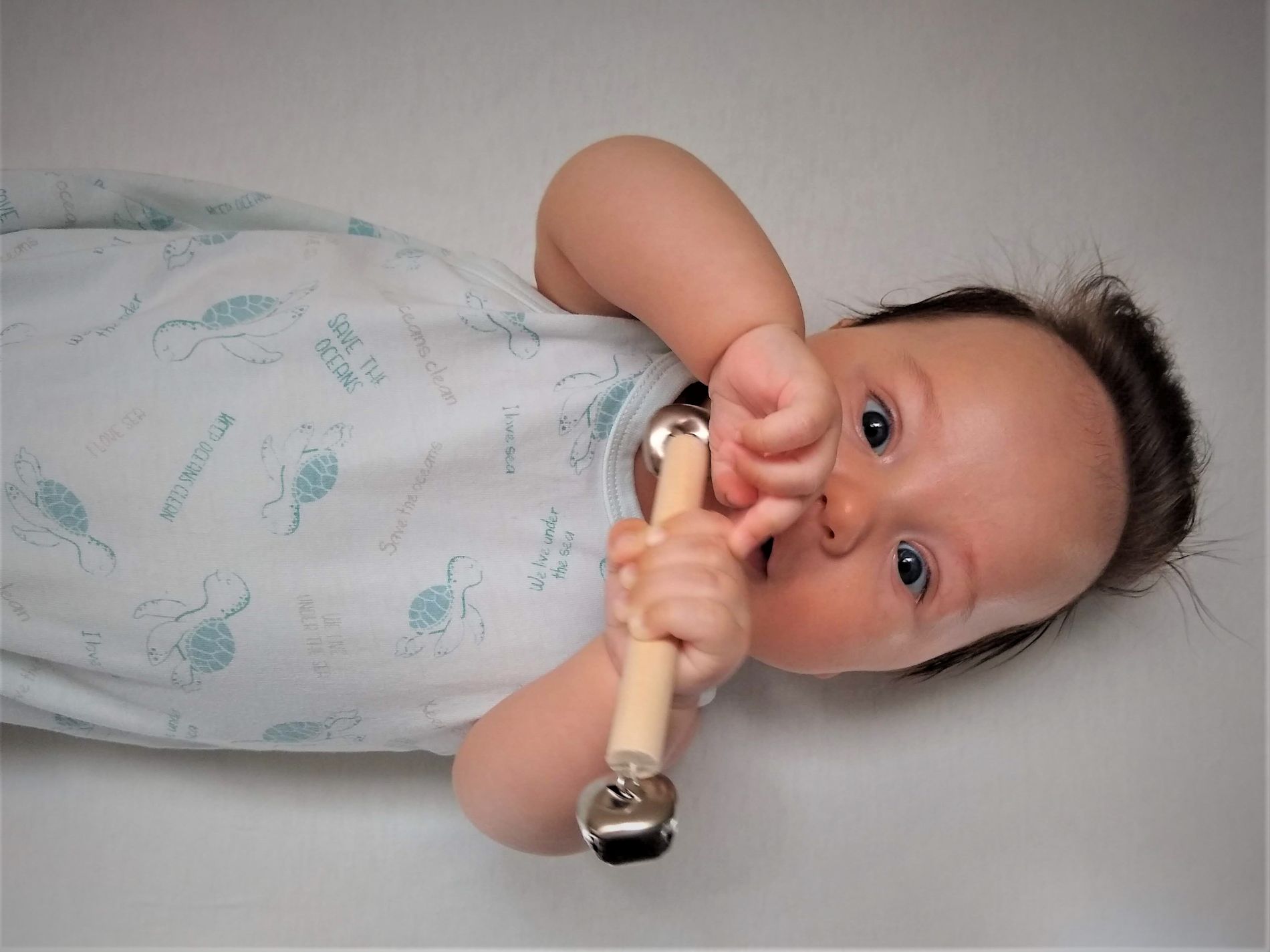
Plastic rattles vs a Montessori bell rattle
Rattles are often one of the first objects a baby encounters. Many combine different textures, colours, and sounds in one object.
A Montessori bell rattle simplifies this experience. When the baby moves their hand, a single clear sound follows. This makes it easier to begin noticing the connection between movement and sound, and to repeat that movement with increasing control. Over time, this supports more controlled and intentional movement.
Plastic sensory balls vs the Montessori puzzle ball
Many sensory balls are designed with different colours, patterns, or raised elements, which can make them visually and superficially tactile. However, despite these variations, the material itself is often the same throughout. The surface remains uniformly plastic, which offers limited contrast for the developing tactile sense.
In the early months, babies are not only seeing but also beginning to build sensitivity through their hands. Subtle differences in texture, weight, and material become meaningful. When these differences are minimal, the experience tends to remain less defined.
Size and shape also play a role. Many plastic balls are relatively large and smooth, which can make them difficult for small hands to grasp. They are easy to push, but harder to hold.
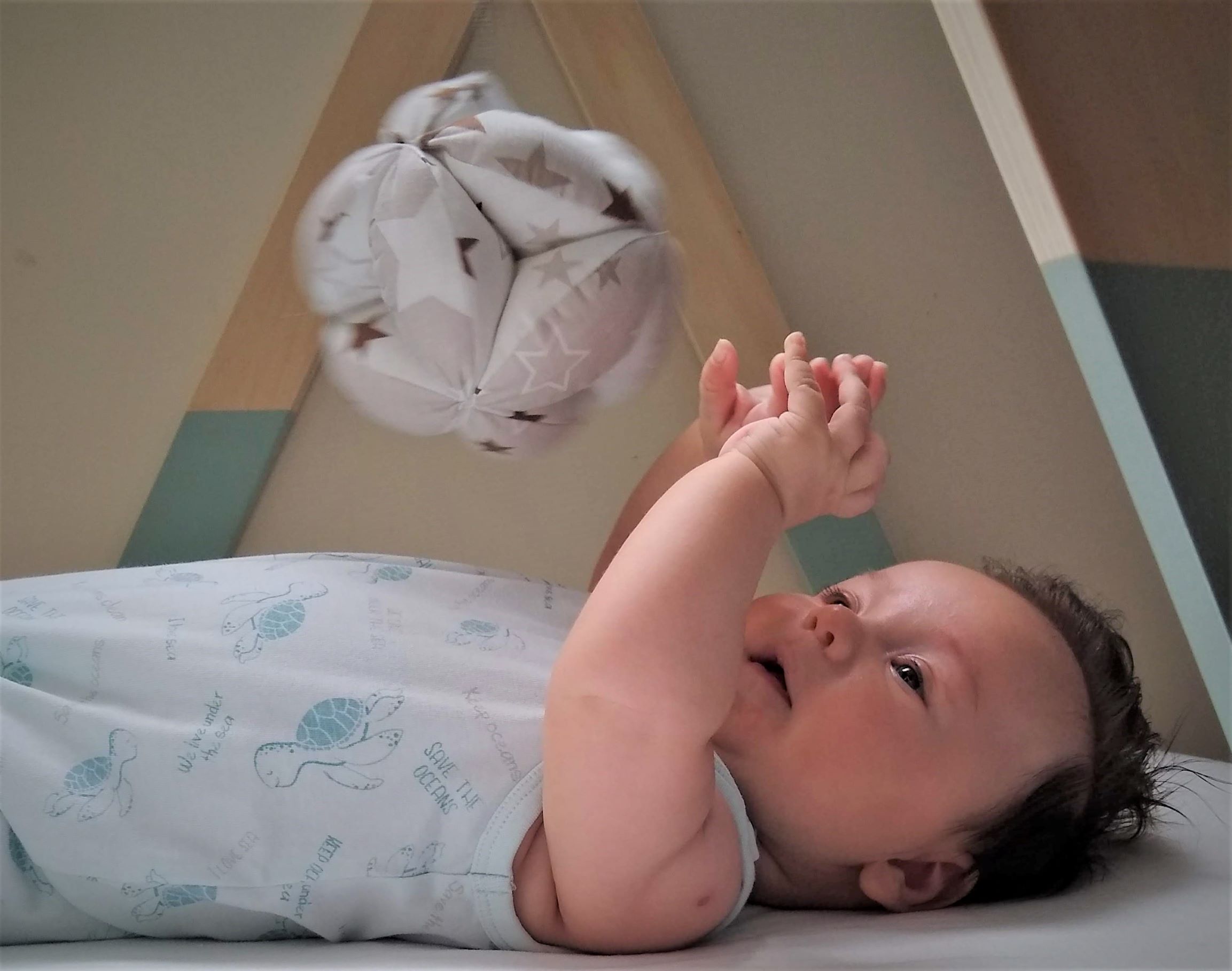
The Montessori puzzle ball approaches this differently. Its segmented structure creates natural openings for the baby’s fingers, making it easier to grasp from multiple angles. Rather than slipping away, it invites repeated attempts at holding and adjusting grip. When it moves, it still rolls, but more slowly and over shorter distances. This makes it easier for the baby to follow and eventually reach, supporting early movement as coordination develops.
This becomes particularly relevant as the baby begins to bring objects toward the centre of the body. A structured puzzle ball, especially one that was made by you, designed for small hands can support this stage in a simple, accessible way.
Plastic teethers vs simple teething rings
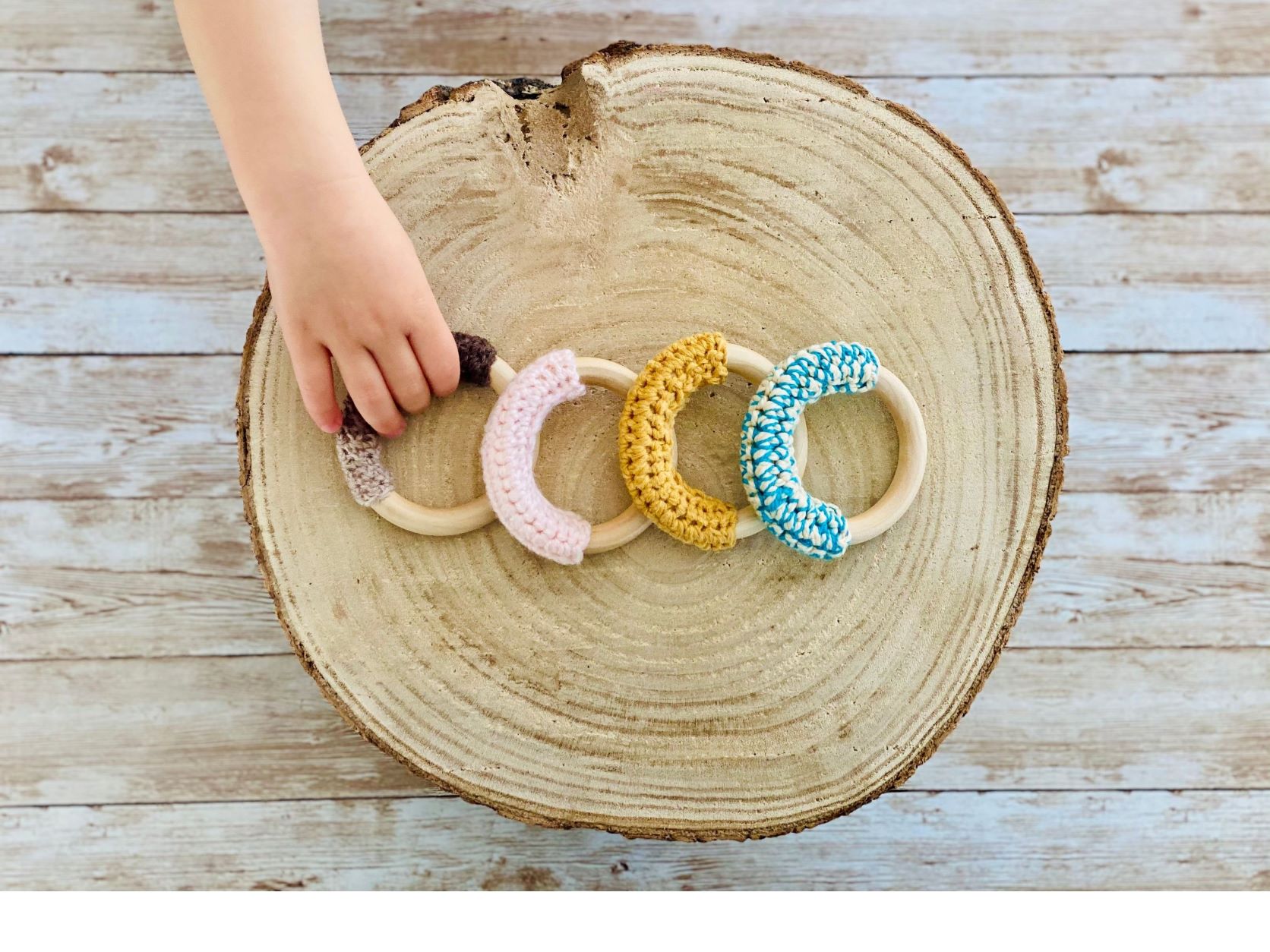
Teething toys are often visually busy, but visual complexity is not the main need at this stage. A simple wooden or fabric teething ring offers a more focused experience. The baby can explore texture, weight, and movement without additional elements competing for attention.
The focus remains on holding, bringing the object to the mouth, and gradually refining grip.
Some variations, such as a ring partially covered in crochet, introduce a subtle additional element. The contrast between the smooth wood and the softer textile creates a clear difference in texture, while the added colour can offer a gentle visual point of interest without becoming overwhelming.
The contrast between the smooth wood and the softer textile creates a clear difference in texture, while the added colour can offer a gentle visual point of interest without becoming overwhelming.
Why simplicity matters in the early months
In the Montessori approach, simplicity is not about limiting the baby’s experience, but about making it clearer. When a material presents one quality at a time, the baby can return to it, repeat actions, and gradually build understanding.
This repetition supports coordination, attention, and confidence in movement. Rather than moving quickly from one stimulus to another, the baby is able to remain with an experience and explore it more deeply.
These kinds of Montessori alternatives focus on one aspect of development at a time, allowing the baby to engage more clearly.
Introducing Montessori alternatives
There is no need to replace everything at once. In many cases, it begins with simplifying the environment—offering fewer materials at a time, allowing space for movement, and observing what the baby returns to.
From there, Montessori alternatives can be introduced gradually, following the baby’s development rather than a fixed schedule.
Safety considerations
All materials should be used with attention to safety. Babies should always be supervised, and materials should match their developmental stage. Mobiles should be securely installed and kept out of reach, and all items should be checked regularly for wear.
Montessori Alternatives FAQ
Do Montessori toys need to be made from natural materials?
Natural materials are often used because they offer clear sensory feedback, but the key factor is simplicity and suitability for the baby’s stage.
Will my baby get bored with simpler toys?
When a material matches development, babies often return to it repeatedly, exploring it in more depth over time.
How many toys does a baby need?
In the early months, a small number of carefully chosen materials is usually enough.
Final thoughts
Montessori alternatives are not about replacing one type of toy with another, but about aligning the environment with how development unfolds in the early months.
When materials match the baby’s abilities, the experience becomes calmer and more coherent, supporting observation, movement, and gradual coordination.
Further Reading
If you’re interested in how babies explore objects and materials during the first year, these articles may also be helpful:
- Montessori Baby Routine
How daily rhythm, environment, and simple materials work together to support calm development in the early months. - Montessori vs Traditional Baby Toys
A closer look at how different types of materials influence attention, movement, and early exploration.