
The Montessori crocheted Gobbi mobile often appears at a developmental moment that is easy to overlook in the first months.
Positioned between the earlier visual mobiles and the later tactile materials, the crocheted Gobbi supports a subtle transition where visual attention remains primary while the body begins responding more noticeably through movement. Its role is not to introduce touch or accelerate motor development, but to acknowledge the growing relationship between seeing and sensing movement, making it a quiet bridge within the Montessori visual mobile sequence.
Why parents are often unsure about the crocheted Gobbi
Parents frequently pause when they encounter the Montessori crocheted Gobbi mobile. Is it still visual, or is it already tactile? Does it belong with the classic Gobbi, or does it signal the beginning of grasping and touch?
The uncertainty usually comes from its material. Crochet looks soft. Softness is often associated with hands rather than eyes. But this assumption can blur the real purpose of the crocheted Gobbi and place it either too early or too late in the baby’s environment.
The Montessori crocheted Gobbi mobile remains primarily visual.
It stays suspended like the classic Gobbi. It still supports visual tracking, colour discrimination, and sustained attention. What changes is not the developmental purpose itself, but the way the mobile responds more softly within the environment.
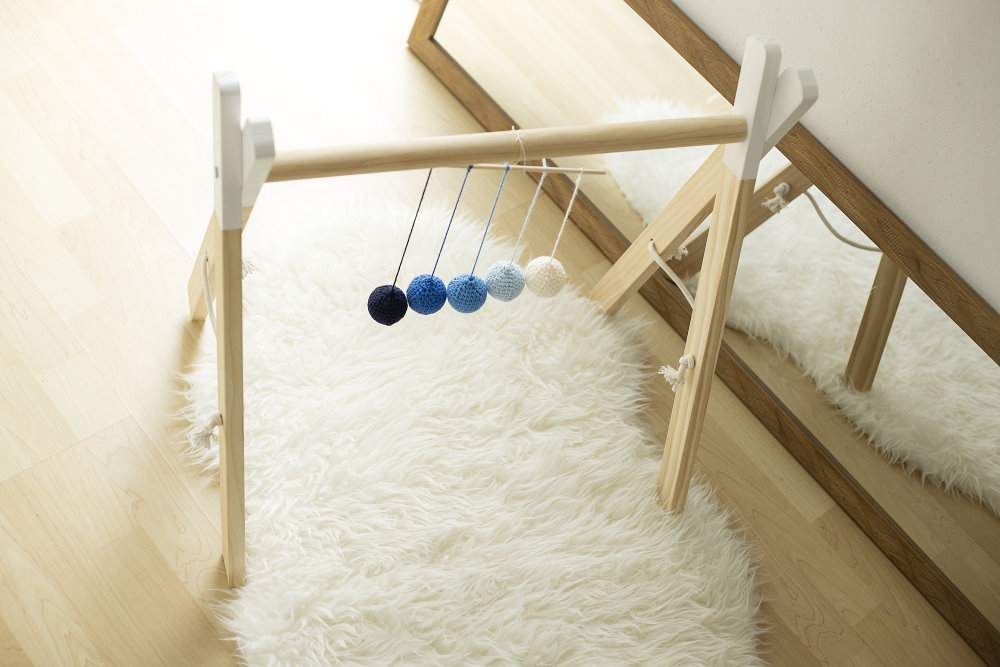
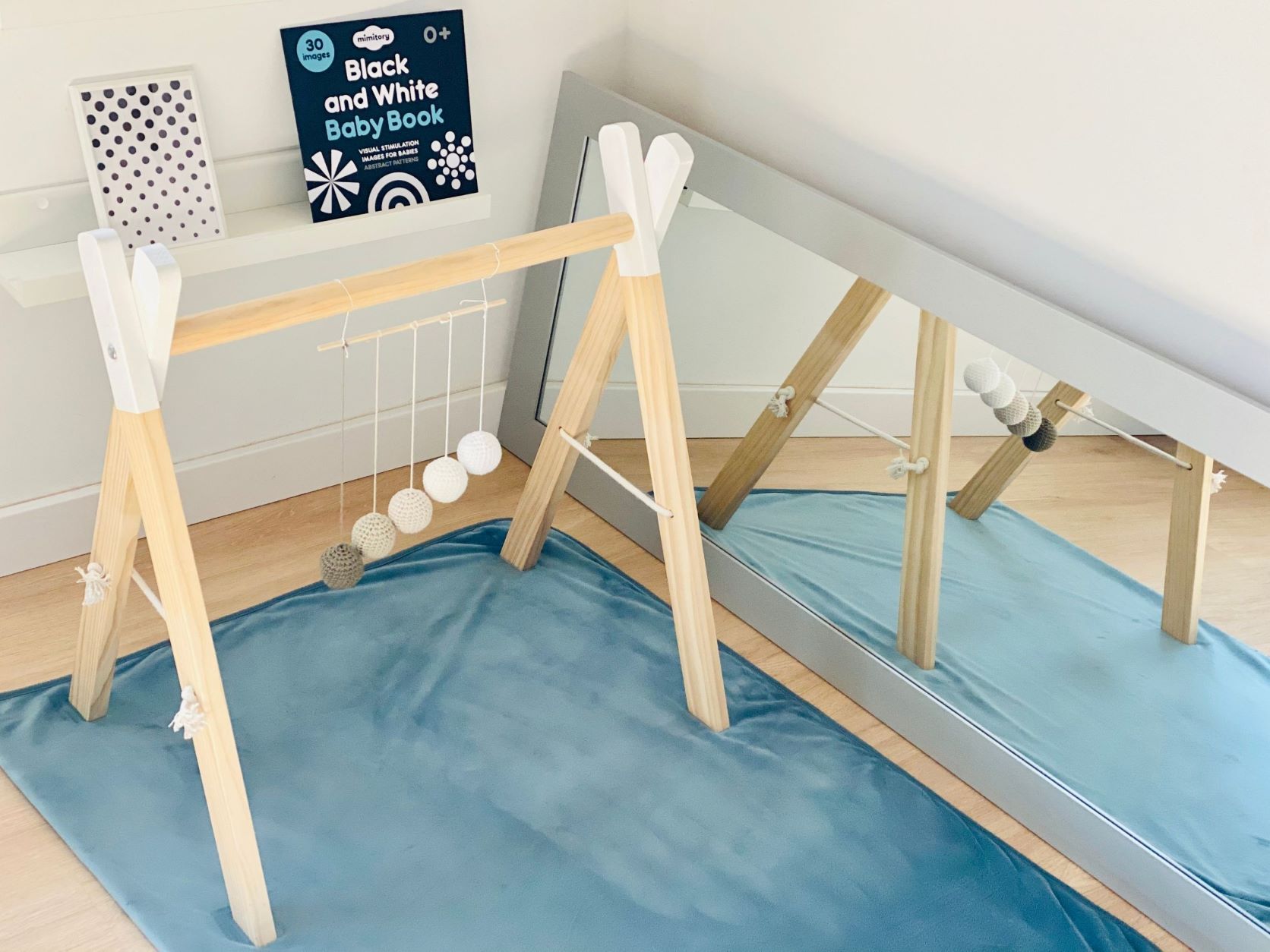
Some families naturally prefer a beige crocheted Montessori Gobbi because it creates an especially soft and calm visual presence within the baby’s space, while others are drawn to blue variations where the differences between the tones feel slightly more visible during this stage of visual development.
Understanding this distinction helps the crocheted Gobbi fit more naturally into the wider Montessori visual mobile sequence.
A brief developmental moment that often goes unnoticed
In the earliest weeks, babies relate to the world almost entirely through observation. Vision leads. Movement follows slowly and without intention. Then, gradually, something begins to shift. The baby still watches, but the body starts participating more visibly. Legs kick. Arms drift outward. The whole body responds to what the eyes are taking in — without reaching, grasping, or interacting purposefully yet.
This stage matters. It is not the beginning of touch, but the beginning of connection between visual attention and movement awareness. Rushing this transition — or skipping over it entirely — can quietly overwhelm a system that is still organising itself.
The Montessori crocheted Gobbi mobile often supports this exact developmental moment.
Because of its lighter structure and softer responsiveness, the mobile may move subtly alongside changes in air, environmental movement, or the baby’s own activity nearby. The baby does not intentionally create this movement, but may begin noticing the relationship between movement and what they see.
This is why the crocheted Gobbi functions as a transitional visual mobile.
Not between looking and touching, but between observing movement and beginning to sense the body’s relationship to it.
Understanding the crocheted Gobbi as a bridge material
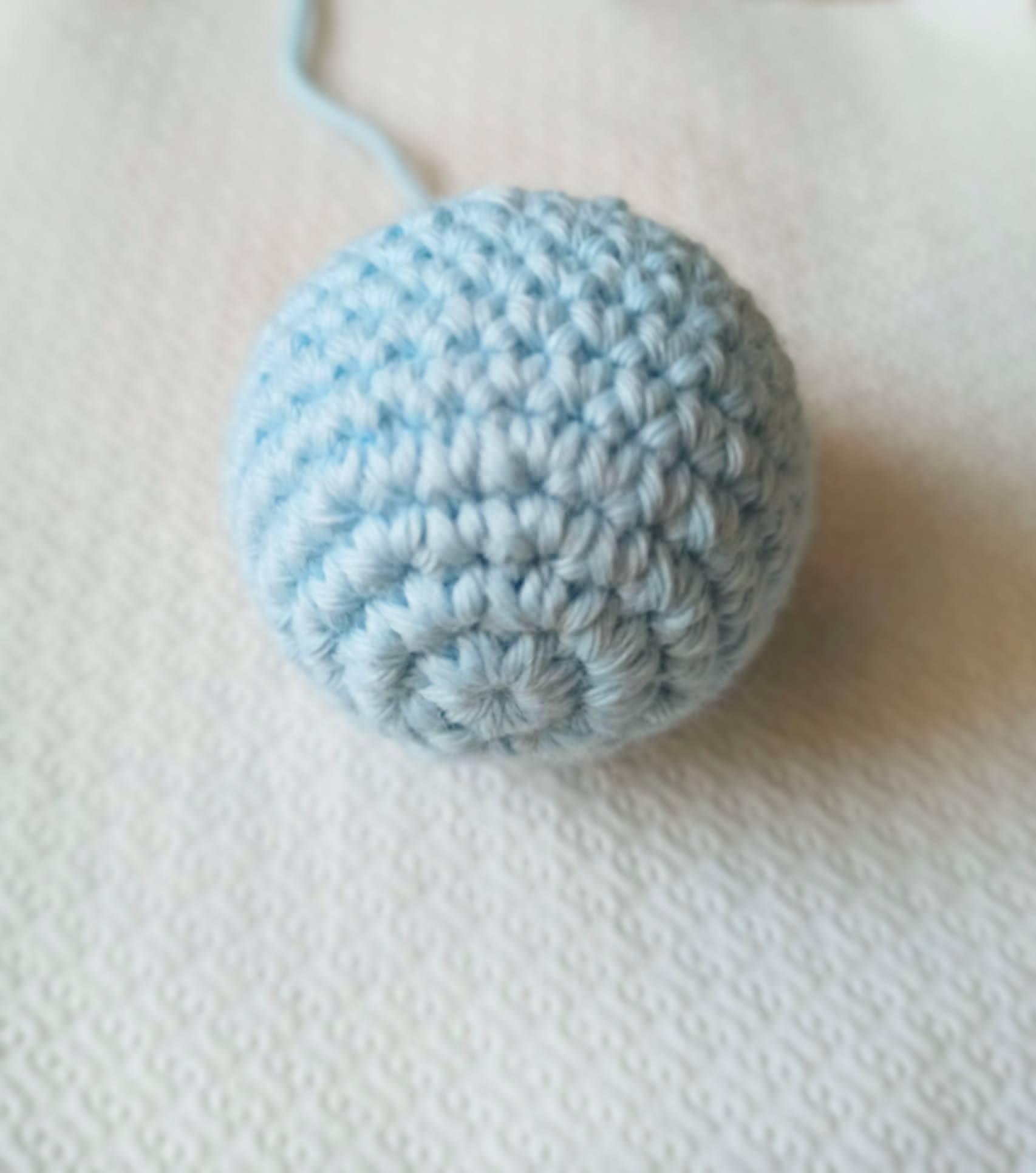
The Montessori crocheted Gobbi mobile is still primarily visual. It remains suspended. It presents a continuous progression of colour. It invites calm visual tracking, just like the classic Gobbi. What changes is not the developmental purpose, but the baby’s response.
As movement becomes more noticeable in the baby’s experience, the softer responsiveness of the crocheted Gobbi can accompany this transition gently without immediately shifting toward tactile interaction.
Compared briefly:
- The classic painted Gobbi remains visually stable and predictable
- The crocheted Gobbi introduces softer visual responsiveness
- Later tactile materials support intentional grasping and hand use
Each material exists for a different developmental purpose. One does not become “better” by doing more.
Colour, calmness, and visual focus
This transitional role of the Montessori crocheted Gobbi mobile remains the same across colour variations. A beige Gobbi offers a softer visual presence that blends naturally into calm environments, while blue variations may provide slightly clearer visual focus while still remaining gentler than highly stimulating visual materials.
Both accompany the same developmental stage. The difference lies mainly in visual emphasis rather than purpose. What matters more is the clarity of the visual experience, the calmness of the environment, and whether the baby can continue observing comfortably without becoming overwhelmed by sensory information.
This is one reason prepared Montessori baby environments often remain visually simpler in the first months. Babies are already processing an enormous amount of sensory information. Additional stimulation does not always support deeper concentration.
Timing is not a rule, but a relationship
Some families encounter the Montessori crocheted Gobbi mobile naturally after the classic Gobbi. Others never feel the need for it at all. Both are completely valid. In Montessori-informed environments, timing is not about schedules or completing every material in sequence perfectly. Observing your baby’s interests matters far more than checklists.
The crocheted Gobbi often becomes relevant when visual attention remains strong, but movement is beginning to participate more visibly in the baby’s experience. Not every baby moves through this transition in the same way or at the same pace.
Sometimes the most helpful question is not: “When should this mobile be introduced?”, but rather: “What is the baby already showing through observation?” For some babies, the classic Gobbi may already fully support this stage. For others, the crocheted version may feel like a gentler continuation before tactile materials begin entering the environment more intentionally.
Observation over categories
It can be tempting to classify every material: visual, tactile, motor, sensory. But babies do not experience development in categories. They experience continuity.
Vision gradually connects with movement. Movement later supports touch. Concentration deepens through repetition and observation long before purposeful interaction fully appears. Research on early object manipulation emphasizes that an infant’s sensory and motor systems do not develop in isolation; instead, visual features and manual actions are deeply intertwined from the first year of life (Annual Review of Developmental Psychology).
The Montessori crocheted Gobbi mobile exists for a relatively narrow developmental moment — when visual attention remains central and movement is beginning to participate more noticeably in the baby’s experience. Its role is subtle. It does not introduce a dramatic milestone or accelerate development. Instead, it gently supports a transition already underway.
As visual development continues, babies gradually become ready for materials with clearer movement and more complex visual relationships. This is one reason the Montessori Dancers mobile typically appears later in the visual sequence, when visual tracking and depth perception have become more established.
Final thoughts
The Montessori crocheted Gobbi mobile exists for a relatively brief developmental stage, and that is precisely why it can sometimes feel difficult to define. It does not replace the classic Gobbi, and it does not function as a tactile material. Instead, it supports a quieter transition where visual attention remains central while the body begins responding more noticeably to movement and observation.
In Montessori-informed environments, not every developmental shift needs to be marked loudly. Sometimes the most supportive materials are simply the ones that meet the baby exactly where they already are, without asking them to do more.
Further reading
If you’d like to understand how visual development continues beyond the crocheted Gobbi stage, or how crochet materials can be used safely in infancy, these articles may also be helpful:
- Play Is the Work of the Child
Why repetition, concentration, and purposeful activity matter so deeply in early development. - Crochet Baby Toys – Safety Tips Every Parent Should Know
What to look for when choosing crochet materials for babies, including safety, supervision, and developmental appropriateness.