
The idea of the work of the child in Montessori is often repeated, but not always clearly understood. The word work can feel misplaced when we are looking at a baby or a young child. From an adult perspective, work and play seem fundamentally different. One is associated with effort and purpose, the other with relaxation and enjoyment.
Maria Montessori used the word work intentionally. Through careful observation, she saw that children engage with their environment in a way that is focused, repetitive, and purposeful. What we observe as simple play is, in reality, the foundational construction of the mind. Scientific research into executive function and early brain development confirms that these self-initiated activities are the essential ‘work’ that prepares the child for a lifetime of learning and self-regulation.
Understanding the concept of the work of the child in Montessori changes how we see even the simplest activities.
Observation before interpretation
Montessori’s approach began with observation rather than assumption. Instead of asking what children should do, she watched what they chose to do when given the opportunity.
She noticed that children were not naturally drawn to passive entertainment. When the environment allowed it, they preferred activities that involved movement, repetition, and real engagement with their surroundings. They poured, carried, wiped, and repeated actions not for an external reward, but because the activity itself supported their development.
This is what she came to describe as the “work of the child.”
What the “work of the child” means in Montessori
For a baby, work does not mean completing a task in the adult sense. It means participating in the process of development. Every movement, every attempt to grasp, every moment of focused observation contributes to building the body and the mind.
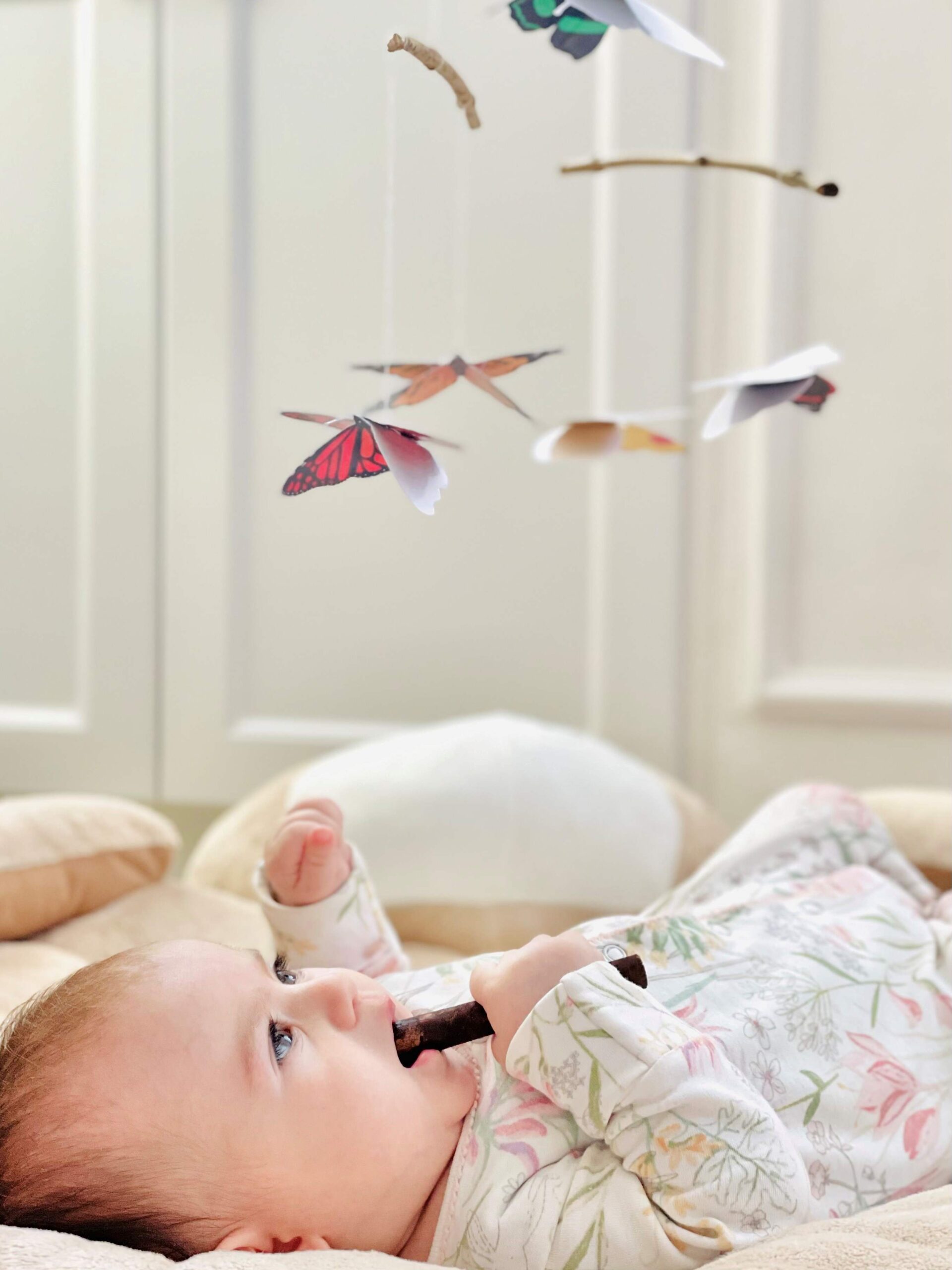
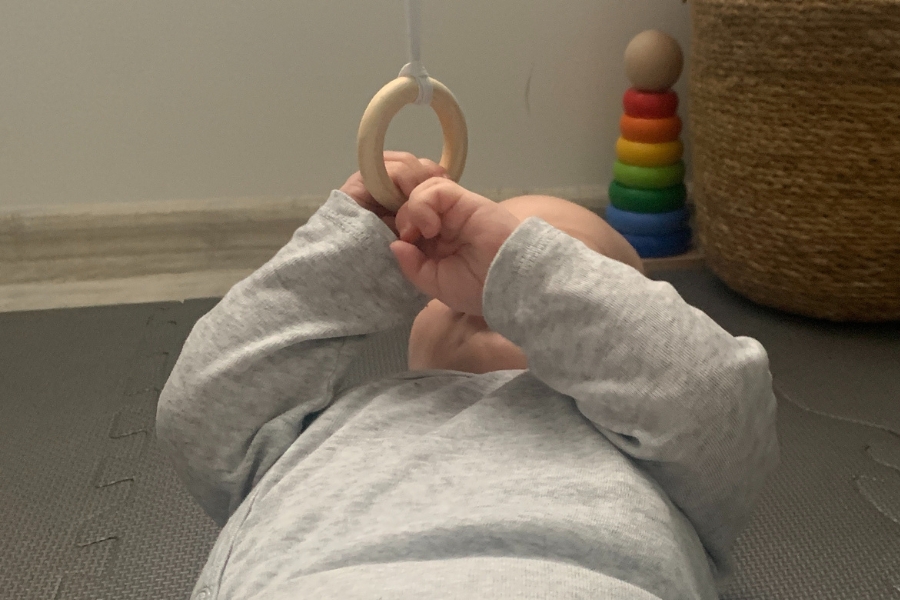
In the first months, this work is largely invisible. A baby watching a mobile is not being entertained. They are refining their ability to focus, to track movement, and to make sense of what they see, as explored in the Montessori visual mobiles. Later, when they begin to reach, grasp, and manipulate objects, materials such as the Montessori bell rattle make this work more visible.
The shift from observation to action is gradual, but the underlying purpose remains the same.
The role of materials
In Montessori, the work of the child is not about producing a result, but about building ability through repeated experience. The materials we offer either support this work or interfere with it.
When a material is simple, clear, and aligned with the baby’s stage of development, it allows the child to engage fully. There is nothing extra to filter out, no competing elements. The baby can focus on one aspect at a time, whether it is movement, sound, or texture. This is why Montessori materials often appear minimal. Their purpose is not to entertain, but to isolate a single experience so the child can explore it deeply, whether it is movement, sound, or texture. This forms the basis of early sensory learning.
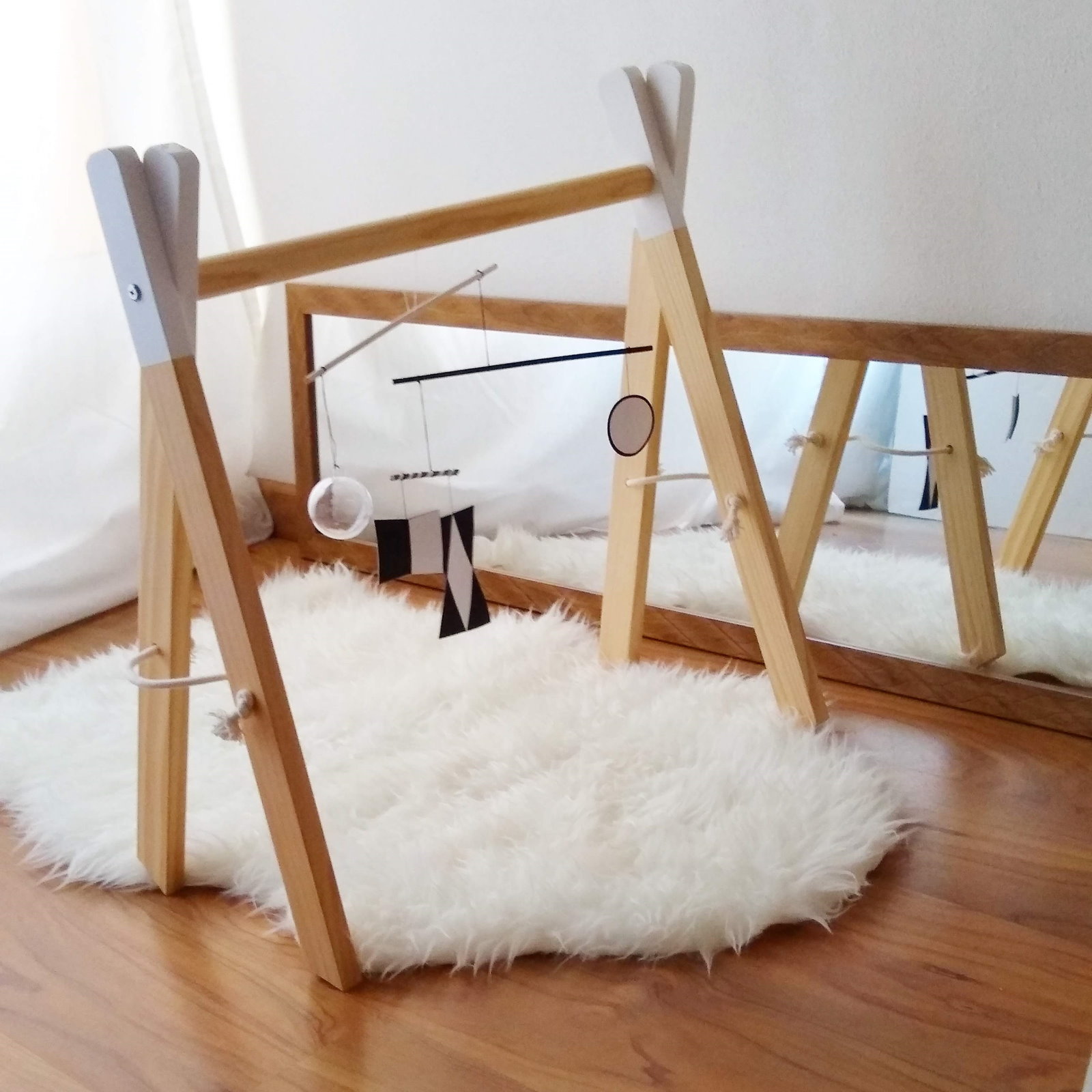
Simple objects such as mobiles, grasping materials, or early sensory tools are not passive items. They become meaningful when they are used in a way that allows the baby to act, repeat, and refine their movements. For parents who choose to prepare materials themselves, this process often becomes part of the experience, creating objects that reflect the same simplicity and intention.
Choosing fewer, more intentional materials often has a greater impact than offering many, a question explored further in whether Montessori toys are worth it.
Work and concentration
One of Montessori’s most significant observations was the level of concentration children can reach when they are engaged in meaningful activity. Even very young babies show early forms of this. They may remain focused on a mobile for longer than we expect, or repeat the same movement again and again when exploring an object. This repetition is not random. It is how development takes place.
Interrupting this process too often can break concentration before it has a chance to deepen. Allowing the child to remain with an activity supports their ability to focus over time.
The role of the adult
If play is the work of the child, then the role of the adult is not to direct that work, but to prepare the conditions for it. This means offering appropriate materials, placing them within reach or view, and preparing an environment that supports independent activity and then stepping back. Observation becomes more important than intervention. The adult watches, responds when needed, and removes or changes the material when the child shows readiness.
This approach requires a shift in perspective. Instead of asking how to keep the baby occupied, the question becomes how to support what the baby is already trying to do.
Final thoughts
When Maria Montessori described play as the work of the child, she was not redefining play, but reframing how we understand it. What looks like simple activity from the outside is, for the child, a process of development that deserves the same respect we give to adult work. In Montessori, this is not described as play in the traditional sense, but as meaningful activity, a perspective explored further in how Montessori understands baby play.
In the first year of life, this work takes place through observation, movement, and interaction with carefully chosen materials. When these are aligned with the child’s needs, they support concentration, coordination, and a growing sense of understanding.
Seen in this way, the work of the child in Montessori is not separate from play, but a deeper way of understanding it.
Further Reading
If you’d like to explore how Montessori materials support this process in practice, these articles may also be helpful:
- Montessori Alternatives to Traditional Baby Toys
A closer look at materials that support calm, focused exploration instead of overstimulation. - Should You Buy or DIY Montessori Materials?
A closer look at how to approach materials with intention, and what to consider when choosing or preparing them yourself.