
During the first year, babies gradually begin to understand that objects continue to exist even when they disappear from view. Objects that disappear start to matter. A dropped item is no longer simply gone. A parent leaving the room feels different than before. Babies begin to repeat small actions—dropping, watching, waiting—not for entertainment, but to understand what happens next. This is the developmental moment often described as object permanence. Babies do not learn this through teaching. It is something they gradually build through repeated, lived experience.
The Montessori Object Permanence Box belongs to this stage—not as a lesson, but as a way to make an invisible process visible.
What Object Permanence Really Means
In early infancy, a baby’s experience is largely immediate. What is seen, heard, or touched exists in the present moment. When something disappears from view, the baby does not yet hold it in mind.
Over time, babies begin to form internal representations. They start to understand that people and objects continue to exist even when they are no longer visible. This understanding does not arrive all at once. It develops slowly, through repetition, predictability, and trust in the environment.
Jean Piaget described this as part of early cognitive development, but parents often see it more simply: a baby who watches, waits, and begins to expect return.
Find a clear, parent-friendly explanation of object permanence here.
Why Repetition Matters
When a baby drops an object again and again, this is not random behaviour and not mischief. It is careful work.
Each repetition helps organise an internal sequence:
- something disappears
- something moves out of sight
- something comes back
Through this, babies begin to link action and outcome. They are not experimenting to get a reaction from the adult, but to understand continuity. This is why repetition—without variation, without added challenge—is essential at this stage.
Repeating the same action helps babies explore cause-and-effect learning in infancy through direct experience.
Where the Object Permanence Box Fits
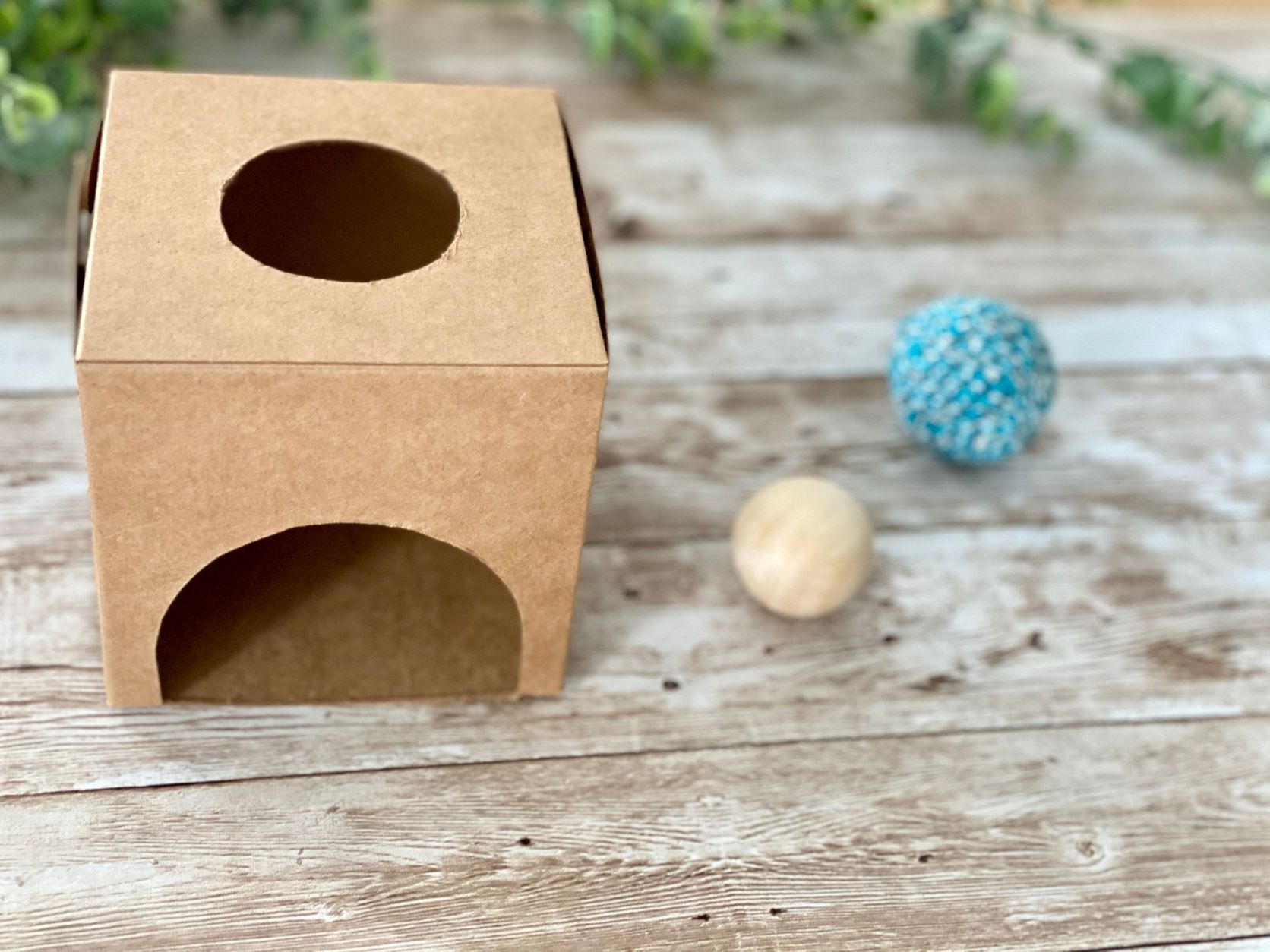
The Montessori Object Permanence Box offers a simple material that aligns with this exact process. A ball is placed into an opening. It disappears briefly. Then it reappears through a side window. The movement is slow, predictable, and visible. Nothing flashes. Nothing distracts. There is no added sound or reward.
The value of the material lies in its consistency. It allows the baby to focus fully on the sequence of disappearance and return, as many times as needed, without interference.
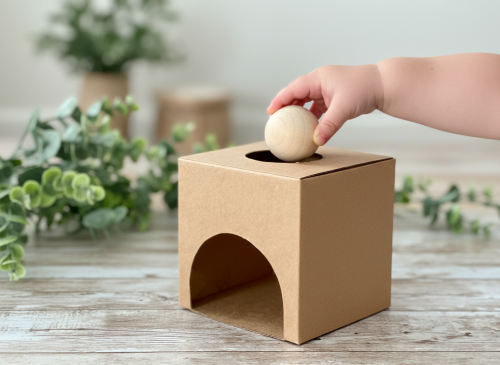
For families who prefer prepared materials, the DIY Object Permanence Box is available through Montessori Edited. Whether purchased or made at home, what matters is that the experience remains simple and unchanged.
Readiness Is Observed, Not Scheduled
There is no fixed age at which object permanence “should” appear. Some babies show interest earlier, others later. What matters is readiness, which is best recognised through observation:
- the baby can sit with stability
- grasping becomes controlled rather than accidental
- attention can be sustained for short periods
- the baby repeats the action with focus.
When interest fades, the work is complete—for now.
What Not to Rush
At this stage, more is rarely better. There is no need to:
- add multiple objects
- introduce different shapes
- increase complexity
- turn the activity into a game
Simplicity supports integration. The baby is not seeking novelty, but clarity.
A Quiet Shift With Lasting Impact
As object permanence develops, it influences how babies experience separation, waiting, and expectation. It lays the groundwork for later understanding of absence and return—not only with objects, but with people.
The Montessori Object Permanence Box does not accelerate this process. It simply offers a clear, consistent experience through which understanding can take shape.
Like all Montessori materials, its role is not to teach, but to make visible what the child is already ready to integrate.
Final Thoughts
Object permanence does not arrive through instruction or repetition planned by an adult. It takes shape quietly through everyday experiences, as the baby notices disappearance and return again and again.
When the environment offers clarity and consistency, the child does the rest. There is no need to rush, vary, or explain. Observation remains the most reliable guide.
Further reading
If you’d like to explore Montessori materials for babies and young children in more depth, these articles offer additional perspective.
- Should You Buy Montessori Materials or Make Them Yourself?
A look at how families approach Montessori materials at home, and how both purchased and DIY options can support a thoughtful prepared environment. - Open-Ended and Closed-Ended Toys in Montessori
An explanation of how different types of materials support different stages of exploration, concentration, and learning.