
A Montessori baby environment is not about creating a perfect room. It is not about buying every beautiful material, preparing every shelf in advance, or turning the home into something that only looks calm from the outside. In the first months of life, the baby needs something much quieter and more meaningful than that.
Many parents begin by thinking about what they need to buy. Montessori often invites us to start somewhere else: with the experiences we want the baby to have every day.
They need repeated experiences they can slowly begin to recognise.
A baby does not understand the home in the way an adult does. They do not know that one area is called a bedroom, another is for changing, and another is for movement. But they do begin to experience patterns. They feel where rest usually happens. They notice where they are placed when they are awake and looking around. They hear the same voice during changing. They feel the rhythm of being cared for, lifted, washed, dressed, held, and returned to familiar places.
Over time, these repeated experiences begin to give the environment meaning. The baby may not understand the purpose of a room, but they slowly begin to recognise what usually happens there. A familiar place, repeated often enough, can start to feel predictable. Predictability is one of the foundations of security in the early months.
This is one of the quiet strengths of a Montessori baby environment. Different spaces are often given different purposes. The sleeping space is kept calm. The movement area supports awake observation and free movement. The changing area becomes a place for connection and care. Visual mobiles are offered where the baby is awake and ready to look, rather than where they are expected to sleep. The goal is not to follow rigid rules. It is to create a home that feels coherent to the baby.
A coherent environment does not need to be expensive, highly styled, or full of materials. It simply needs enough clarity for the baby to gradually associate different places with different experiences.
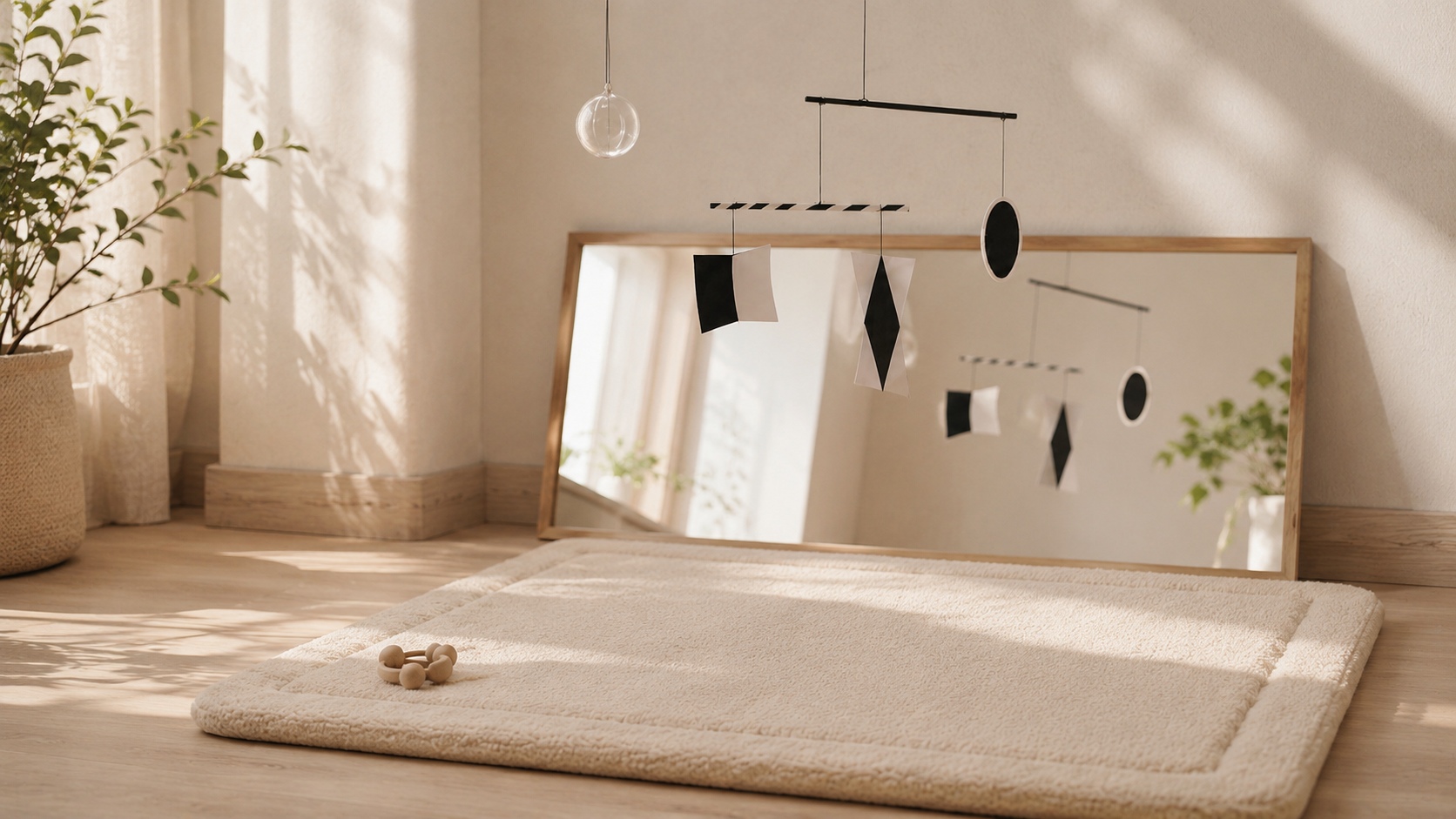
How Familiar Spaces Begin to Gain Meaning
In the beginning, a baby’s world is mostly sensory. They know warmth, light, shadow, sound, touch, movement, hunger, closeness, and rest. The home is not yet a map. It is a series of repeated impressions.
This is why consistency matters so much in the early months. A baby may not consciously think, “This is where I sleep,” or “This is where I look at my mobile.” But through repetition, the body begins to recognise patterns.
The same quiet sleeping space.
The same movement mat.
The same place where a visual mobile gently moves above them.
The same rhythm during changing.
The same adult voice returning again and again.
These patterns help the environment become less random.
This does not mean every day needs to be identical. Real family life is not perfectly ordered, and babies do not need perfection. But a few repeated spaces can create a sense of orientation. The baby begins to experience the home as a place with rhythm. For practical layouts on establishing these distinct spaces, this Aid to Life guide on creating a supportive home environment provides an excellent blueprint for balancing movement and rest. The baby begins to experience the home as a place with rhythm.
This is where Montessori thinking becomes especially useful. It asks us to look not only at what we give the baby, but where, when, and why we offer it. Before buying more Montessori baby materials, it helps to ask a simpler question: What experience is this space meant to support?
That question changes everything.
Why Montessori Baby Spaces Are Usually Simple
Many parents first discover Montessori through searches for Montessori nursery ideas and materials. The mobiles, the floor bed, the movement mat, the wooden toys, the low shelves, the carefully chosen objects. These things can be useful, but they are not the foundation. The foundation is the prepared environment.
For a baby, a prepared environment does not need to contain much. In fact, it often works better when it contains less. A young baby is already working hard to process the world: light, sound, digestion, movement, sleep, touch, and human connection. A visually noisy space can make it harder to notice what actually matters.
A simple Montessori baby environment gives the baby fewer competing messages.
The sleeping space does not need to entertain.
The movement area does not need to be full.
The changing area does not need many distractions.
The baby does not need every material at once.
Simplicity is not lack. It is clarity. When a space has a clear purpose, the adult can observe more easily too. You can see whether your baby is looking, turning away, reaching, relaxing, becoming tired, or asking for a change in their own way. The environment becomes readable for both the baby and the adult.
This is why Montessori baby spaces often feel calm. The calm does not come from emptiness. It comes from the fact that each space is not trying to do everything.
The Sleeping Space: Rest, Rhythm, and Calm
The sleeping space has one main purpose: rest. That sounds obvious, but it is easy to forget when preparing a baby’s room. Many baby spaces are designed to be visually charming for adults. They are filled with decorative items, hanging objects, bright contrasts, and things to look at. But from the baby’s perspective, the sleeping space does not need to be visually active. It can be warm, beautiful, and cared for without being stimulating.
In a Montessori baby environment, the sleeping space is usually kept calmer because rest is a separate experience from active observation. The baby gradually encounters this space as a place where the rhythm slows down. The light may be softer. The adult’s voice may be quieter. There may be fewer visual invitations. This is not about being strict. It is about making rest easier to recognise.
It also explains why Montessori visual mobiles are usually not placed in sleeping spaces. A visual mobile has a different purpose. It invites the baby to look, focus, follow movement, and engage visually. Those are awake experiences.
When the sleeping space is for rest and the visual mobile is offered in an awake movement area, the environment becomes more coherent. The baby is not being asked to rest in the same place where they are also being invited to concentrate.
This distinction is gentle, but important. It allows the sleeping space to stay calm, while giving visual development its own clear place.
The Movement Area: The Baby’s First Work Space
The movement area is one of the most important parts of a Montessori baby environment. This is often the first place where parents begin to see concentration emerge.
It can be very simple: a firm movement mat, a safe place on the floor, enough room for the baby to move freely, and perhaps a mirror or visual mobile when appropriate. It does not need to be elaborate.
This is the baby’s awake space. Here, the baby can lie on their back or practice tummy time, turn their head, move their arms and legs, watch the room, study light and shadow, and slowly begin to discover their own body. These early movements may look small to an adult, but they are meaningful work for the baby.
In Montessori, a baby’s “work” is not academic. It is developmental. Looking, stretching, kicking, reaching, turning, and repeating small movements are all part of the baby’s work. The movement area supports this because it gives the baby time and space.
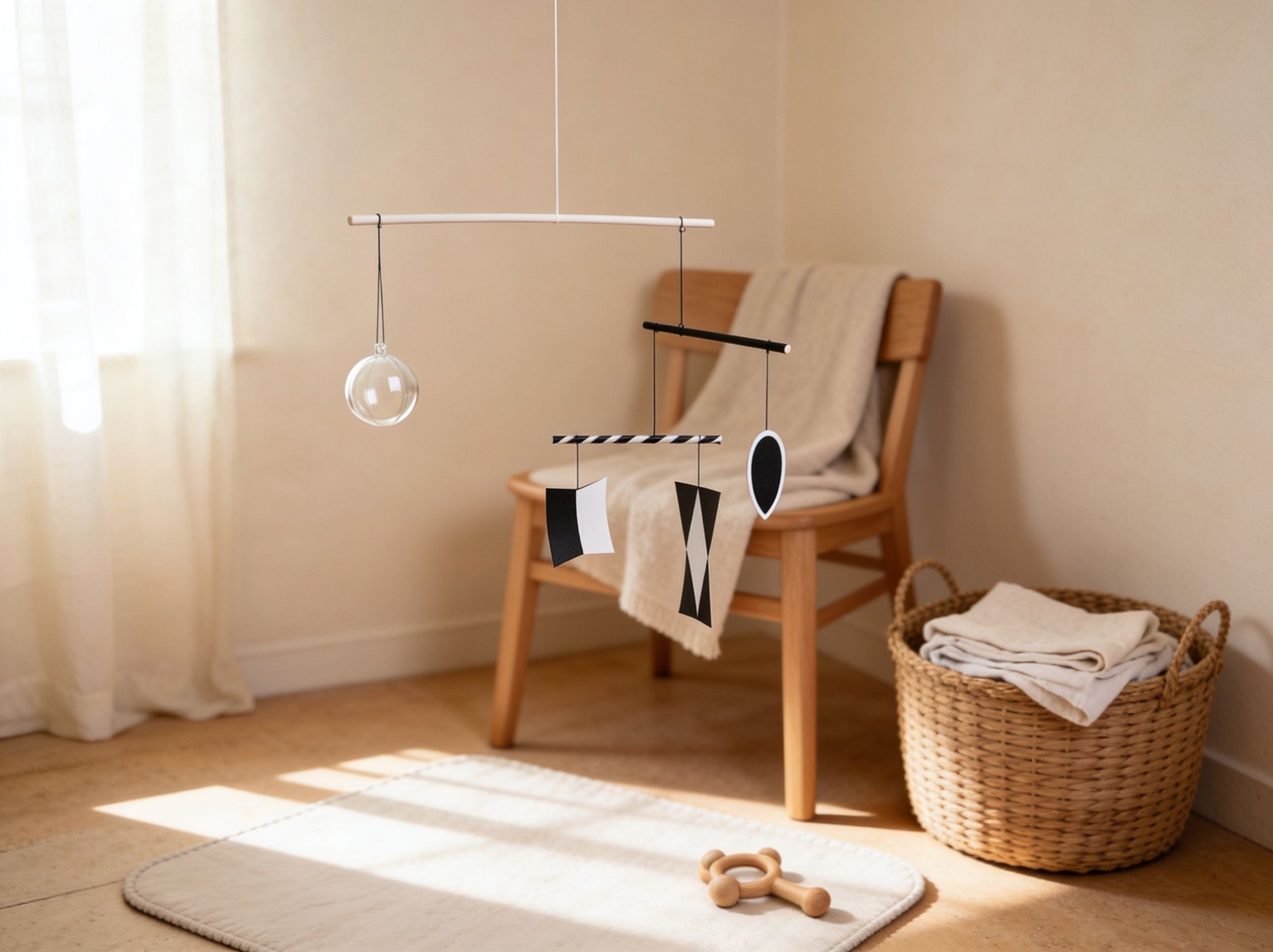
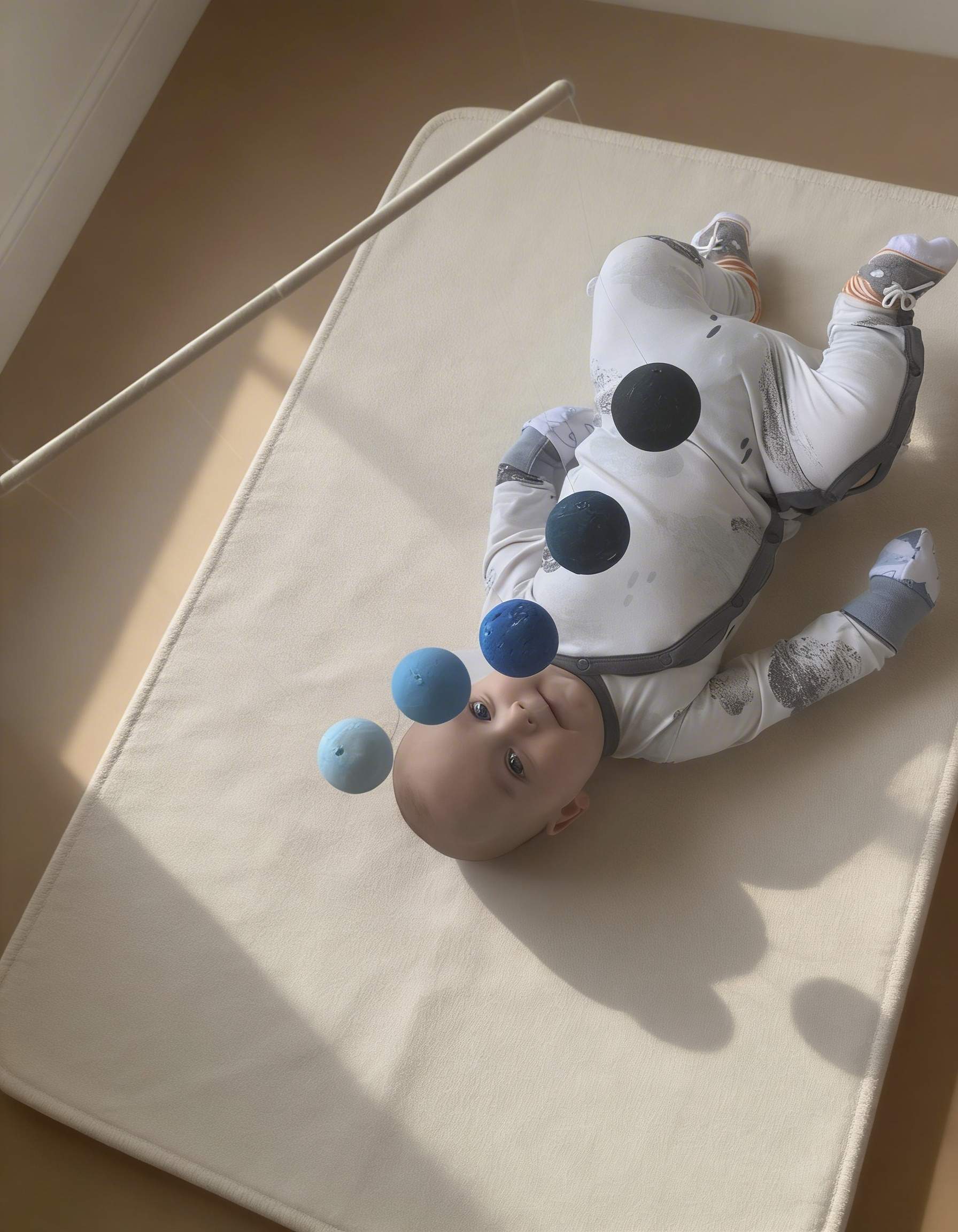
This is also the most natural place for Montessori visual mobiles. When a baby is awake and settled, a mobile can become a clear visual point of interest. The baby can look at it, follow its movement, pause, look away, and return to it. The adult can observe how the baby responds. A newborn may first be drawn to black and white visuals with strong contrast. Later, the baby may become ready for colour, depth, gradation, reflection, or more complex movement. This is why Montessori mobiles are often introduced in a sequence, but the sequence should never replace observation.
The age guide can help. The baby’s response matters more.
Visual Mobiles Belong to Awake Observation
Montessori visual mobiles are sometimes misunderstood because they are beautiful. They can easily be seen as decoration. But their purpose is not decoration. Their purpose is visual development.
A black and white mobile for the newborn stage offers contrast when the baby’s vision is still immature. Other Montessori mobiles gradually introduce different visual challenges, such as colour, depth, subtle shades, movement, and visual tracking. This is why placement matters.
A visual mobile works best when the baby is awake, calm, and able to observe it for a short period of time. The adult can stay nearby and notice the baby’s cues. Is the baby focused? Are the eyes following? Does the baby turn away? Is the body calm or becoming restless? Has the experience been long enough? In this context, the mobile becomes part of a relationship between baby, material, space, and adult observation. It is not something used to keep the baby busy. It is not something that needs to be available all day. It is a carefully chosen visual experience offered in the right place, at the right time, for the right stage.
For parents choosing Montessori visual mobiles, the question is not only which mobile to buy, but whether the baby is ready for that stage and where the mobile will fit within the wider environment.
A Montessori baby mobile makes the most sense when it has a clear place in the awake movement area. That is where it can do its real work.
The Changing Area: Care, Connection, and Familiarity
The changing area is often treated as purely practical, but for a baby it can become one of the most familiar places in the home. Many times a day, the baby is brought to the same place. The adult comes close. There is touch, voice, eye contact, lifting, dressing, wiping, pausing, and responding. These moments are not separate from development. They are part of the baby’s early experience of being cared for.
In a Montessori approach, care routines matter. The changing area can become a place of connection rather than a rushed task. The adult can speak to the baby, move slowly enough for the baby to participate in small ways, and treat the routine as shared time. This does not mean the changing area needs to become visually busy. It may include one simple visual point nearby, especially in the early months when black and white contrast can be engaging. But the purpose of the space remains care and connection.
Like the movement area and the sleeping space, the changing area becomes meaningful through repetition. The baby does not need every care routine to be perfect. They need the adult to return, again and again, with enough rhythm and presence that the experience becomes familiar.
Observation Before Buying More Montessori Baby Materials
When parents first discover Montessori baby materials, it is easy to feel that everything needs to be prepared immediately.
A floor bed.
A movement mat.
Visual mobiles.
A mirror.
Grasping materials.
Tactile toys.
Low shelves.
Beautiful baskets.
A complete baby setup.
But a Montessori baby environment is not built by collecting everything at once.
It is built by observing the baby.
Observation helps you decide what is useful now, what can wait, and what may not be needed at all. A newborn who is just beginning to focus does not need many materials. A baby who is deeply engaged with a simple black and white mobile does not need the next stage rushed in too early. A baby who is working on movement may need more floor time, not more objects.
Before buying Montessori baby materials, it helps to watch what your baby is already doing.
Are they focusing on contrast?
Are they turning toward light?
Are they beginning to follow movement?
Are they more settled in one space than another?
Do they need a clearer movement area?
Do they seem tired when there is too much visual input?
These questions make the environment more personal and more respectful. They also prevent the common problem of over-preparing. Montessori is often associated with beautiful materials, but the deeper work is not collecting. It is noticing.
The best material is only useful when it meets the baby at the right moment.
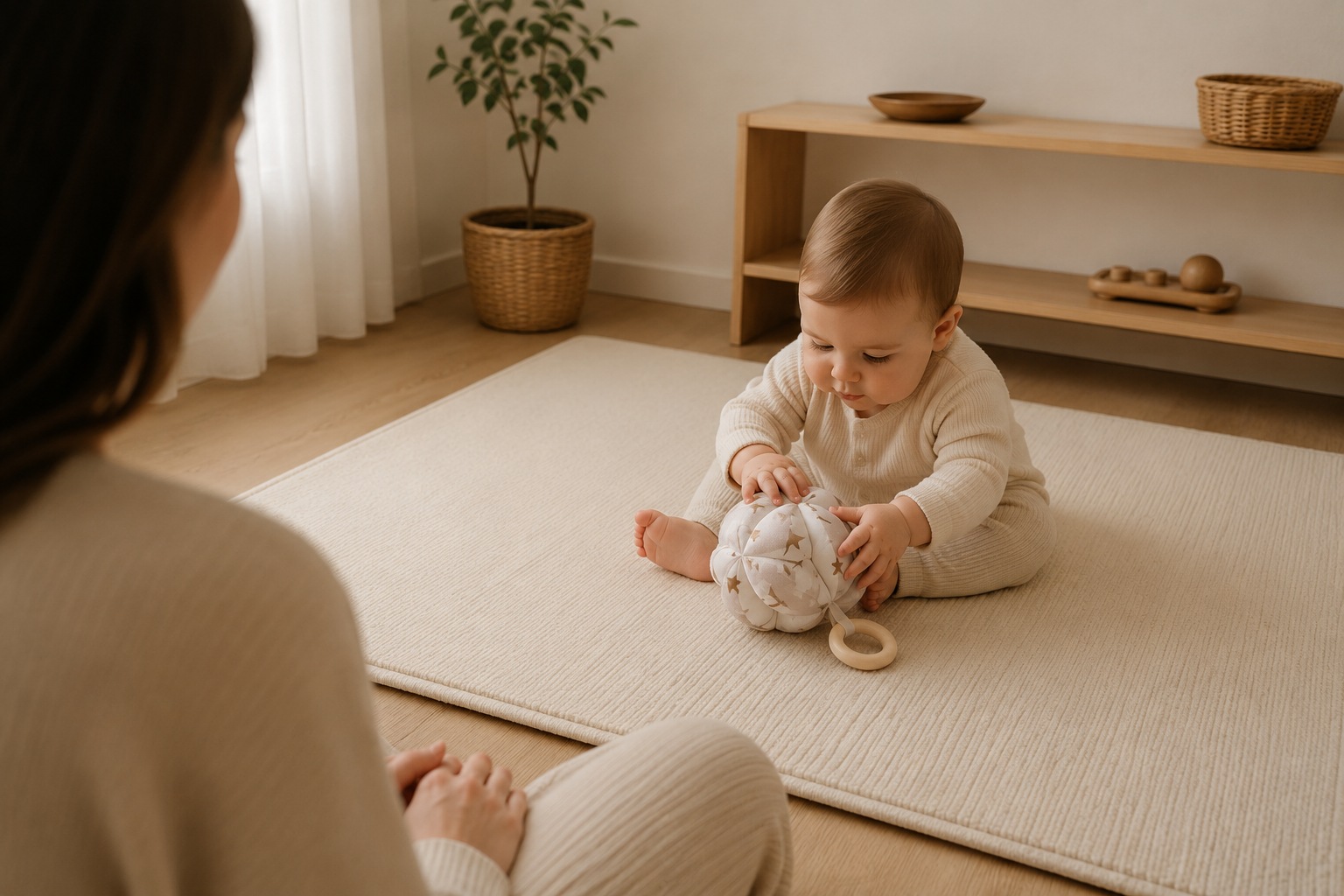
Creating a Calmer Montessori Baby Environment at Home
A calmer Montessori baby environment does not require a complete redesign. It usually begins with giving each important space a clearer role.
The sleeping space can stay visually calm and associated with rest. The movement area can become the place for awake time, free movement, and visual mobiles. The changing area can become a place for care, eye contact, and connection. Other routines in the home can develop their own rhythm over time. The key is not perfection. It is consistency.
You may start with one movement mat and one visual mobile. You may keep the sleeping area simpler than you first imagined. You may decide to stop adding materials for a while and observe how your baby uses the space already available. You may notice that your baby engages more deeply when there is less around them.
This is where the Montessori baby environment becomes different from a styled nursery or a shopping list. It is not arranged to impress adults. It is prepared to support the baby’s real experiences. A young baby does not need a home full of stimulation. They need a few familiar places where rest, movement, care, and observation can happen again and again.
Over time, those places begin to mean something. The sleeping space says rest. The movement area says look, move, and explore. The changing area says care and connection. The adult’s observation says: I am watching who you are becoming.
If you have older children, involving them in preparing the baby’s environment can be a meaningful way to help them feel part of the transition. I share more ideas in Helping Your Firstborn Feel Included When a New Baby Arrives.
Final Thoughts
A Montessori baby environment is not built in one afternoon. It grows slowly, through repeated routines, small adjustments, and careful observation. The most important question is not whether the room looks perfectly Montessori. It is whether the baby can begin to recognise what each space is for.
A clear place for rest.
A clear place for movement.
A clear place for care.
A clear place for visual exploration.
A parent willing to observe before adding more.
That is the quiet foundation of the Montessori baby environment. A young baby does not need a home filled with things. They need familiar places where rest, movement, care, and observation can happen again and again. Over time, those experiences become the meaning of home.
Further Reading
To explore this idea further, you may find these guides helpful:
- Buy or DIY Montessori Materials? How to Choose for Your Baby – If you are preparing a Montessori baby environment, this guide helps you decide when it makes sense to buy materials and when a DIY approach may be more practical, personal, or meaningful.
- How to Tell Your Firstborn About a New Baby – A gentle guide for preparing an older child for a new baby through observation, inclusion, honesty, and gradual family transition.